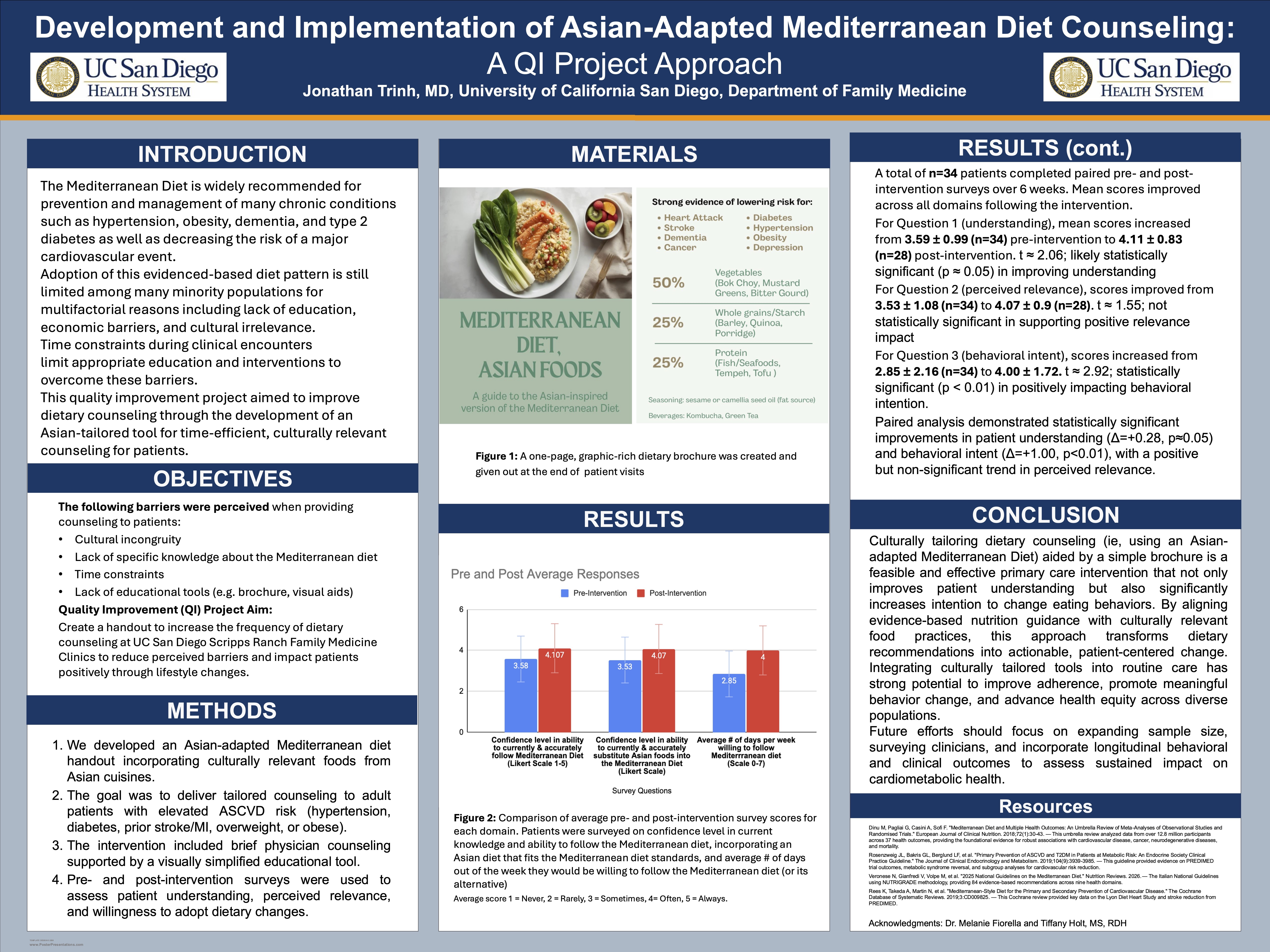
Development and Implementation of Asian-Adapted Mediterranean Diet Counseling: A QI Project Approach
Abstract
Background: The Mediterranean Diet is widely recommended for prevention and management of chronic conditions such as hypertension and type 2 diabetes. However, adoption remains limited among diverse populations– possibly due to cultural incongruence. Furthermore, time constraints during clinical encounters can make it difficult to spend an appropriate amount of time educating and making recommendations suitable to the patient. This quality improvement project aimed to improve dietary counseling by developing an Asian-tailored option of the Mediterranean diet and providing a time-efficient educational tool for patients.
Methods: We developed an Asian-adapted Mediterranean diet handout incorporating culturally relevant foods from Asian cuisines. The goal was to deliver tailored counseling to adult patients with elevated ASCVD risk (hypertension, diabetes, prior stroke/MI, overweight, or obese). The intervention included brief physician counseling supported by a visually simplified educational tool. Pre- and post-intervention surveys were used to assess patient understanding, perceived relevance, and willingness to adopt dietary changes.
Results: A total of n=34 patients completed paired pre- and post-intervention surveys. Mean scores improved across all domains following the intervention. For Question 1 (understanding), mean scores increased from 3.59 ± 0.99 (n=34) pre-intervention to 4.11 ± 0.83 (n=28) post-intervention. For Question 2 (perceived relevance), scores improved from 3.53 ± 1.08 (n=34) to 4.07 ± 0.9 (n=28). For Question 3 (behavioral intent), scores increased from 2.85 ± 2.16 (n=34) to 4.00 ± 1.72 (n=28). Improvements were observed across all domains, with the largest gains in understanding and perceived relevance. Overall, results demonstrate improved patient engagement and comprehension with culturally tailored materials.
Conclusion: A culturally adapted Mediterranean diet handout is a feasible and effective strategy to enhance dietary counseling in primary care. Tailoring evidence-based nutrition guidance to culturally relevant foods improves patient understanding and engagement. Future directions include expansion to other cultural groups and dietary patterns, including plant-based adaptations.