Skip to main content
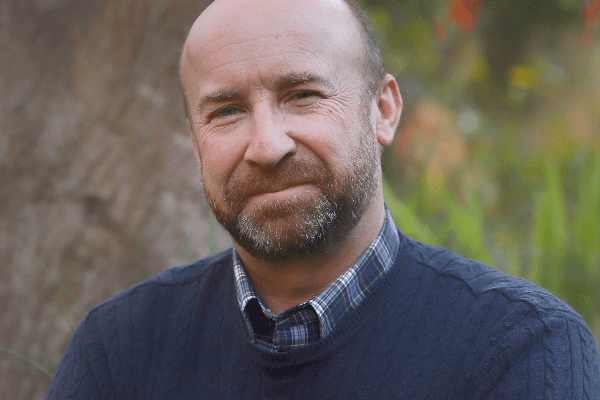

Interview with Damian Bacich
Interview with Damian Bacich
Editor-in-Chief of Mester XXXII (2003)
Professor at San José State University
Mester: Dear Professor Bacich, thank you for talking to us. We would like to know how the department was. Or Mester? If you could tell us a little bit about it.
Damian Bacich: In terms of the department, I think one of the big differences – a physical difference and a social difference – is that most of us were TAs in either Spanish or Portuguese. We had two big offices in Rolfe Hall right next to each other. And each of those offices had about 20, 25 desks in them. So, as graduate students, we didn't have an office with one or two people. Instead, there were 20 of us in each office. On the one hand, it made for a great social atmosphere. We were all around each other, we saw each other all the time, we partied together, we traveled together, and we shared ideas. And we forged some really good friendships. On the other hand, it was also a very distracting place. So if you wanted to get any serious research-type work done, you needed to go to the library or someplace else (my personal favorite was the CMRS library in Royce). There was a lot of camaraderie. We all fed into that, which was great because you'd spend a lot of time there. I studied mainly early modern Spain and Latin America, but I had colleagues who studied modern Spain or contemporary Brazilian film, etc. So, we got to share a lot of ideas.
And then, in terms of Mester, I think that the editorial board was smaller. I think there were probably fewer than ten of us. And once again, it was sort of representative of the different strands in the department, the different disciplinary areas, and that was good! We were able to share ideas, solicit articles, or find articles that would broadly represent the different disciplinary areas.
So, what was it like to be the editor at that time? It was solitary. When I went from being a TA, working with a whole bunch of people, to being an editor, a lot of it was just communications with authors, editors, or readers. Then, we would have editorial board meetings in person occasionally because there was no Zoom or anything like that. So, I remember that, for me, it was a really good experience because, later, when I became department chair at San Jose State, I had that experience of working with a team of people who all came from different backgrounds and different disciplinary areas. Putting something together and producing something together was a very good experience because it is generally not the type of thing one learns to do as part of graduate studies.
Mester: Why did you decide to become the editor-in-chief of Mester?
Damian Bacich: I wanted to be involved in scholarship, and so I thought it would be a good way to see behind the scenes of how scholarly publishing works. Being the editor of Mester allowed me to see what it was like to produce a journal. It was also very helpful because it can be intimidating when you submit an article to a journal or submit a book to a press. You're wondering, “Well, is this good enough?” “What will they think?” The cool thing about being editor is that you get to see all of the submissions. You see that some of the submissions are really good, some are not. Then you realize that, at least, I can produce a scholarship that is of a level to be published in a blind peer-reviewed journal. So that was really helpful.
And, of course, the fellowship that comes with it was important, because, as graduate students, you don't make very much money. It was a way to have some funding, that didn't involve being a TA in a classroom. My time was more flexible, and that was important, especially during the dissertation phase.
Mester: Do you have any memorable challenges, or any fun stories? We would love to hear.
Damian Bacich: At the time, we would ask for both a hard copy and a version in Microsoft Word, but it was all on floppy disks. Usually, we would use the hard copy and make marks on that. And then there was a form that each reviewer had to fill out, which was anonymous, of course, but we had to rank it whether it was: accept as it is, or accept with revisions, or reject and resubmit.
If I remember correctly, we had some conflicts at the beginning when we first met for our editorial board—and that was a good learning experience for me in ensuring that there is a broad consensus on what you want to do. It was one of the things that helped me when I later became a department chair: sometimes conflict is unavoidable, but it is important to create a climate of collaboration and avoid breaking into factions.
I remember one of the things we did was to update the design. At the time, the logo and the cover art had been the same for over a decade. So we tried to make the format more appealing—more attractive. Changing the colors, putting a larger logo, using a different typeface, and doing things like that. We also tried to make it look a bit more professional and less like a graduate student journal from 20 years prior. I'm proud that we did that, and I'm sure it's also evolved since then.
Mester: And looking back, would you have done anything differently?
Damian Bacich: I don't think so. I was learning, and even learning through mistakes is important.
Mester: One last question: any advice for the current editorial board of Mester?
Damian Bacich: That, more than anything, to look at it as an experience that will prepare you for the academic world, for being a professional. In my own professional life, I have continued to participate as a reader for other journals in my discipline.
The only other thing I would say is to take good notes. To be aware of what you're learning and that you'll be able to apply that when you get into the professional world. When you're in the dissertation phase, your focus is very narrow, on your topic, your dissertation adviser, your committee. And then, when you get your first job or whatever it might be, you're going be with a group of people from different backgrounds and disciplines, and you will have students who don't know anything about your dissertation topic. You will be back to having a broader focus.
Stay in touch with the people you work with, share as you go through the academic job market, share your stories and experiences, and help one another. Continue to do that throughout your career. I've been fortunate to stay in touch with some of my colleagues, and we share ideas and share experiences, etc. Try to stay active, to use it as an experience to work on other journals or prepare your own articles.
Mester: Who was your adviser at that time?
Damian Bacich: My dissertation advisor was Efraín Kristal, to whom I am very grateful for his mentorship. I was also fortunate to have Enrique Rodríguez Cepeda and (the late) Claudia Parodi, who were excellent advisors and mentors.