


1. Introduction
People regularly encounter sentences and structures that they would not spontaneously produce, but which they nevertheless readily understand. These may be antiquated (“Besides, I like you not”, Shakespeare, As You Like It; “Till death us do part”, The Book of Common Prayer, 1662), belong to another dialect (Have you a pencil?, when encountered by US English users), or be stigmatized in some way (e.g., swearing or other taboo language). Mismatches between production and comprehension present an interesting puzzle: What kind of knowledge of these structures do language users have? The current article explores this question through the lens of Mainstream US English (MUSE) users’ real-time comprehension of negative concord (e.g., She didn’t say nothing ‘she said nothing’), which represents one such mismatch. We compare the process by which speakers comprehend unproduced negative concord structures with parallel structures that they do produce, containing negative polarity items (e.g., She didn’t say anything). Given the structural and semantic parallelism between these structures, the results afford a unique window into how speakers may handle structures in comprehension that they have likely encountered but which they do not produce.
1.1 Comprehension, production, and shared representations
The extent to which language production and comprehension draw on a shared set of representations is a long-standing question (e.g., Bresnan & Kaplan, 1984; Chater, McCauley & Christiansen, 2016; Garrett, 1980; Levelt, 1989; see Meyer et al., 2016, for review). On one hand, shared representations are a parsimonious explanation for overlap between language users’ production and comprehension repertoires, and for the fact that children apparently learn to produce by comprehending (Bresnan & Kaplan, 1984; Chater et al., 2016). On the other hand, comprehension and production unfold differently in real time, with different types of uncertainty and different goals, and each process may be best served by different types of representations (Clark & Malt, 1984; Indefrey, 2018; Levelt, 1989). Within the larger debate, evidence such as robust priming of abstract syntactic structures from comprehension to production (e.g., Bock et al., 2007) has led to a relatively broad assumption that syntactic representations are shared, even if phonological or phonotactic representations may not be (e.g., Kittredge & Dell, 2016).
If production and comprehension reference the same body of shared syntactic knowledge, then how do mismatches between them arise? First, there are reasons other than absence of representation for something to be absent from production. For instance, people who swear little or not at all avoid the relevant words and phrases because they are taboo, not because they cannot produce them. Second, people may appear to comprehend a structure (or even comprehend it quite successfully), despite lacking the relevant representation. This is one possible explanation for instances like Till death us do part, where a comprehender understands the gist of a structure despite being unable to produce novel instances. In such cases, comprehension might succeed by repurposing other knowledge through analogy, a bit like successfully turning a screw with a coin rather than a screwdriver, or by gathering meaning from context rather than building it compositionally.
On the other hand, it may be that, despite evidence for syntactic priming from comprehension to production and children’s apparent ability to learn to produce by comprehending, representations are not shared. Evidence for priming from comprehension to production comes from structures that participants both produce and comprehend (e.g., passives; Bock et al., 2007), and demonstrates robust connections between modalities. This evidence is therefore straightforwardly compatible with shared representations, but can also be modeled by a system with separate but linked representations (e.g., Clark & Malt, 1984). If representations are not shared, then an additional source of comprehension-production mismatches becomes possible: language users may have representations in their comprehension repertoires that are not in their productive repertoires.
Demonstrating the existence of structures that people comprehend without analogy or reliance on context but which they cannot effectively produce would present a strong challenge to models with fully shared representations. Conversely, evidence that even the most accurate comprehension of unproduced structures is achieved through analogy or context would favor models with shared representations. One promising place to test these possibilities is in closely related dialects, which often have both important structural differences and large areas of overlap.
1.2 Evidence from comprehension of unproduced structures
Several threads of prior work have explored people’s comprehension of structures they do not produce, but which are attested in closely related dialects. The findings suggest a range of patterns in how comprehenders handle such structures: a lack of representation for unfamiliar structures but a role for analogy in interpreting them, existing representations for at least some familiar unproduced structures, and cases where people achieve accurate comprehension of unproduced structures in context. We outline some of the evidence for these patterns here.
A variety of studies have explored people’s adaptation to unfamiliar, unproduced structures (e.g., US Midland needs Ved; Maher & Wood, 2011) over the course of an experiment (e.g., Kaschak & Glenberg, 2004). Participants are typically slow to read such structures early in an experiment but speed up with exposure. This has been proposed to reflect an initial absence of representation, followed by learning (Fine et al., 2013; Fraundorf & Jaeger, 2016; Kaschak & Glenberg, 2004). However, studies show that participants also speed up on superficially similar, unattested structures after exposure to needs Ved (e.g., The lawn needs mow, Boland et al., 2023; see also The copier will recycled, Fraundorf & Jaeger, 2016; also compare Weissler & Brennan, 2020), which suggests that any representations participants build over the course of the experiment are vague, at best. Intriguingly, readers unfamiliar with needs Ved show patterns of acceptance with different verbs (needs, wants, likes) that echo those of people who use the structure (Blanchette et al., 2026), suggesting a role for analogy or application of other linguistic knowledge in the absence of an existing representation.
Other studies show that people have existing representations for familiar unproduced structures. For instance, Squires (2014) found that Mainstream US English (MUSE) users were consistently faster to read a common but unproduced structure, singular don’t (e.g., the turtle don’t walk very fast), as compared to a superficially similar unattested one, plural doesn’t (e.g., the turtles doesn’t…). This result suggests that MUSE users began the experiment with an existing representation of the familiar structure, and that this representation held enough detail to differentiate it from the unattested one. Together, these findings suggest that: (i) exposure to a structure may encourage the development of a representation, (ii) in the absence of an existing representation, other linguistic knowledge may be recruited, and (iii) with longer (and perhaps richer) exposure, the representation becomes at least somewhat more detailed and specific.
Like Squires (2014), the current article explores a feature that, though absent from the production patterns of our participants, is common in many widely used varieties of English and therefore likely to be familiar: negative concord (e.g., They didn’t bake no cookies ‘They baked no cookies’). Like singular don’t, it is a structure that MUSE users have substantial exposure to, but do not typically produce. Unlike singular don’t, it is interpretively complex, allowing us to explore the comprehension process. Prior work has shown that when sentences like They didn’t bake no cookies are presented with preceding contextual support, MUSE users readily interpret them with a single semantic negation (i.e., ‘They baked no cookies’), despite the absence of this pattern in their production (Blanchette & Lukyanenko, 2019a; see 1.4). The current article explores how MUSE users arrive at this single negation interpretation, focusing on the role of context and analogy. To do this, we provide a following, rather than a preceding supportive context, and compare negative concord directly to a linguistically parallel, produced structure, namely, negative polarity item constructions (e.g., They didn’t bake any cookies).
Below, we outline key patterns in English negation and prior work addressing MUSE users’ comprehension of negative concord before providing more detail on the design and predictions for the current study.
1.3 Negative dependencies in English
To express a single semantic negation in a sentence with a negative auxiliary, English speakers have three primary options: they can use a bare plural, as in (1), a negative polarity item (NPI; e.g., anybody, anything, any X), as in (2), or a negative noun (e.g., nobody, nothing, no X) in a negative concord structure, as in (3).
- (1)
- She didn’t say things. bare plural
- (2)
- She didn’t say anything. negative polarity
- (3)
- She didn’t say nothing. negative concord
Examples (1–3) have similar meanings (Childs, 2017), but they are not identical in terms of their structure. While the bare plural things in (1) can stand on its own, the NPI anything in (2) and the negative noun nothing in (3) are tied to the preceding negation. NPIs need a preceding element like negation to sound natural (*She said anything; Ladusaw, 1979), and in negative concord structures, the negative particle n’t and the negative noun work together to create a single semantic negation (Haegeman & Zanuttini, 1996). Thus, sentences like (2) and (3) involve negative dependencies, in which a noun phrase is grammatically dependent on a preceding negation. Given the choice between NPI constructions like (2) and negative concord sentences like (3), MUSE users typically choose NPIs (Robinson & Thoms, 2020; Wolfram & Fasold, 1974).
Interestingly, in antecedent clauses in conditionals, as in (4–6) below, the same three types of noun phrases are all possible, but result in two different meanings:
- (4)
- If she says things, I’ll be surprised. bare plural
- (5)
- If she says anything, I’ll be surprised. negative polarity
- (6)
- If she says nothing, I’ll be surprised. negative noun
In (4) and (5), the surprising event is the person saying something, and in (6) it is them saying nothing. Thus, words like anything and nothing contribute the same meaning under negation, and opposite meanings in conditionals.
It is important to note that strings like (3) have two possible interpretations: In addition to the negative concord reading described above, it is also possible for each syntactic negation to contribute a separate semantic negation, resulting in what is known as a double negation interpretation (i.e., She didn’t say nothing, meaning ‘It is not the case that she said nothing’ or ‘She said something’). The double negation interpretation is considered prescriptively correct and occurs in MUSE users’ production, though infrequently, due to its heavy pragmatic conditioning (Horn, 2001). In contrast, there is a strong prescriptive bias against the negative concord use of such sentences, and despite its frequent occurrence in English more broadly, negative concord is generally absent from MUSE production (Wolfram & Fasold, 1974).
1.4 Previous evidence of MUSE users’ comprehension of negative concord
Prior studies have explored aspects of MUSE users’ comprehension of negative concord.1 In one, Blanchette and Lukyanenko (2019a) used eye-tracking during reading to explore MUSE users’ comprehension of the negative concord and double negation interpretations of sentences like (3). The authors used preceding context sentences, such as those shown in (7), to encourage the negative concord or double negation interpretation of critical sentences with two negations, as in (8).
- (7)
- a.
- negative concord context:
- Dave had a terrible day as his soccer team’s goalkeeper.
- b.
- double negation context:
- Dave has been having bad luck as a goalkeeper, but today’s game was different.
- (8)
- He didn’t block no shots during the game.
MUSE users spent less time reading critical sentences and less time rereading context sentences in negative concord contexts than in double negation contexts. That is, analyses showed that the negative concord interpretation was easier for MUSE users to reach than the double negation interpretation. This result provides an initial suggestion that MUSE users’ comprehension repertoires may include an existing representation for negative concord, despite its absence from production and the availability of another interpretation for the same string.
But how does MUSE users’ comprehension of negative concord compare to that of equivalent structures they produce? In a second study, Blanchette and Lukyanenko (2019b) compared MUSE users’ interpretation of NPIs, negative noun phrases, and bare plurals (Table 1), using offline judgments. In each sentence, the first clause was either negative or conditional and contained one of the three noun types, resulting in six combinations: negative-bare plural, negative-NPI, negative-negative, conditional-bare plural, conditional-NPI and conditional-negative. The second clause served as following context, clarifying and elaborating on the meaning of the first clause.
Table 1: Sample stimulus item. Blanchette & Lukyanenko (2019b), example (33).
| First Clause Type | First Clause | Second Clause | ||
| negative | things | so her backpack is gonna be super heavy during her walk home. | ||
| My older sister didn’t leave | anything | in her locker, | ||
| nothing | ||||
| conditional | things | then her backpack is gonna be a bit lighter during her walk home. | ||
| If my older sister leaves | anything | in her locker, | ||
| nothing | ||||
Participants rated the naturalness of the first clause and the extent to which the second clause made sense as a follow-up on a scale of 1–7. Second clauses after negative first clauses were designed to follow from a single negation interpretation, while second clauses after conditionals were designed to follow from a non-negative reading. Thus, second clauses should make sense following all first clauses except conditional-negative ones, in which the meaning reverses, as in (6) above. For example, in the last sentence shown in Table 1, it does not make sense that a backpack would be lighter if nothing had been left in a locker.
MUSE users’ naturalness ratings reflected their production patterns: They rated negative-negative first clauses low (median = 3) and all other first clauses high (medians = 6–7). Despite this, participants’ second clause ratings reflected that they understood all first clauses with the intended interpretation. In particular, they rated second clauses as similarly and highly sensible following both negative-negative and negative-NPI first clauses (medians = 7), and as nonsensical following conditional-negative sentences (median = 1),2 meaning that they understood all three as having a single negation interpretation. As this was an offline task, it is unclear precisely how participants arrived at the single negation interpretation. While it is possible that the single negation interpretation was their first interpretation of negative-negative first clauses, it is also possible that they initially arrived at a double negation interpretation (compare, e.g., adults’ double negation interpretations in Thornton et al., 2016), which they revised upon encountering conflicting information in the second clause.
1.5 The current study
Negative concord represents an accurately comprehended, unproduced structure for MUSE users. The current study is designed to help clarify how MUSE users arrive at the intended single negation interpretation of negative concord sentences, with particular interest in whether doing so requires drawing on analogies or context. Evidence for required use of context or analogy would suggest that, despite the relative ease and accuracy of their comprehension (Blanchette & Lukyanenko, 2019a), MUSE users might not have an existing representation of the structure to draw on. In contrast, evidence for successful interpretation without reliance on context or analogy would argue for a rich existing representation of an unproduced structure. To investigate this, we used eye-tracking while reading to explore MUSE users’ comprehension processes as they read the stimuli from Blanchette and Lukyanenko (2019b). This allowed us to compare reading patterns for negative concord and negative-NPI constructions in sentences where the contextual support for the negative concord reading follows the relevant clause rather than precedes it.
If participants in Blanchette and Lukyanenko’s (2019b) study succeeded with negative concord items by revising an initial double negation interpretation upon encountering the context provided by the second clause, we predict slower reading of the second clause and more regressions to the first clause in negative-negative items than in negative-NPI items. In contrast, if participants interpret negative-negative items with a single negation without relying on context, we expect second clause reading patterns to be similar in negative-negative and negative-NPI items. This design also allows us to ask whether MUSE users rely on the simplest analogy – treating nothing as interchangeable with anything when this swap would resolve a seemingly incongruous meaning. If participants are willing to make this swap, they should be able to salvage the otherwise nonsensical non-negative continuations in conditional-negative items, and we would predict similar reading patterns in conditional-negative and negative-negative items.
While an answer in either direction will not resolve the question of whether syntactic representations are shared between comprehension and production, determining whether there is a key role for context or analogy in MUSE users’ comprehension of negative concord represents an important step in determining the existence or absence of structures that are deeply and accurately comprehended, but absent from the production repertoire.
2. Methods
2.1 Participants
Fifty-three participants (41 women, 12 men) were recruited in State College, Pennsylvania, USA. Participants were 18 to 66 years old (median = 23, mean = 28). All grew up in the US, most in the mid-Atlantic (n = 46), and a few elsewhere (Pacific Northwest, n = 2; Florida, n = 2; Midwest, n = 2; California, n = 1). All reported English as their first language, and 6 also reported early exposure to another language (Spanish, n = 3; Arabic, n = 1; ASL, n = 1; Italian, n = 1). Many participants were college students. Highest levels of education completed were therefore high school or some college (n = 28), 4-year college (n = 9), some post-graduate study or a post-graduate degree (n = 16).
In order to confirm that the participants were MUSE users, after the main task, we asked them to rate how likely they and their family and friends were to use negative concord or NPIs to express negative meanings on a scale from 1 (never) to 7 (always).3 As shown in Table 2, participants’ self-ratings were low for negative concord and high for NPIs. Participants were slightly more likely to ascribe negative concord use to family and friends than to themselves, perhaps because of social pressure or simply because social networks can be large and may include one or more negative concord users. Only one participant rated themself as more likely to use negative concord than NPIs (self, 5 vs. 4; family and friends, 5 vs. 3).4 An additional two participants indicated that they never hear NPIs from family and friends. However, these same participants rated themselves as quite likely to use NPIs to express the relevant meanings (6 and 7), and gave very low ratings for both NC use and exposure (all 1s). It is not fully clear what they intended to indicate with the low NPI exposure ratings, but, on the whole, these results suggest that our participants were not regular negative concord users.
Table 2: Participant self-reports of negative concord (NC) and NPI use and exposure.
| 1 (never) | 2 | 3 | 4 | 5 | 6 | 7 (always) | |
| NC use | 48 | 4 | 0 | 0 | 1 | 0 | 0 |
| NC exposure | 34 | 13 | 2 | 2 | 2 | 0 | 0 |
| NPI use | 0 | 0 | 0 | 2 | 2 | 6 | 43 |
| NPI exposure | 2 | 0 | 1 | 4 | 4 | 15 | 27 |
2.2 Materials and design
The stimuli for the current study were the same as in Blanchette and Lukyanenko (2019b). The critical items were 48 two-clause sentences, each with 6 versions created by crossing first-clause type (negative, conditional) with first-clause object NP type (bare plural, NPI, negative NP), as shown in Table 3. The critical sentences were arranged into 6 lists using a Latin Square design. The 48 critical sentences in each list were interspersed with 112 two-clause fillers of similar complexity. See the supplementary materials for a full list of stimuli. To maximize the likelihood that negative concord would seem natural, sentences used features common in casual spoken English (e.g., gonna, contractions, there’s + plural).
Table 3: Critical stimulus sentence types and interest areas.
| Sentence Type | First Clause | Second Clause | ||||
| Key Region | Key Region | |||||
| negative | The news anchor didn’t | people | so folks are | gonna think it’s safe to stay in their homes | ||
| warn | anybody | about the floods, | ||||
| nobody | ||||||
| conditional | If the news anchor | people | then folks are | gonna know it’s risky to stay in their homes | ||
| warns | anybody | about the floods, | ||||
| nobody | ||||||
Sentence order was randomized for each participant, with the constraint that critical sentences could not appear adjacent to one another. Twenty-four percent of the sentences were followed by true/false comprehension questions, and 15% (16 fillers, 8 critical) had second clauses that did not make sense following the first.
The experiment was run on an SR Research Eyelink 1000+ eye-tracker in head-stabilized mode. Stimuli were presented in black text (25-point Consolas) on a white background on a 24-inch monitor.
2.3 Procedure
The eye-tracking task took approximately 30 minutes and included 9-point calibration. The experiment began with 4 practice trials, half with sensical and half with nonsensical continuations, each followed by a true/false comprehension question that targeted details or direct inferences from one or both clauses (e.g., Sentence: The fluffy dog dragged mud all over the living room, so his owners are gonna reward him with a treat. Comprehension Question: The living room was dirty because of the dog. T/F?). During the practice phase, comprehension questions were followed by feedback on whether participants’ responses matched the expected response. Of the 160 test trials, 24% were followed by true/false comprehension questions without feedback. Comprehension questions were intended to encourage reading for comprehension and attention to content, but did not target the key negative or non-negative meanings. On each trial, the two clauses appeared on separate lines. Verification questions, when they occurred, appeared on a subsequent screen. Participants completed trials at their own pace and were prompted to take a break halfway through the experiment. Participants completed a demographic questionnaire immediately following the eye-tracking task. In total, participation took about 45 minutes.
2.4 Data preparation and exclusions
Fixations that were short (<80 ms) and close (<.5° of visual angle) to a temporally adjacent fixation were merged. Remaining fixations shorter than 40 ms or longer than 1200 ms were removed from the data. This resulted in the removal of 342 fixations (0.2%). Fixations outside the interest areas were also removed (1106 fixations, 2%).
At the beginning of data collection, five items inadvertently included typos in one or more of their forms. These typos were subsequently fixed. To maintain a reasonable balance between sentence types, all versions of the affected items were removed for participants before the fix (n = 135 trials, 5% of 2544 possible trials), and all were retained for participants afterward. Additionally, trials were eliminated from the dataset if they contained no data (n = 7), or if the participant did not fixate both clauses (n = 17). This left 2385 trials for analysis.
All participants met the inclusion criteria: all had at least 75% accuracy on the verification questions for sensical fillers, and no participant had more than half of their trials in any condition excluded.
3. Results
To better understand the roles of context and analogy in MUSE users’ comprehension of negative concord, we focused on three aspects of participants’ reading patterns: the amount of time between when they first entered the key region of the first clause (see Table 3) and when they first exited it to the right (first-clause go-past time), the total amount of time they spent reading the key region of the second clause (second-clause total time), and the amount of time they spent revisiting the first clause after first having fixated the key region of the second (first-clause rereading time). Together, these measures give us a window into participants’ processing patterns.
Sentences with two negations are rare in written English, since negative concord is rarely written and double negation is heavily pragmatically restricted. Moreover, by their own report, the participants in this study rarely experience and use negative concord. Since people tend to slow down when they encounter unfamiliar or uncommon structures (e.g., Fraundorf & Jaeger, 2016; Squires, 2014), we expected participants’ first-clause go-past times to be longer for negative-negative sentences compared to negative-NPI sentences, regardless of how they interpreted them.
In contrast, second-clause total time and first-clause rereading time help us ask whether participants are arriving at their interpretations of negative concord through a context-driven revision process. If participants initially interpret the two negations in negative concord sentences independently and reach a double negation interpretation, the context that follows the critical sentence should be their first signal that this was not the intended meaning. In this case, we would expect them to slow down upon encountering the continuation, and likely revisit the first clause as they work toward the intended meaning. In contrast, if participants arrive at the intended meaning before fixating the second clause, we do not expect to see differences between negative concord and negative-NPI items. Similarly, if participants succeed with negative concord by relying on the simplest analogies and allowing anything to stand in for nothing when doing so would resolve an otherwise incongruous meaning, we would expect participants to show similar patterns in conditional-negative and negative-negative items.
All reading time measures were analyzed with mixed-effects models fit using the lmer() function of the lme4 package (version 1.1-35.5; Bates, et al., 2015) in R (version 4.4.1, R Core Team, 2024), with an effects-coded contrast for sentence type (conditional = –0.5, negative = 0.5). NP type was entered into the model using two contrasts, one that compared bare plural items to NPI items, and one that compared NPI items to negative NP items. Models also included a centered, scaled variable for trial number. Interactions between sentence type and both the bare plural vs. NPI contrast and the NPI vs. negative NP contrast were included. Models included random intercepts for participants and items.
To preview the results, patterns in the negative sentences suggested that negative-negative sentences were interpreted with a single negation without reliance on context or analogy: In negative-negative sentences, participants showed longer go-past times, but did not show an increase in second-clause total time or first-clause rereading time. Conditional sentences showed slower reading times across the board, complicating comparisons, but, importantly, they showed marked slow-downs for the continuations that were expected to be nonsensical, in conditional-negative sentences.
3.1 First-clause go-past time
As shown in Figure 1, participants were slower to read negative-negative (i.e., negative concord) first clauses than any other type. Interestingly, conditional first clauses appeared somewhat slower than negative first clauses for bare plural and NPI items, perhaps due to the relatively complex logic involved in interpreting them (e.g., Fugard, et al., 2011). However, the large slow-down in go-past time for negative-negative first clauses caused this pattern to reverse for negative object NPs, such that negative sentences were read more slowly than conditional ones.
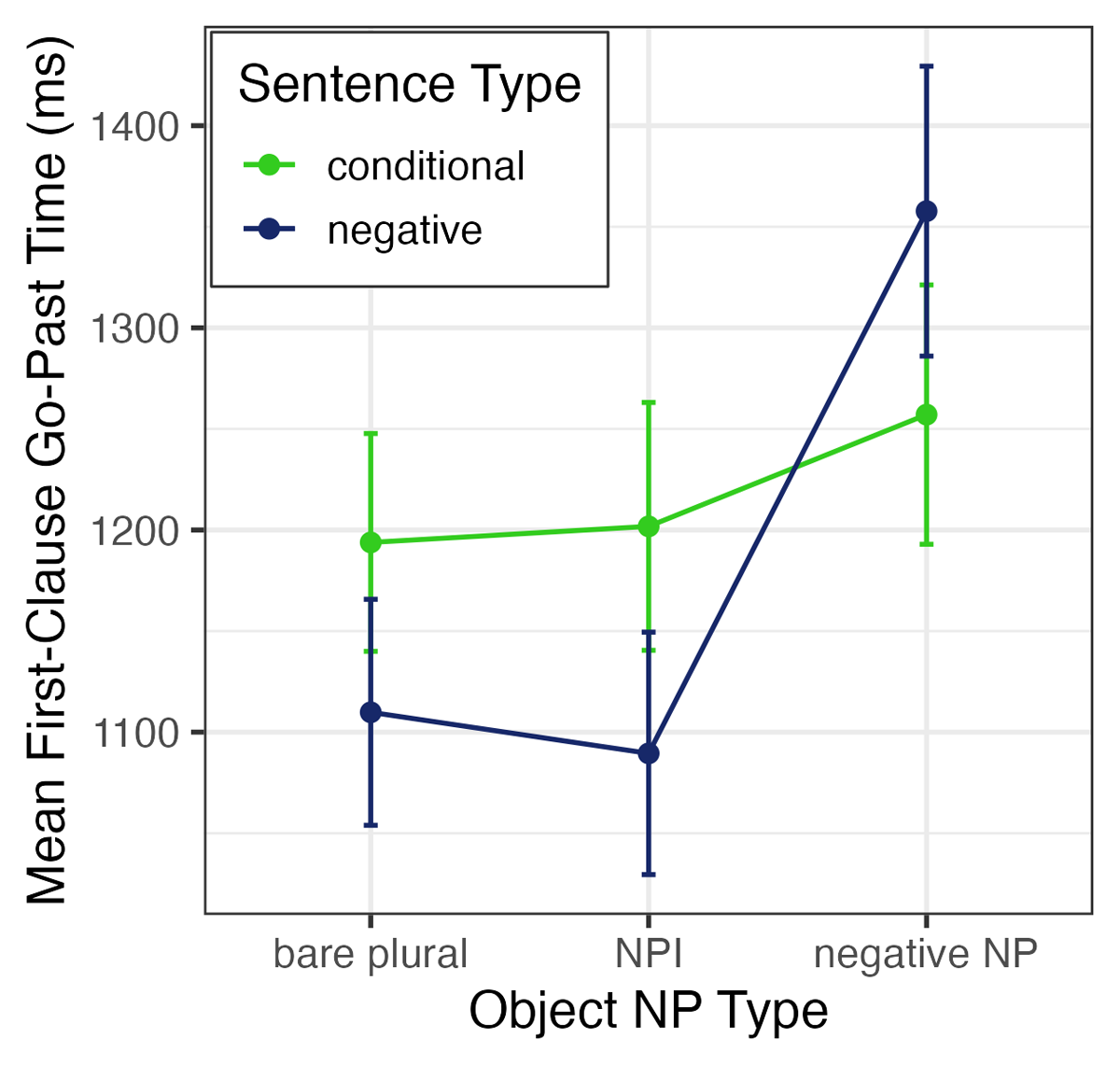
Figure 1: Mean go-past time for the key region of the first clause. Error bars show standard error of the mean.
The slow-down for negative-negative first clauses was confirmed in the linear mixed-effects model analysis, the results of which are shown in Table 4. There was a main effect of the NPI vs. negative NP contrast, and a significant interaction of sentence type and the NPI vs. negative NP contrast, such that the slow-down between reading an NPI object and a negative object was much more dramatic for negative sentences than conditional ones. This is consistent with participants being surprised to encounter negative concord in writing. A simple-effects analysis showed that the NPI vs. negative NP contrast is reliable for the negative sentences (B = 270.92, t = 6.45, p < .001), but not the conditional sentences (B = 44.12, t = 1.05, p = .29). There was also a reliable effect of trial order, as participants sped up over the course of the study.
Table 4: Linear mixed-effects model results for first-clause key region go-past time. For details of model specification, see Section 3, above.
| Estimate | St Err | t-value | p | |
| intercept | 1213.77 | 56.33 | 21.55 | |
| sentence type (effects-coded) | –26.33 | 24.27 | –1.09 | .28 |
| NP type | ||||
| bare v NPI | 2.00 | 29.78 | 0.07 | .95 |
| NPI v neg | 157.52 | 29.68 | 5.31 | <.001* |
| trial order | –169.36 | 20.70 | –8.18 | <.001* |
| sentence type × bare-NPI | –26.70 | 59.56 | –0.45 | .65 |
| sentence type × NPI-neg | 226.80 | 59.44 | 3.82 | <.001* |
3.2 Second-clause total time
Figure 2 shows that participants spent substantially more time reading the key region of the second clause in conditional-negative sentences, where that continuation did not make sense, than in negative-negative sentences. This pattern suggests that participants arrived at the intended negative concord interpretation of negative-negative sentences before reading the second clause. We also see an unpredicted difference between the conditional-NPI and negative-NPI sentences.
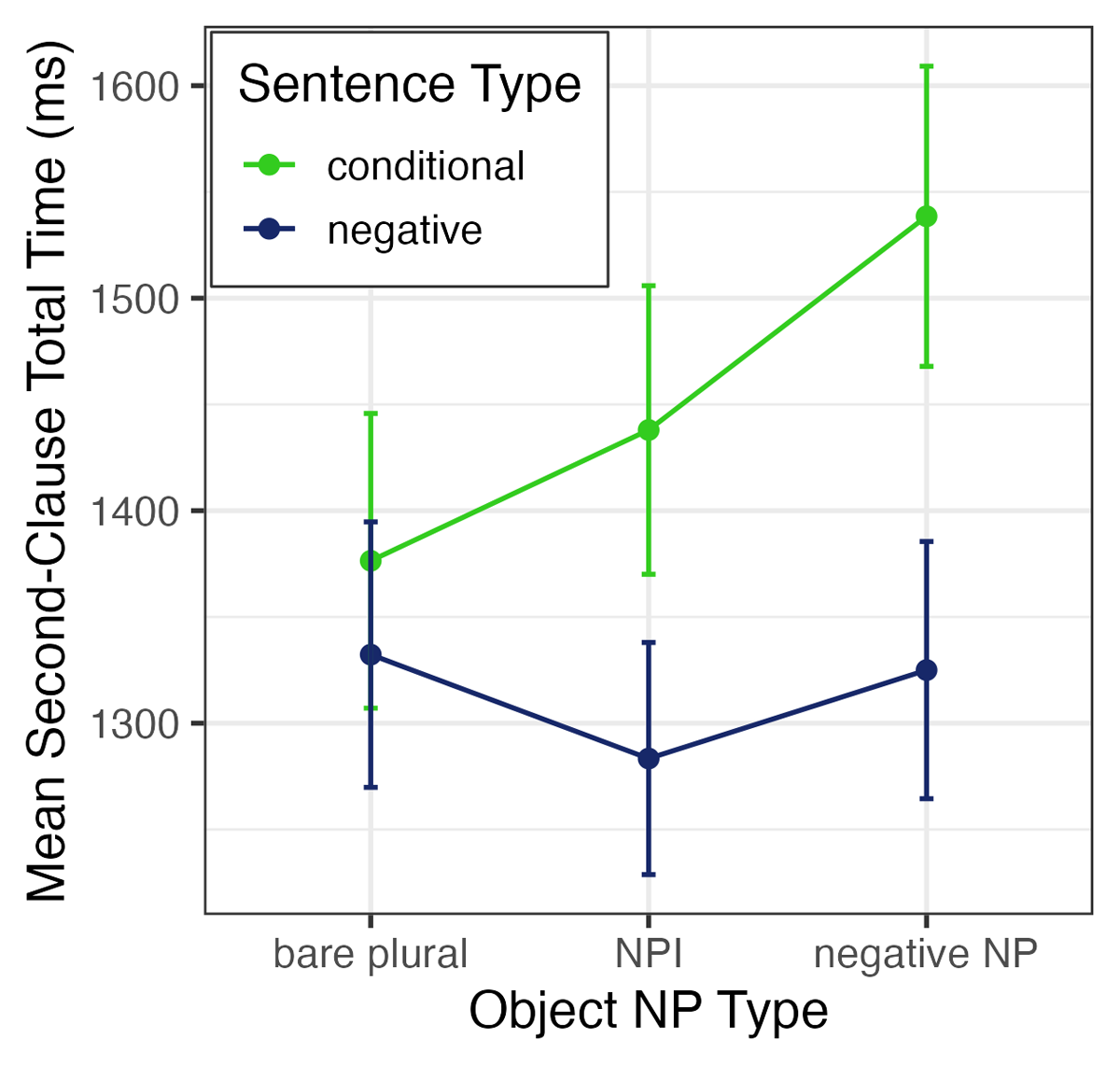
Figure 2: Mean total time for the key region of the second clause. Error bars show standard error of the mean.
These patterns were largely confirmed by the linear mixed-effects model (Table 5). Reliable main effects of sentence type and the NPI vs. negative NP contrast indicated that continuations were read more slowly in conditional items overall and in items with negative NPs, and a reliable effect of trial order indicated a tendency to speed up over the course of the study. The predicted interaction between sentence type and the NPI vs. negative NP contrast was not significant, likely due to the unexpectedly long reading times in conditional-NPI sentences. However, a simple effects analysis showed that the NPI vs. negative NP contrast was reliable for the conditional sentences (B = 89.58, t = 2.06, p = .04), but not for the negative sentences (B = 54.15, t = 1.24, p = .21). We return to this discrepancy in 3.4, below.
Table 5: Model results for second-clause key region total time. For details of model specification, see Section 3, above.
| Estimate | St Err | t-value | p | |
| intercept | 1388.42 | 62.03 | 22.38 | |
| sentence type (effects-coded) | –126.23 | 25.09 | –5.03 | <.001* |
| NP type | ||||
| bare v NPI | 8.96 | 30.77 | 0.29 | .77 |
| NPI v neg | 71.87 | 30.72 | 2.34 | .02* |
| trial order | –174.60 | 21.36 | –8.17 | <.001* |
| sentence type × bare v NPI | –111.01 | 61.54 | –1.80 | .07 |
| sentence type × NPI v neg | –35.45 | 61.51 | –0.58 | .56 |
3.3 Rereading time
Figure 3 shows that, overall, participants spent more time rereading the key region of the first clause after entering the key region of the second clause in conditional sentences than in negative sentences. This difference was somewhat larger for sentences with negative NPs than for those with NPIs or bare plurals.
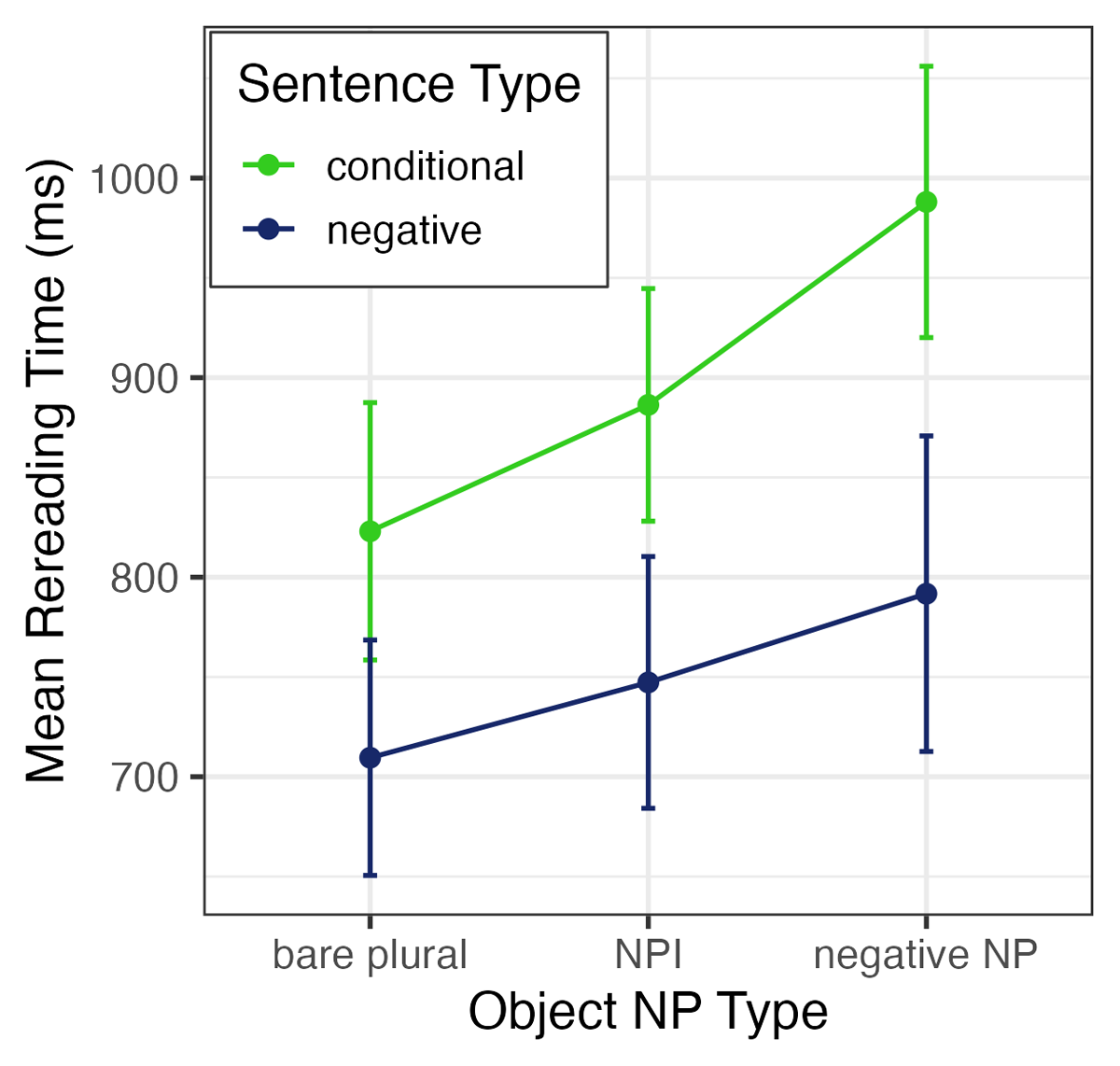
Figure 3: Mean rereading time for the key region of the first clause, given that the key region of the second clause has been fixated. Error bars show standard error of the mean.
The results of a linear mixed-effects model analysis of rereading time are shown in Table 6. There was again a reliable effect of trial order, sentence type, and of the NPI vs. negative NP contrast, but no reliable interaction between sentence type and the NPI vs. negative NP contrast. A simple main effects analysis showed that the increase in rereading time between NPI and negative NP was marginal for the conditional sentences (B = 97.59, t = 1.94, p = .05), and not reliable for the negative ones (B = 68.13, t = 1.35, p = .18).
Table 6: Model results for first-clause key region rereading time. For details of model specification, see Section 3, above.
| Estimate | St Err | t-value | p | |
| intercept | 826.99 | 99.01 | 8.35 | |
| sentence type (effects-coded) | –143.56 | 29.05 | –4.94 | <.001* |
| NP type | ||||
| bare v NPI | 41.47 | 35.63 | 1.16 | 0.24 |
| NPI v neg | 82.86 | 35.57 | 2.33 | .02* |
| trial order | –131.56 | 24.80 | –5.31 | <.001* |
| sentence type × bare v NPI | –13.52 | 71.27 | –0.19 | 0.85 |
| sentence type × NPI v neg | –29.46 | 71.23 | –0.41 | 0.68 |
3.4 Discussion of statistical patterns
While the predicted interaction between sentence type and the NPI vs. negative NP contrast did not emerge for second-clause total time or for first-clause rereading time, this appears to be for reasons unrelated to our central questions. In particular, it seems that the expected interaction failed to emerge not because of difficulty associated with the interpretation of negative-negative (i.e., negative concord) sentences, but rather because of an unpredicted pattern of longer reading times in conditional sentences, particularly conditional-NPI sentences. Despite the lack of a significant interaction, simple-effects analyses showed the predicted patterns within sentence types. Participants spent reliably more time reading second clauses and marginally more time revisiting first clauses in conditional-negative than in conditional-NPI sentences. They did not show reliable differences between negative-NPI sentences and negative-negative sentences on either measure.
There are likely multiple sources for the larger-than-expected differences between negative-NPI and conditional-NPI sentences for the revision measures. First, conditional sentences were read more slowly than expected, overall. Longer reading times began emerging for conditional sentences in first-clause go-past time (Figure 1). This, along with prior literature (e.g., Fugard, et al., 2011), suggests that there are complexities in processing conditionals that we did not account for when we designed our comparisons, and which are neither related to the fit between first and second clauses nor to the type of object NP. Second, there is a substantial increase in first-clause rereading time and second-clause total time for conditional-NPI sentences, relative to conditional-bare plural sentences. This may be due to the complexity added by the dependency between the conditional context and the NPI, but may also be due to the stimulus materials: Revisiting the results of Blanchette and Lukyanenko (2019b) with the current results in mind, we notice a wider spread of second-clause sensicality ratings for conditional-NPI sentences (1st quartile = 5, median = 6, on a 7-point scale) than for negative-NPI sentences (1st quartile = 7, median = 7). Along with comments from an anonymous reviewer and our own reflection, this pattern suggests that some of the non-negative continuations may not have followed as sensibly from conditional-NPI clauses as intended. Compare, for instance, the sentences below, repeated from Table 3.
- (9)
- The news anchor didn’t warn anybody about the floods, so folks are gonna think it’s safe to stay in their homes. negative-NPI
- (10)
- If the news anchor warns anybody about the floods, then folks are gonna know it’s risky to stay in their homes. conditional-NPI
It follows fairly directly that if nobody is warned, as in (9), people will think it’s safe to stay. It is less certain that if anybody is warned, as in (10), people in general will know that it is risky to stay. For instance, the news anchor warning the camera crew would satisfy the first clause of (10), but would be unlikely to result in the general awareness implied by the continuation. This pattern was not universal in the stimuli (see Table 1: If my older sister leaves anything in her locker, then her backpack will be a bit lighter during her walk home), but it may have contributed to the larger-than-expected differences between conditional-NPI and negative-NPI sentences.
In contrast to the unexpected patterns in conditional sentences, patterns for the negative sentences were in line with expectations: negative-bare plural and negative-NPI sentences showed relatively similar reading times on all three measures. It was only on the initial encounter with negative-negative first clauses (go-past time) that participants reliably slowed down. In particular, we note that second-clause total times are numerically comparable in negative-bare plural and negative-negative sentences. This suggests that unproduced negative concord structures are interpreted with similar ease to produced structures, both those with a negative dependency (negative-NPI) and those without (negative-bare plural).
On the whole, despite the lack of the predicted interaction between sentence type and the NPI vs. negative NP contrast, we take the statistical patterns to support the conclusion that MUSE users arrive at the negative concord reading of negative-negative sentences without engaging in a context-driven revision process.
4. General discussion
The current study explored MUSE users’ online processing of conditional and negative sentences, including negative concord sentences, which they do not produce. Reading times suggested that participants processed negative-NPI and negative concord structures with similar ease: There was no reliable difference in second-clause reading time or first-clause rereading time between these structures. Importantly, participants did not always treat negative NPs and NPIs equivalently. There was a reliable difference between conditional-NPI and conditional-negative items for second-clause total time and a marginal one for first-clause rereading time, suggesting that participants correctly arrived at opposite interpretations for these items, consistent with prior offline findings (Blanchette & Lukyanenko, 2019b). Due to the lack of interaction between sentence type and the NPI vs. negative NP contrast discussed above, the inference was less straightforward than we anticipated. The results nevertheless point toward straightforward comprehension of negative concord.
How do we explain the fact that participants appeared to easily comprehend negative concord despite its absence from their production? The similarity of reading patterns in negative-negative and negative-NPI items shows that participants are treating a construction they produce and one they do not produce similarly. In particular, we found no evidence that they are relying on context-driven revision or simple analogies to appropriately interpret negative concord items.
The current results indicate that MUSE users arrive at a single-negation interpretation of negative concord before being influenced by context: While they take longer to read the negative concord clauses themselves, they show no evidence of difficulty upon encountering the following context. This limits potential explanations for their success: MUSE users cannot be reaching negative concord interpretations by relying on context rather than the negative concord structure itself. Further, if MUSE users are succeeding by analogy, it is not the simplest one, and it is drawn on as soon as they encounter negative concord. That is, participants are not simply treating negative NPs and NPIs as interchangeable everywhere. Such an analogy would have allowed them to “save” the otherwise surprising second clauses in conditional-negative items by treating them like conditional-NPI items, but the reading times showed no evidence of this. Instead, participants must either be succeeding through a more complex analogy or by accessing an existing representation of negative concord.
A more complex analogy that could explain the results draws on existing knowledge of negative-NPI constructions, rather than NPIs more broadly. Indeed, a number of formal analyses of negative concord and negative-NPI structures account for them by using similar mechanisms (Blanchette, 2015; Giannakidou & Zeijlstra, 2017). If negative concord and negative-NPI structures are represented similarly by people who produce both (e.g., Appalachian English users; Blanchette, 2015), then there is little difference between this analogy and accessing an existing representation. While the current data do not allow us to distinguish between these possibilities, they do demonstrate that MUSE users are processing negative concord immediately and in a way that, in later measures at least, closely parallels their processing of negative-NPI sentences, a structure in their production repertoire.
4.1 Implications for shared representations
The current results rule out a reliance on context and the simplest analogies as explanations for MUSE users’ success with negative concord, and are consistent with MUSE users accessing an existing representation during comprehension, despite negative concord’s systematic absence from their production. Negative concord therefore remains a candidate mismatch between MUSE users’ comprehension and production repertoires and an interesting case to investigate further.
The current results are compatible with the possibility that comprehension and production draw on separate syntactic representations. There are two ways in which these results remain compatible with a shared representations approach, however. First, negative concord may be absent from the shared repertoire, and participants may succeed through a more complex, linguistically constrained analogy. If the complex analogy to negative-NPI constructions applies, then negative concord is absent from production because nothing prompts the analogy. Second, negative concord may be present in a shared repertoire. If this is the case, then negative concord structures are absent from production either because of intentional avoidance, due to prescriptive prohibitions on “double negatives” (Horn, 2010), or a more subtle effect of the low frequency of the structure in MUSE, as might be predicted on a number of models (e.g., Chater, et al., 2016; Robinson & Thoms, 2021).
5. Conclusion and future work
The current study explored a context in which comprehension appears to exceed production: MUSE users readily comprehend negative concord, despite its absence from their production. Reading patterns indicated that participants arrived at a correct interpretation of negative concord before encountering disambiguating context, and not through a process of revision. Together with prior offline findings, this allows us to rule out a reliance on context and the simplest analogies. Instead, it points toward a more sophisticated level of linguistic knowledge. We conclude that MUSE users are either making a complex, linguistically-constrained analogy immediately upon encountering negative concord, or that they have an existing representation that they are accessing during comprehension. In ongoing work, we are investigating these possibilities, and asking whether any existing representation MUSE users have is available to the production system. Negative concord and other variable syntactic features present a promising avenue for exploring these and other questions about the boundaries of people’s linguistic knowledge.
Data accessibility statement
Stimuli, data and analysis scripts are available at https://osf.io/xpktz/.
Ethics and consent
The research reported here was declared exempt by the Penn State University Institutional Review Board, reference number 00007476.
Acknowledgements
The authors gratefully acknowledge Kiara Smith for assistance preparing stimuli, Olivia Barnum for assistance recruiting and running participants, Karen Miller for the use of her eye-tracking equipment, the Center for Language Science at Penn State University, and research funding from the Penn State Eberly College of Science.
Competing interests
The authors have no competing interests to declare.
Authors’ contributions
The authors were jointly responsible for most stages of the project, including Conceptualization, Methodology, Project Administration, and Writing – review & editing. Cynthia Lukyanenko took primary responsibility for Data Curation, Formal Analysis, Visualization, and Writing – original draft. Frances Blanchette took primary responsibility for Investigation by collecting the eye-tracking data.
Notes
- In addition to a handful of adult studies, negative concord has been explored in acquisition (e.g., Coles-White, 2004; Thornton et al., 2016). These studies suggest that children acquiring mainstream varieties in which negative concord is apparently absent nevertheless readily comprehend it. This is consistent with the possibility that MUSE users have an existing representation for the structure, despite not producing it. [^]
- We use these same stimuli in the current study, and an anonymous reviewer notes that for some stimulus items, it is possible to construct a plausible context for the conditional-negative sentences and the non-negative continuation. For instance, for the item If my favorite aunt brings nobody to the cookout, then I bet she is gonna be entertained the entire evening, it could be that her usual guest is boring and the other attendees are delightful, so bringing no one is, in fact, the more entertaining option. This sort of reinterpretation could explain some of the variability that Blanchette and Lukyanenko (2019b) observed in the conditional-negative sentences: Participants’ ratings ranged from 1–7 on the 7-point sensicality scale. On the whole, however, ratings for this condition were very low (median = 1, 3rd quartile = 2), and dramatically different from the other sentence types, suggesting that for most stimuli, most participants did not construct a plausible context. [^]
- For instance, participants were asked “How likely are your family and friends to say a sentence like ‘I didn’t eat anything for breakfast’ to communicate that they skipped breakfast?” (NPI exposure, emphasis original). Other questions substituted you for your family and friends, and nothing for anything, to probe participants’ perceived use of, and exposure to, both NC and NPI forms. [^]
- The analyses reported below include this participant. Excluding them does not change the significance level of the results. [^]
References
Bates, D., Maechler, M., Bolker, B., & Walker, S. (2015). Fitting linear mixed-effects models using lme4. Journal of Statistical Software, 67(1), 1–48. http://doi.org/10.18637/jss.v067.i01
Blanchette, F. (2015). English negative concord, negative polarity, and double negation. [Doctoral dissertation, City University of New York]. https://ling.auf.net/lingbuzz/002654
Blanchette, F., Dubinsky, S., Harman, A., & Sim, R. (2026). This construction needs understood: An experimental study of the Alternative Embedded Passive. American Speech, 101(1), 20–50. http://doi.org/10.1215/00031283-11466542
Blanchette, F., & Lukyanenko, C. (2019a). Unacceptable grammars? An eye-tracking study of English Negative Concord. Language and Cognition, 11(1), 1–40. http://doi.org/10.1017/langcog.2019.4
Blanchette, F., & Lukyanenko, C. (2019b). Asymmetries in the acceptability and felicity of English negative dependencies: Where Negative Concord and Negative Polarity (do not) overlap. Frontiers in Psychology, 10, Article 2486. http://doi.org/10.3389/fpsyg.2019.02486
Bock, J. K., Dell, G. S., Chang, F., & Onishi, K. H. (2007). Persistent structural priming from language comprehension to language production. Cognition, 104(3), 437–458. http://doi.org/10.1016/j.cognition.2006.07.003
Boland, J. E., Atkinson, E., De Los Santos, G., & Queen, R. (2023). What do we learn when we adapt to reading regional constructions? PLOS One, 18(4), Article e0282850. http://doi.org/10.1371/journal.pone.0282850
Bresnan, J., & Kaplan, R. M. (1984). Grammars as mental representations of language. In W. Kintsch, J. R. Miller, & P. G. Polson (Eds.), Methods and tactics in cognitive science (pp. 103–135). Lawrence Erlbaum Associates Press.
Chater, N., McCauley, S. M., & Christiansen, M. H. (2016). Language as skill: Intertwining comprehension and production. Journal of Memory and Language, 89, 244–254. http://doi.org/10.1016/j.jml.2015.11.004
Childs, C. (2017). Integrating syntactic theory and variationist analysis: The structure of negative indefinites in regional dialects of British English. Glossa: A Journal of General Linguistics, 2(1), Article 106. http://doi.org/10.5334/gjgl.287
Clark, H. H., & Malt, B. C. (1984). Psychological constraints on language: A commentary on Bresnan and Kaplan and on Givón. In W. Kintsch, J. R. Miller, & P. G. Polson (Eds.), Method and tactics in cognitive science (pp. 191–214). Lawrence Erlbaum Associates Press.
Coles-White, D. (2004). Negative concord in child African American English: Implications for specific language impairment. Journal of Speech, Language, and Hearing Research, 47(1), 212–222. http://doi.org/10.1044/1092-4388(2004/018)
Fine, A. B., Jaeger, T. F., Farmer, T. A., Qian, T. (2013). Rapid expectation adaptation during syntactic comprehension. PLOS One, 8(10), Article e77661. http://doi.org/10.1371/journal.pone.0077661
Fraundorf, S. H., & Jaeger, T. F. (2016). Readers generalize adaptation to newly-encountered dialectal structures to other unfamiliar structures. Journal of Memory and Language, 91, 28–58. http://doi.org/10.1016/j.jml.2016.05.006
Fugard, A. J. B., Pfeifer, N., Mayerhofer, B., & Kleiter, G. D. (2011). How people interpret conditionals: Shifts toward the conditional event. Journal of Experimental Psychology: Learning, Memory, and Cognition, 37(3), 635–648. http://doi.org/10.1037/a0022329
Garrett, M. F. (1980). Levels of processing in sentence processing. In B. Butterworth (Ed.), Language production: Speech and talk (Vol. 1, pp. 177–220). Academic Press.
Giannakidou, A., & Zeijlstra, H. (2017). The landscape of negative dependencies: Negative Concord and N-words. In M. Everaert & H. van Riemskijk (Eds.), The Wiley Blackwell companion to syntax (2nd ed., pp. 1660–1712). John Wiley & Sons, Inc.
Haegeman, L., & Zanuttini, R. (1996). Negative concord in West Flemish. In A. Belletti & L. Rizzi (Eds.), Parameters and functional heads (pp. 117–179). Oxford University Press.
Horn, L. (2001). A natural history of negation. CSLI Publications.
Horn, L. (2010). Multiple negation in English and other languages. In L. Horn (Ed.), The expression of cognitive categories: Expression of negation (pp. 117–148). Walter de Gruyter.
Indefrey, P. (2018). The relationship between syntactic production and comprehension. In S.-A. Rueschemeyer & M. G. Gaskell (Eds.), The Oxford handbook of psycholinguistics (2nd ed., pp. 482–505). http://doi.org/10.1093/oxfordhb/9780198786825.013.20
Kaschak, M. P., & Glenberg, A. M. (2004). This construction needs learned. Journal of Experimental Psychology: General, 133(3), 450–467. http://doi.org/10.1037/0096-3445.133.3.450
Kittredge, A. K., & Dell, G. S. (2016). Learning to speak by listening: Transfer of phonotactics from perception to production. Journal of Memory and Language, 89, 8–22. http://doi.org/10.1016/j.jml.2015.08.001
Ladusaw, W. A. (1979). Polarity sensitivity as inherent scope relations [Doctoral dissertation, University of Texas]. Published, Garland (1980).
Levelt, W. J. M. (1989). Speaking: From intention to articulation. MIT Press.
Maher, Z., & Wood, J. (2011). Needs washed. Yale grammatical diversity project: English in North America. http://ygdp.yale.edu/phenomena/needs-washed. Updated by Tom McCoy (2015), Katie Martin (2018) and Sara Sparling (2024).
Meyer, A. S., Huettig, F., & Levelt, W. J. M. (2016). Same, different, or closely related: What is the relationship between language production and comprehension? Journal of Memory and Language, 89, 1–7. http://doi.org/10.1016/j.jml.2016.03.002
R Core Team (2024). R: A language and environment for statistical computing. R Foundation for Statistical Computing. https://www.R-project.org/.
Robinson, M., & Thoms, G. (2021). On the syntax of variable English Negative Concord. University of Pennsylvania Working Papers in Linguistics, 27(1), 195–204. https://repository.upenn.edu/handle/20.500.14332/45321
Shakespeare, W. (n.d.) Much ado about nothing. (B. Mowat & P. Werstein, Eds.). The Folger Shakespeare. https://www.folger.edu/explore/shakespeares-works/as-you-like-it/read/
Squires, L. (2014). Processing, evaluation, knowledge: Testing the perception of English subject-verb agreement variation. Journal of English Linguistics 42, 144–172.
The Book of Common Prayer (1662). The Church of England. https://www.churchofengland.org/prayer-and-worship/worship-texts-and-resources/book-common-prayer.
Thornton, R., Notley, A., Moscati, V., & Crain, S. (2016). Two negations for the price of one. Glossa: A Journal of General Linguistics, 1(1), Article 45, 1–30. http://doi.org/10.5334/gjgl.4
Weissler, R. E., & Brennan, J. R. 2020. How do listeners form grammatical expectations to African American Language? University of Pennsylvania Working Papers in Linguistics, 25(2), 135–141. https://repository.upenn.edu/handle/20.500.14332/45252
Wolfram, W., & Fasold, R. (1974). The study of social dialects in American English. Prentice Hall.