


1. Introduction
Languages vary in the types of entities that can be expressed by the subject of a causal verb (Comrie, 1989; Craig, 1977; Guilfoyle, 2000; Hawkins, 1985; Wolff & Ventura, 2009; among others). Notably, in English, the subjects of causal verbs can denote either sentient or non-sentient entities, as illustrated in (1) (Wolff et. al., 2009, p. 168). In contrast, in many languages, including Korean, Japanese, and German, non-sentient causers, such as knife in (1b), sound unnatural:
- (1)
- a.
- The boy broke the window.
- b.
- The knife cut the bread.
Drawing on arguments from Hawkins (1985) and Guilfoyle (2000), Wolff et al. (2009) ascribe this cross-linguistic difference to the combination of whether or not a language has morphological case-marking and whether the entity in question is capable of initiating an event. Hawkins (1985) observed that German tends to prefer subjects that denote sentient entities (or entities that generate internal power, such as fire), whereas English allows subjects that denote a wide range of entities. He argued that this contrast results from the presence or absence of a morphological case-marking system. German has such a system, and, thus, grammatical functions (subject, object, indirect object) can be identified using case morphology. English, on the other hand, lacks a productive case-marking system, and as a result, word order is a key cue to grammatical function, with subjects occurring sentence-initially. However, in terms of information structure, the sentence-initial position corresponds to given (as opposed to new) information. Since the discourse-given element in a sentence is not necessarily always an agentive subject, Hawkins proposed that English developed to allow semantically unrestricted subjecthood, in order to accommodate a range of thematic roles in its sentence-initial (i.e., subject) position. German, by contrast, has a relatively free word order that can accommodate any grammatical role in the sentence-initial discourse-given position, because case marking indicates each noun’s role. Wolff et al. (2009) bring this argumentation together with Guilfoyle’s (2000) classification of languages as either “initiator languages” or “non-initiating”, where initiator languages are defined as those in which there is a preference for subjects to denote entities with the ability to initiate an event. Noting that Guilfoyle’s initiator languages have morphological case systems and relatively free word order, like German, Wolff et al. (2009) proposed the initiator hypothesis, whereby, in languages with morphological case, “the external argument of a clause [i.e., the subject] must be able to initiate the causal chain” (p. 173).
Wolff and colleagues’ experimental study tested the initiator hypothesis using physical causative verbs (e.g., break, melt) in Korean, Chinese and English. Korean is a language with morphological case-marking and relatively free word order, whereas Chinese, similarly to English, lacks case-marking and has a more fixed word order.1 Consequently, they predicted that in Korean, only subjects that denote entities that are capable of initiating causation would be felicitous, whereas in Chinese and English, subjects that denote non-initiating entities would also be felicitous. They tested this using a series of three experiments, but we focus here on just the first experiment, an acceptability judgement task (AJT). Participants rated 30 transitive causative sentences that each contained an inanimate subject categorized as high or low self-energizing. High self-energizing arguments denote entities capable of independent energy generation, such as natural forces or energy-transforming devices (e.g., microwave in The microwave defrosted the meat); while low self-energizing arguments denote entities that lack internal power sources and typically function as instruments in linguistic terms (e.g., knife in (1a)).2
The results revealed a significant effect of “energy generation” across all three languages: high self-energizing causers were rated as more acceptable than low self-energizing causers. However, a significant interaction between language and energy generation showed that this contrast was most pronounced for Korean speakers, who rated self-energizing causers considerably lower than the English and Chinese speakers did. In short, the results supported the initiator hypothesis: Korean, which has morphological case, tended to restrict subjects to entities that can initiate a causal chain (in the sense of being self-energizing), whereas English and Chinese, which lack case-marking, did not exhibit such a restriction.
Wolff and colleagues’ focus was on physical causation, using verbs that describe direct, observable actions that bring about a physical change. However, causation is not limited to physical interactions: (causative) psychological verbs (henceforth, psych verbs) encode causal relationships between a causer and an experiencer’s mental or emotional state. These verbs (e.g., frighten, annoy) inherently express causation but with some differences from their physical counterparts. First, psych verbs allow a stative reading, in addition to potentially allowing agentive and eventive readings. For example, in The student surprised Dora, the subject could be agentive, in that the student performed some action that caused Dora to feel surprised; but, alternatively, Dora’s surprise could arise without any agentive action by the student, but rather due to their unexpected presence. The latter is the stative reading, where the causer does not initiate a discrete event, but simply possesses a quality that causes the experiencer to feel a certain way (Arad, 1998; Grafmiller, 2013). Second, psych verbs differ in terms of event structure. Physical causatives involve a bi-eventive structure consisting of a causing event followed by a change of state. In contrast, psych verbs lack a distinct change-of-state process undergone by the experiencer (Fritz-Huechante et al., 2020; Landau, 2010).
Given these differences between psychological and physical causatives, it remains unclear whether the cross-linguistic variation in subjecthood constraints observed for physical causative constructions also extends to the domain of psychological causation. If the initiator hypothesis extends to psych verbs, this would suggest that speakers’ preferences for certain subject types are not limited to concrete, physical interactions, but instead reflect a more general constraint on the linguistic encoding of causation. Conversely, if it does not, this would indicate an important limit on the scope of the initiator hypothesis. Thus, psych verbs provide a critical test of the theoretical generality of the initiator hypothesis across semantic domains. To address this gap, the current study investigates whether Wolff and colleagues’ initiator hypothesis extends to psych verbs. Operationalization of “initiation ability” in terms of volitionality is appropriate for psych verbs, because Wolff and colleagues’ original notion of self-energizing was grounded in physical causation. Unlike physical events, psych verbs do not involve overt energy transmission or physical change, but rather the causation of an internal mental state. With this operationalization in mind, our specific question is whether the subjects of psych verbs are restricted to denoting potentially volitional entities (sentient entities) in a language with case morphology (Korean), while languages that lack case morphology (Chinese and English) allow both volitional and non-volitional entities.
2. Experiment
2.1 Participants
The study involved three participant groups: 44 native Korean speakers, 46 native Mandarin Chinese speakers and 29 native English speakers. The groups were recruited at universities or language institutions in Seoul, Hebei Province and the UK, respectively. The group mean ages were 21.51 years (Korean, SD = 1.26), 21.64 years (Chinese, SD = 1.59), and 29.86 years (English, SD = 6.99).
All participants provided informed consent before participating. Completion of the experiment (detailed below) took 10–15 minutes. The Korean and Chinese participants volunteered without compensation; the English participants were offered a £5 shopping voucher for their participation.
2.2 Design
The experiment consisted of an AJT, in which participants were presented with 40 sentences one-by-one, including both critical and filler sentences. The critical sentences were constructed using eight psych verbs in the three languages, as shown in Table 1.
Table 1: Psych verbs used in the experiment.
| Korean | Chinese | English |
|
ràng fènnù make angry |
anger |
|
ràng yìnxiàng shēnkè make impressed |
impress |
|
ràng nánguò make upset |
upset |
|
ràng nánkān make embarrassed |
embarrass |
|
ràng jīngxǐ make surprised |
surprise |
|
ràng hàipà make frightened |
frighten |
|
ràng kāixīn make amused |
amuse |
|
ràng fánnǎo make annoyed |
annoy |
In order to investigate the effect of subject (non)volitionality, we created pairs of sentences using the verbs in Table 1. Within each pair, one sentence had a (potentially) volitional subject (e.g., (2a)) and the other, a non-volitional subject, (2b).3,4
- (2)
- a.
- Volitional subject
- Korean:
- Namphyen-i
- husband-nom
- anay-lul
- wife-acc
- nola-key
- surprise-caus
- ha-l
- make-fut
- kes-ita.
- nml-cop.dcl
- Chinese:
- Zhàngfu
- husband
- huì
- fut
- ràng
- caus
- qīzi
- wife
- jīngxǐ.
- surprise
- English:
- The husband will surprise the wife.
- b.
- Non-volitional subject
- Korean:
- Panci-ka
- ring-nom
- anay-lul
- wife-acc
- nolakey
- surprise.caus
- ha-l
- make-fut
- kes-ita.
- nml-cop.dcl
- Chinese:
- Jièzhǐ
- ring
- huì
- fut
- ràng
- caus
- qīzi
- wife
- jīngxǐ.
- surprise
- English:
- The ring will surprise the wife.
The Korean and Chinese sentences contrast with English, in that they express causation through periphrastic constructions involving a causative auxiliary verb (-key ha-ta in Korean, ràng in Chinese), whereas the causative meanings are lexically encoded in English.5 In the Korean construction -key ha-ta, the suffix -key functions as a resultative or causative marker, while ha-ta serves as a causative verb, meaning ‘make/cause (someone to do something).’ For the Chinese sentences, the causative verb ràng was used, though Chinese has two causative markers, ràng and shǐ. Both are commonly employed in causatives, typically following the pattern [NP1 + ràng/shǐ + NP2 + VP] (Liu & Li, 2022). Through a collostructional analysis, Liu and Li (2022) showed that the usage of the two markers differs depending on lexical verb semantics. Ràng was selected for our sentences, because it is more frequently associated with psychological verbs, as it conveys indirect causation, whereas shǐ is typically used with causative events involving direct control.
Each verb in Table 1 was used in two sentence pairs. The English version of the second pair for the verb surprise is shown in (3). (The test materials are shared in full at https://doi.org/10.17605/OSF.IO/PH296).
- (3)
- a.
- b.
- Volitional subject:
- Non-volitional subject:
- The gentleman will surprise the woman.
- The flowers will surprise the woman.
The resulting 32 critical sentences were distributed across two lists, such that each verb appeared twice in each list, once in the volitional condition (e.g., (2a)), and once with the alternative sentence frame, in the non-volitional condition (e.g., (3b)). In addition to the 16 critical sentences per list, 24 filler sentences were added, to obscure the primary objective of the investigation. Among these fillers, eight contained psych verbs and were unnatural, due to violations of the expected semantic relationships between the subject and object (e.g., (4)). The remaining 16 fillers did not contain psych verbs. They included four grammatical sentences and 12 sentences that were ungrammatical for different reasons which, in some cases, were customized to the specific languages. The reasons for ungrammaticality included tense mismatches (e.g., The doctor wrote the prescription tomorrow), inappropriate case markers (in Korean) or inappropriate prepositions (Chinese and English). The majority of the fillers were ungrammatical, in order to balance the critical items, which were all grammatical in the Chinese and English versions, though in Korean, half of the critical items were expected to be perceived as somewhat unnatural.
- (4)
- Ungrammatical filler with psych verb
- Korean:
- *Haksayng-tul-i
- students.nom
- kyelsyek-ul
- absence.acc
- soksangha-key
- upset-caus
- ha-l
- fut
- kes-ita.
- nml-cop.dcl
- chinese:
- *Xuéshēngmen
- students
- huì
- fut
- rang
- caus
- quēxí
- absence
- bù’ān.
- upset
- English:
- *The students will upset the absence.
The critical sentences and fillers were randomized within each list, to minimize potential order effects. Participants completed the experiment in their native language. They were instructed to rate the naturalness of each sentence on a 5-point scale ranging from 0 to 4. A rating of 4 indicated that the sentence was completely natural and reflective of everyday language, whereas a rating of 0 indicated that the sentence was completely unnatural and unlikely to be used. Participants were asked to base their judgments on their intuition. The experiment was administered using the Qualtrics survey platform (Qualtrics, 2024). Participants completed the experiment using their own electronic devices.
Based on the cross-linguistic differences in argument selection outlined above, different patterns of acceptability judgments were expected. The Korean speakers, due to their language’s strict case-marking system, were predicted to show lower ratings for sentences containing non-volitional subjects than for sentences containing volitional subjects. In contrast, Chinese and English speakers, whose languages lack morphological case-marking, were predicted to have high ratings for sentences containing for both volitional and non-volitional causers.6
2.3 Results
Mean ratings were calculated by group and by condition for both critical items and fillers. We than ran ordinal mixed-effects regression models on the raw ratings for the critical items, for each group separately. These analyses are reported in turn. The full dataset and code can be viewed at https://doi.org/10.17605/OSF.IO/PH296.
Table 2 shows the mean ratings for the grammatical and ungrammatical fillers for each group. We investigated the fillers first, in order to verify that the task had worked as expected.
Table 2: Mean ratings (SDs) for fillers (scale = 0–4).
| Group | Grammatical Fillers | Ungrammatical Fillers |
| Korean | 3.82 (0.41) | 0.53 (0.90) |
| Chinese | 3.38 (0.91) | 1.13 (1.21) |
| English | 3.81 (0.49) | 0.73 (1.04) |
The results show that, across groups, participants had high mean ratings (>3.3) on the grammatical fillers and low ratings (<1.2) on the ungrammatical fillers, confirming the expected differentiation between grammatical and ungrammatical.
Figure 1 shows the mean ratings for the critical volitional and non-volitional conditions, by group.
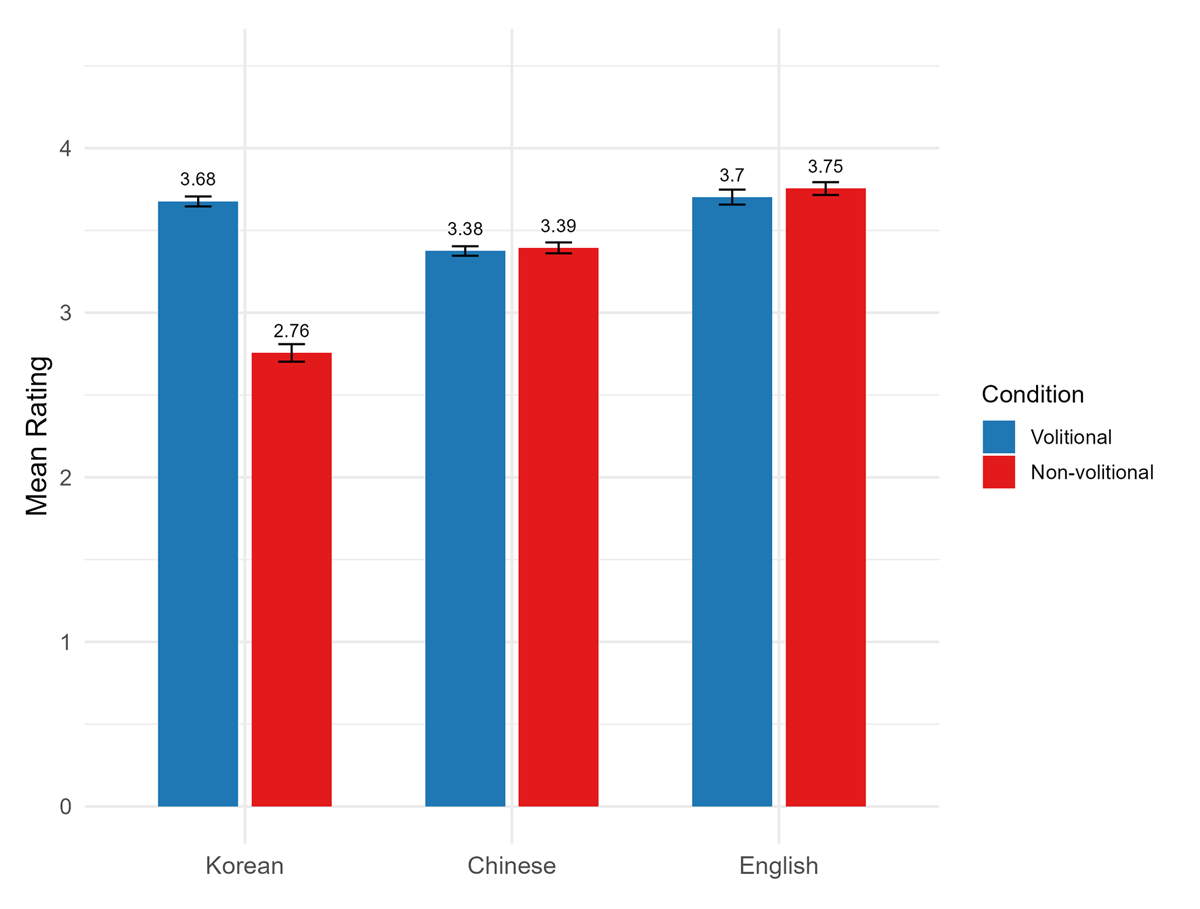
Figure 1: Mean ratings (scale = 0–4) by Condition and Group.
Note. Error bars represent ±1 standard error of the mean.
The figure shows a clear between-group difference: the Korean group has notably lower ratings for the non-volitional condition compared to the volitional condition, whereas in the Chinese and English groups, there is almost no difference between conditions. All mean ratings, except for the Korean group’s rating in the non-volitional condition, are high, at ≥3.38 out of 4. This suggests that the Chinese and English groups accept both conditions as natural, whereas for the Korean group, the non-volitional condition (mean rating, 2.76) is perceived as less natural than the volitional condition.
Acceptability ratings were analysed using cumulative link mixed-effects models (CLMMs), implemented with the clmm function in the ordinal package (Christensen, 2024) in R (R Core Team, 2024). The dependent variable was the ordinal rating score. Fixed effects included Group (Korean, Chinese, English) and Condition (volitional vs. non-volitional), as well as their interaction. Predictors were sum-coded to interpret the effects relative to the grand mean rather than a specific reference group. A maximal random-effects structure including random intercepts for participants and items, as well as random slopes for Condition by both participants and items, was initially specified (Barr et al., 2013). However, this model failed to converge. The final model retained random slopes for Condition by participants, but removed the corresponding slope for items.
The sum-coded cumulative link mixed-effects model revealed a significant main effect of Condition, indicating that sentences with non-volitional subjects were rated lower, overall, than those with volitional subjects (β = –0.453, SE = 0.133, p < .001). Main effects of Group were also observed, with both the Korean (β = –0.783, SE = 0.188, p < .001) and Chinese (β = –0.564, SE = 0.184, p = .002) groups differing significantly from the grand mean in their overall rating tendencies. Crucially, a significant Group × Condition interaction was found. Within this interaction, the Korean group showed a substantial reduction in acceptability for non-volitional subjects, relative to the grand mean (β = –1.085, SE = 0.095, p < .001), whereas the Chinese group showed a significant effect in the opposite direction (β = 0.534, SE = 0.088, p < .001), neutralizing the negative effect of non-volitionality observed in the grand mean.
To facilitate interpretation of the Group × Condition interaction and to examine condition effects within each group, pairwise comparisons were conducted, based on the estimated marginal means (EMMs), using the emmeans package (Lenth, 2024). These comparisons showed that, within the Korean group, non-volitional subjects were rated significantly lower than volitional subjects (β = –3.074, SE = 0.312, p < .001). In contrast, no reliable difference between the two conditions was observed for either the Chinese group (β = 0.164, SE = 0.289, p = .572) or the English group (estimate = 0.195, SE = 0.387, p = .614). Taken together, these results indicate that heightened sensitivity to subject volitionality was specific to the Korean group. These findings align with the predictions. The data revealed high acceptance of both volitional and non-volitional subjects of psych verbs in Chinese and English, but only of volitional subjects in Korean.
3. Discussion and conclusion
This study has investigated whether the cross-linguistic variation in subject selection constraints that has been identified for physical causative constructions extends to psych verbs, focusing on Korean, Chinese and English. The contrast between the Korean group’s lower ratings for non-volitional subjects relative to volitional subjects and the Chinese and English groups’ high ratings for both types of subjects provides empirical support for the proposal that in Korean, stricter constraints are imposed on subjecthood in psych verb constructions than in Chinese or English. Further, there was no evidence that this result could be due to, or affected by, differences in causative structure (i.e., periphrastic in Korean and Chinese; lexical in English; see note 7), because the Chinese and English groups showed similar behaviour, despite having different morphosyntactic encoding of causativity.
This finding provides new evidence to support Wolff et al.’s (2009) initiator hypothesis, which proposed that in languages with morphological case, the external argument of a clause must be able to initiate a causal chain. Korean has an overt case-marking system, and this leads to the preference for volitional subjects with psych verbs, since these can more plausibly initiate a causal chain than non-volitional subjects. In contrast, English and Chinese, which lack morphological case-marking, permit a broader range of subjects, including non-volitional ones, reflecting greater flexibility in subject selection. The key contribution of this study lies in its finding that crosslinguistic differences in subject selection, previously observed in physical causative constructions, also extend to causative psych verbs.
Nonetheless, we note some limitations of the study. First, volitionality and self-energizing capacity were not empirically separable in the stimulus set, as these properties largely co-varied across items (i.e., volitional subjects had high self-energizing capacity, while non-volitional subjects tended to have low self-energizing capacity). Consequently, the observed pattern cannot be attributed with full certainty to volitionality alone. Future research should, therefore, include non-volitional but high-energy causers (e.g., storms, alarms), in order to disentangle the roles of volitionality and self-energizing capacity in subject selection. Second, our use of future marking in the sentences could have biased participants against accepting non-volitional subjects (see note 5). If this had been the case, we would expect to see some effect across all groups, in the form of slightly lower ratings on non-volitional subjects even in the Chinese and English groups. Such a pattern did not emerge. However, we cannot rule out the possibility that use of the future disproportionately affected the Korean group’s judgements and consequently played a role in the lower ratings for the non-volitional condition in that group. A follow-up study using present or past tense forms instead of future forms could shed light on this issue. Finally, although the current sample size was sufficient to detect main effects, we acknowledge that increasing the number of items and participants would boost statistical power.
We conclude by noting an implication of this finding for second language (L2) acquisition research on psych verbs. It raises the question of whether semantic restrictions on subjecthood in a first language (L1) may influence the acquisition of psych verbs in an L2. Previous research on the L2 acquisition of English psych verbs reported difficulties with the argument structure of these verbs. For example, learners produce sentences like John frightens exams, mistakenly assigning the experiencer role to the subject position (White et al., 1999). White and colleagues attributed such difficulties to the presence of explicit causative morphology in the learners’ L1s, which may lead them to expect overt morphological marking in English psych verb constructions, as well. However, the present findings raise the question of whether influence from L1 semantic constraints on subjecthood could also play a role. For instance, Korean learners of English may be affected by an L1-based preference for volitional subjects and, as a result, may struggle to interpret non-volitional subjects in English psych verb constructions even after successfully acquiring English causative meanings in the absence of causative morphology. We recommend further research to investigate this question.
Abbreviations
ACC = accusative
CAUS = causative
COP = copula
DCL = declarative ending
FUT = future
NML = nominalizer
NOM = nominative
Data accessibility statement
The materials, anonymized data, and analysis scripts for this study are publicly available at the following OSF repository: https://doi.org/10.17605/OSF.IO/PH296.
Ethics and consent
This study was approved by the Education Ethics Committee at the University of York. All participants provided informed consent prior to participation. All data were collected anonymously, in accordance with the university’s data protection and research ethics guidelines.
Acknowledgements
We would like to thank Fan Zhang for assistance with the Chinese materials and recruitment of the Chinese participants. We are also grateful to Fan Zhang, Buhan Guo and Shiyang Fu for helpful discussion of causatives in Chinese.
Competing interests
The authors have no competing interests to declare.
Author contributions
Both authors were involved in all aspects of the study, including its conceptualization, data collection and analysis, and the writing of the manuscript. Both authors approved the final version of the manuscript.
Notes
- As Wolff and colleagues note, citing LaPolla (1993, 2009), the notion of “subject” in Chinese is not the same as in English. Chinese is typically characterised as having a sentence structure that is topic–comment rather than subject–object. [^]
- Entities were categorized as high or low self-energizing in a prior rating task, in which 20 English speakers had judged “the degree to which the affectors (i.e., external arguments) […] were able to generate their own energy/force” (Wolff et al., 2009, p. 179). [^]
- See the Abbreviations section after the main text for a list of the abbreviations used in the examples. [^]
- In all three languages, the sentences contain a future marker: will, kes (Korean) and hui (Chinese). This was a deliberate choice to strengthen a potentially volitional interpretation of the subject and thereby highlight the subject’s causal involvement in the event, driven by Huddleston and Pullum’s (2022, p. 192) observation that will can convey volition or intention and function as a marker of dynamic modality. We discuss possible implications of this decision in Section 3. [^]
- Korean and Chinese do not have direct lexical equivalents to English psych verbs that encode the causative meaning within a single verb. [^]
- These predictions assume that there will be no effect of the fact that the Korean and Chinese sentences use periphrastic causative constructions while the English sentences use lexical causatives. If an effect of causative structure were to arise, then a difference between the English ratings, on the one hand, and the Chinese and Korean ratings, on the other, is predicted. We address this further in 2.3. [^]
References
Arad, M. (1998). Psych-notes. UCL Working Papers in Linguistics, 10, 203–223.
Barr, D. J., Levy, R., Scheepers, C., & Tily, H. J. (2013). Random effects structure for confirmatory hypothesis testing: Keep it maximal. Journal of Memory and Language, 68, 255–278. http://doi.org/10.1016/j.jml.2012.11.001
Christensen, R. H. B. (2024). ordinal: Regression models for ordinal data (R package version 2024.3.1). Retrieved from https://CRAN.R-project.org/package=ordinal
Comrie, B. (1989). Language universals and linguistic typology (2nd ed.). University of Chicago Press.
Craig, C. C. (1977). The structure of Jacaltec. University of Texas Press.
Fritz-Huechante, P., Verhoeven, E., & Rott, J. A. (2020). Agentivity and non-culminating causation in the psych domain: Cross-linguistic evidence from Spanish and Korean. Glossa: A Journal of General Linguistics, 5(1), 102. http://doi.org/10.5334/gjgl.896
Grafmiller, J. (2013). The semantics of syntactic choice: An analysis of English emotion verbs [Doctoral dissertation]. Stanford University.
Guilfoyle, E. (2000). Tense and N-features in Modern Irish. In A. Carnie & E. Guilfoyle (Eds.), The syntax of verb initial languages. Oxford University Press. http://doi.org/10.1093/oso/9780195132229.003.0004
Hawkins, J. A. (1985). A comparative typology of English and German: Unifying the contrast. University of Texas Press.
Huddleston, R. D., Pullum, G. K., & Reynolds, B. (2022). A student’s introduction to English grammar (Second edition.). Cambridge University Press. http://doi.org/10.1017/9781009085748
Landau, I. 2010. The locative syntax of experiencers. MIT Press. http://doi.org/10.7551/mitpress/8387.001.0001
LaPolla, R. J. (1993). Arguments against ‘subject’ and ‘direct object’ as viable concepts in Chinese. Bulletin of the Institute of History and Philology, 63, 759–813.
LaPolla, R. J. (2009). Chinese as a topic-comment (not topic-prominent and not SVO language. In Janet Xing (ed.), Studies of Chinese linguistics: Functional approaches, 9–22. Hong Kong University Press. http://doi.org/10.1515/9789882205437-004
Liu, N., & Li, F. (2022). Mandarin analytic causative constructions with shǐ and ràng: A usage-based collostructional analysis. In J. Li, H. Sun, & M. Zhang (Eds.), Chinese lexical semantics: 23rd workshop, CLSW 2022, virtual event, May 14–15, 2022, revised selected papers, part I (pp. 539–552). Springer. http://doi.org/10.1007/978-3-031-28953-8_39
Qualtrics. (2024). Qualtrics survey platform [Computer software]. Qualtrics. Retrieved from https://www.qualtrics.com
R Core Team. (2024). R: A language and environment for statistical computing (Version 2024.3.1). R Foundation for Statistical Computing. Retrieved from https://www.R-project.org/
van Voorst, J. (1996). Some systematic differences between Dutch, French, and English transitive constructions. Language Sciences, 18, 227–245. http://doi.org/10.1016/0388-0001(96)88328-8
White, L., Brown, C., Bruhn-Garavito, J., Chen, D., Hirakawa, M., & Montrul, S. (1998). Psych verbs in second language acquisition. In E. Klein & G. Martohardjono (Eds.), The development of second language grammars: A generative approach (pp. 171–196). John Benjamins. http://doi.org/10.1075/lald.18.10whi
Wolff, P. (2003). Direct causation in the linguistic coding and individuation of causal events. Cognition, 88, 1–48. http://doi.org/10.1016/S0010-0277(03)00004-0
Wolff, P., Jeon, G. Y., & Li, Y. (2009). Causers in English, Korean, and Chinese and the individuation of events. Language and Cognition, 1(2), 167–196. http://doi.org/10.1515/LANGCOG.2009.009
Wolff, P., & Ventura, T. (2009). When Russians learn English: How the semantics of causation may change. Bilingualism: Language and Cognition, 12(2), 153–176. http://doi.org/10.1017/S1366728909004040