


1. Introduction
Pronoun resolution involves a complex process. Potential antecedents include referents that are compatible with the morphological features (e.g., gender, number) of the pronoun. Yet, the identification of an antecedent is also contingent upon phrase-structure rules, as only referents in structurally accessible positions are ruled in as legitimate antecedents. A key question in psycholinguistic research is whether such structure-sensitive constraints strictly guide real-time pronoun resolution, or whether they can be temporarily overridden by non-structural cues during processing (e.g., Badecker & Straub, 2002; Chen et al., 2012; Cunnings et al., 2015; Dillon et al., 2013; Patil et al., 2016; Sturt, 2003).
In the present study, we address this question by investigating pronoun resolution in crossover configurations (Postal, 1971; Wasow, 1972), which has received increasing attention in psycholinguistic research (e.g., Felser & Drummer, 2017; Kush et al., 2017; Wasow & Clausen, 2011), but still requires more thorough investigation. In crossover constructions, an operator, such as a wh-phrase, moves across a pronoun to the clause-peripheral position, as illustrated in (1a-b). In such cases, the pronoun cannot be coindexed with the moved wh-phrase, ruling out a bound–variable interpretation. We call this type of prohibition against coreference the crossover constraint.
- (1)
- a.
- Which mani did he*i/j help t1?
- b.
- Which mani did his*?i/j supervisor help ti?
The sentences in (1a-b) instantiate strong crossover (SCO) and weak crossover (WCO) configurations, respectively. While coreference contravenes the crossover constraint in both configurations, SCO additionally violates Condition C of the Binding Theory (Chomsky, 1981), as the pronoun (e.g., he) c-commands the wh-phrase in its base (reconstructed) position.1 Previous studies have shown that bound variable interpretations in WCO are degraded, but not categorically excluded, as reflected by gradient unacceptability (*?) rather than complete unacceptability (*), especially when the wh-phrase is specific (or D-linked; Pesetsky, 1987) and referentially complex (e.g., which man) (e.g., Falco, 2010; Ishii, 2006; Wasow, 1972; Wasow & Clausen, 2011).
Crossover effects have been analyzed from syntactic (e.g., Agüero-Bautista, 2014; Bianchi, 2001; Bresnan, 1998; Ishii, 2006; Koopman & Sportiche, 1982; Reinhart, 1983; Safir, 1984), semantic (e.g., Büring, 2004; Ruys, 2000), and processing-based perspectives (e.g., Alphonce, 1998; Culicover, 2013; Shan & Barker, 2006). Among these, syntactic accounts grounded in the A-binding constraint (Reinhart, 1983) have been particularly influential. Under this account, pronominal variables can only be bound by an operator in an argument position (A-position). For example, the wh-phrases in (1a-b) are in Spec-CP, which is a non-argument position (A’-position), and thus cannot directly bind the pronoun. In contrast, a sentence like which mani ti helped hisi supervisor allows a bound pronoun reading, because the trace of the wh-phrase binds the pronoun from Spec-TP, which is an A-position.
It is important to note that the crossover constraint cannot simply be reduced to a surface linearity constraint (e.g., Chomsky’s (1976) Leftness Condition) that prohibits bound pronouns from linearly preceding their traces (see, e.g., Barker, 2012; Reinhart, 1983; Safir, 2017). In fact, pronominal binding is possible even when the pronoun precedes the trace during certain stages of derivation, provided that the relevant structural relations are satisfied. For example, in sentences like Everyonei ti seems to his mother ti to be a genius, binding is grammatical, despite the pronoun linearly preceding the trace in its base position (but see Bresnan, 1994, 1998, for crosslinguistic variation in crossover effects). Such facts suggest that crossover effects in English are fundamentally structural, rather than (purely) linear.
Given the robustness of Reinhart’s syntactic account across a range of crossover constructions (Lasnik & Stowell, 1991; but see Barker, 2012, for discussion), we follow Safir (2017) in assuming that crossover effects are syntactically conditioned, arising from specific structural relations among the operator, the trace, and the pronoun,2 even if the ultimate source of the constraint could be non-syntactic. At the same time, for the purposes of this study, we abstract away from different theoretical formulations of the crossover constraint (see Agüero-Bautista, 2014; Safir, 2017, for overviews) and treat crossover as a structure-sensitive constraint, in line with recent experimental work (Felser & Drummer, 2017; Kush et al., 2017).
The primary goal of this study is to probe how comprehenders deploy structure-sensitive constraints, such as the crossover constraint, during real-time processing, a topic that remains actively debated (e.g., Dillon et al., 2013; Fujita & Yoshida, 2024; Kush & Dillon, 2021; Patil et al., 2016; Sturt, 2003). When identifying the antecedent for a pronoun, the parser needs to attend to not only the structural positions of potential antecedents, but also their morphological features, such as gender. A crucial question, therefore, is whether structural constraints are prioritized over morphological agreement since early moments of processing, or whether both types of information play prominent roles. Crossover configurations are particularly well suited to addressing this issue, since structural constraints and agreement cues can be in direct competition.
A prior self-paced reading study by Kush et al. (2017) made notable contributions in this area by investigating the interaction between crossover constraints and gender agreement in SCO and WCO configurations, exemplified in (2a–b).
- (2)
- a.
- Jane asked which maintenance man it appeared that he already spoke with ___. [SCO]
- b.
- Jane asked which maintenance man it appeared that his supervisor already spoke with ___. [WCO]
Kush et al. (2017) found that native English speakers did not consider structurally illicit bound variable interpretations in SCO configurations during early stages of processing, but did so in WCO configurations. They took these findings to suggest that the crossover constraint may yield to gender agreement. However, as we argue in Section 2, the relatively long linear and structural distance between the antecedents and the pronoun may have facilitated bound variable interpretations, due to reduced reconstruction of the wh-phrase and the decay of structurally accessible antecedents in memory. This raises the possibility that the observed weakening of crossover effects reflects properties of the specific sentence structures tested, rather than the parser’s general insensitivity to the crossover constraint. Our study goes beyond Kush and colleague’s work in two respects. First, we adopt a design that allows us to simultaneously assess the influence of structurally (in)accessible referents on pronoun resolution. Second, we use simpler sentence structures, to minimize the potential effects associated with long-distance dependencies mentioned above.
The remainder of this article is organized as follows. In Section 2, we introduce two competing views of pronoun resolution in the context of crossover configurations and review relevant psycholinguistic work. In Section 3, we review prior debates on the availability of bound pronoun readings in WCO configurations, as our study provides an empirical context for discussing these theoretical issues. Section 4 provides an overview of our study’s aims. We then report two self-paced reading experiments on SCO and WCO configurations in Sections 5 and 6, respectively. We summarize the findings and discuss the broader implications of this study in Section 7, and conclude in Section 8.
2. The timing of structural constraints and the processing of crossover
2.1 Two different views on the timing of structural constraints
In Section 1, we adopted the widely held view that crossover is a structural constraint: regardless of its theoretical source, crossover effects depend on configurational relations among the operator, the trace, and the pronoun. Building on this assumption, this section examines how structural and non-structural constraints interact during sentence processing and how we probe the time-course of structural and agreement cues in crossover configurations.
During real-time pronoun resolution, the parser must establish a dependency between a pronoun and a potential antecedent. When multiple candidates are available, the parser relies on a range of constraints and cues to locate or retrieve an optimal candidate. For our purposes, the relevant constraints involved are the structural constraints (SCO and WCO constraints) and the gender agreement constraint. Although previous psycholinguistic work has shown that both structural and agreement information can guide antecedent retrieval (e.g., Badecker & Straub, 2002; Cunnings & Sturt, 2014; Felser & Cunnings, 2012; Sturt, 2003), there is no consensus on their relative timing during online processing. Below, we outline two different views. For ease of exposition, we illustrate their predictions using WCO configurations; both approaches make parallel predictions for SCO.
One prominent view holds that a wide variety of linguistic information, structural and non-structural alike, is available from the earliest stages of processing for antecedent retrieval (e.g., Badecker & Straub, 2002; Jäger et al., 2015; Kaiser et al., 2009; Lewis et al., 2006; Lewis & Vasishth, 2005; Patil et al., 2016; Runner et al., 2006). We refer to this class of approaches, irrespective of particular implementation details (e.g., cue-based memory retrieval), as the Uniform Multiple Constraints Hypothesis. Building on interactive models of sentence processing (e.g., Ferreira & Henderson, 1990; MacDonald et al., 1994; Tanenhaus et al., 1995; Trueswell et al., 1993, 1994), this hypothesis predicts that structural and agreement constraints are uniformly available and can influence pronoun resolution from the outset. As a conceptual starting point, we further assume that structural and non-structural constraints are similarly weighted during early-stage processing,3 where weight refers to relative influence during online processing and does not denote constraint ranking within the grammar. Therefore, the Uniform Multiple Constraints Hypothesis predicts that gender-congruent antecedents, regardless of their structural accessibility, are considered during the initial processing stages in crossover configurations.
In contrast, the Early Filter Hypothesis posits that only structurally accessible referents are initially considered as potential antecedents, while structurally inaccessible referents are excluded at early stages but may become available later (e.g., Chang et al., 2020; Chow et al., 2014; Cunnings et al., 2015; Cunnings & Sturt, 2014, 2018; Dillon et al., 2013; Sturt, 2003). On this view, structural constraints function as early, defeasible filters. In terms of timing, they are deployed immediately to restrict the candidate set of antecedents, based on configurational relations; but in terms of strength, their effects may weaken over time. Importantly, this prediction extends to all configurational constraints, including the crossover constraint and Condition C, whose ultimate theoretical status may be syntactic, semantic, or pragmatic (for a stricter interpretation in which only purely syntactic constraints are prioritized, see Drummer & Felser, 2018). What matters for the predictions of the Early Filter Hypothesis is that coreference depends on structural relations (e.g., c-command) between the pronoun and its potential antecedents (e.g., Cunnings et al., 2014; Kazanina et al., 2007; Kush et al., 2015, 2017; Phillips et al., 2011). Applied to crossover, the Early Filter Hypothesis predicts that wh-phrases should not influence early pronoun resolution due to their structural inaccessibility, irrespective of gender congruency.
To illustrate these predictions, consider the WCO configuration in (3). Upon encountering the pronoun her, the parser searches for a structurally accessible antecedent matching its agreement features. For ease of exposition, we represent structural accessibility by {+Access}, abstracting away from the specific crossover constraint in question (e.g., A-binding). Gender features are represented as {+/–Masc/Fem}, with +/– indicating feature match or mismatch. Furthermore, following standard terminology (e.g., Dillon et al., 2013; Sturt, 2003), we refer to the structurally accessible DP as the target and the structurally inaccessible DP as the distractor.
- (3)
- Sarah wondered which man in the office her supervisor had promoted ___ recently.
In (3), the target Sarah is retrieved, because it is the only structurally accessible DP matching the gender of her. Both hypotheses make similar predictions here: the distractor which man is an unlikely antecedent for her due to both gender mismatch and structural inaccessibility. The predictions diverge, however, when the distractor matches the pronoun’s gender, as in (4).
- (4)
- Peter wondered which man in the office his supervisor had promoted ___ recently.
Under the Uniform Multiple Constraints Hypothesis, the gender-congruent distractor which man may be considered at early stages. Furthermore, in cue-based implementations (Lewis et al., 2006; Lewis & Vasishth, 2005),4 it additionally predicts slower retrieval in (4) than in (3) due to competition between Peter and which man. This slowdown – inhibitory interference – arises when morphological and structural cues have similar weights. By contrast, the Early Filter Hypothesis predicts no such effect: as only the target is retrieved during the early processing stages, antecedent retrieval speed should not differ between (3) and (4) at the onset of the pronoun.
Examples (3–4) involve cases where the target fully matches the pronoun’s gender. Now, consider cases where the target mismatches the pronoun, as in (5–6). In these cases, neither of the potential antecedents are optimal. However, the distractor which man matches the gender of the pronoun in (5), but not in (6). In this case, will the gender of the distractor affect pronoun resolution?
- (5)
- Sarah wondered which man in the office his supervisor had promoted ___ recently.
- (6)
- Peter wondered which man in the office her supervisor had promoted ___ recently.
The Uniform Multiple Constraints Hypothesis again predicts that in (5), the gender-congruent distractor may be retrieved early. However, compared to (6), this manifests as a facilitatory interference (see Jäger et al., 2017, p. 319 for a similar understanding of the concept) in prior sentence processing studies, shown by faster reading times in (5) compared to (6). The distractor interference effect in (5) is facilitatory, rather than inhibitory, because the sentence contains a gender-congruent distractor which man, in contrast to (6) where neither referent is semantically plausible. The Early Filter Hypothesis predicts no early interference in either case, as the distractor is excluded by the crossover constraint regardless of gender agreement.
In summary, the Uniform Multiple Constraints Hypothesis posits that gender congruency between the pronoun and the distractor causes some form of interference – facilitatory or inhibitory – during the initial processing stages. We call this kind of interference gender intrusion effects. By contrast, the Early Filter Hypothesis predicts no intrusion from the distractor during the early stages, with processing difficulties only arising from gender mismatch between the pronoun and the target. It should be noted that these two approaches to pronoun resolution primarily differ in their predictions for early-stage processing, as gender intrusion frequently occurs at later processing stages, including post-reading judgments (e.g., Chow et al., 2014; Cunnings et al., 2015; Sturt, 2003). Therefore, in our self-paced reading study, we not only examine gender intrusion at the pronoun (early stage) and the spillover (later stages) regions, we also assess readers’ post-reading acceptability judgments (global stage), in order to get a comprehensive understanding of pronoun resolution in crossover configurations.
2.2 The processing of SCO and WCO configurations
As mentioned above, both hypotheses predict similar processing patterns for SCO and WCO configurations. However, some prior studies of crossover processing present results that do not fully align with this prediction. In an eye-tracking study in German, Felser and Drummer (2017) found no gender intrusion in the SCO configuration, but observed early signs of gender intrusion in WCO configurations, as reflected in first-fixation and first-pass reading times. However, this unexpected asymmetry – where gender intrusion is present in WCO, but not in SCO – should be interpreted with caution, because the WCO constraint might not apply in German (e.g., Grewendorf, 1988; Haider, 1993) and the strength of WCO effects appears to vary cross-linguistically due to different strength relationships between hierarchical prominence and linear order across languages, as suggested by Bresnan (1998).
A more substantial challenge to these hypotheses is presented by Kush et al. (2017). They tested whether and when structurally inaccessible antecedents are retrieved in SCO and WCO configurations in English, as in (7a-b), and reported findings similar to Felser and Drummer (2017). Using self-paced reading, Kush and colleagues found that in SCO configurations like (7a), where the structurally accessible target does not match the gender of the pronoun, no reliable gender intrusion was observed, as gender mismatch between the wh-phrase and the pronoun did not cause reading slowdowns. However, in WCO configurations like (7b), a facilitatory interference effect was observed at the pronoun, as gender match between the wh-operator and the pronoun led to faster reading times. To explain the different processing patterns observed in SCO and WCO configurations, Kush and colleagues suggest that the crossover constraint, which applies to both SCO and WCO, may be less weighted compared to Condition C, which only applies to SCO. Thus, Kush and colleagues account is essentially a weaker version of the early filter approach as they posit that only certain structural constraints (e.g., Condition C) are prioritized at the early stage of processing, while others (e.g., the crossover constraint) are not.
- (7)
- a.
- Jane asked which {maintenance man/lunch lady} it appeared that he already spoke with ___. [SCO]
- b.
- Jane asked which {maintenance man/lunch lady} it appeared that his supervisor already spoke with ___. [WCO]
We recognize that different structural constraints may show variability in their weights during processing. However, we consider it premature to conclude that the crossover constraint is weak and does not constrain early-stage processing. Alternative explanations for Kush and colleagues’ findings are conceivable. In their stimuli, the wh-operator and the pronoun occur in different clauses: the operator appears in a higher clause, while the pronoun is embedded in a subordinate clause. Huang (1993) notes that reconstruction effects, which are linked to crossover effects, are attenuated when the pronoun occupies a more deeply embedded position, and subsequent experimental work has shown that both linear and structural distance between the wh-operator and the pronoun modulates reconstruction effects (e.g., Adger et al., 2017; Salzmann et al., 2023; Wierzba et al., 2021). Relatedly, independent observations also suggest WCO effects are weaker when the pronoun is more embedded structurally (e.g., Agüero-Bautista, 2012, 2014; Ishii, 2006).
Moreover, the relatively high structural complexity of Kush and colleagues’ test materials may have increased the overall processing load, potentially encouraging shallow parsing strategies (e.g., Ferreira et al., 2002; Sanford & Sturt, 2002). Under shallow processing, readers may construct underspecified representations and rely more heavily on salient surface cues, such as linearly proximal gender features of the distractor, rather than fully compute hierarchical relations. Further contributing to this potential bias, in their tested sentences, the structurally accessible target consistently mismatched the pronoun in gender, a design choice that could potentially bias participants towards bound variable readings. These factors may particularly affect WCO configurations relative to SCO, since the crossover constraint itself is relatively more violable than Condition C and thus more susceptible to distance-related effects. Taken together, it is worth exploring whether early gender intrusion effects would still arise when the wh-phrase and the pronoun occur within the same clause and the overall sentence structure is less complex, as in (3–6).
To summarize, the processing of pronouns in crossover configurations presents an ideal case for assessing contrasting views of real-time pronoun resolution. While previous studies have yielded valuable insights, there remains space for further exploration due to factors related to experimental design. In this study, we follow in the footsteps of prior work by examining the processing of SCO and WCO configurations, in order to further evaluate psycholinguistic models of pronoun resolution.
3. Theoretical debates on the robustness of the weak crossover effect
In the previous sections, we treated crossover as a structure-sensitive constraint and focused on its role in real-time processing, largely setting aside broader theoretical debates. Although the present study is not designed to adjudicate directly among different theoretical formulations of the crossover constraint, the sentence types examined here nonetheless provide a useful empirical window into one theoretically contested aspect of the crossover phenomenon, i.e., how specificity affects bound variable readings in WCO. In this sense, our processing-oriented investigation also creates an opportunity to engage with ongoing theoretical discussions.
Following earlier experimental work (Felser & Drummer, 2017; Kush et al., 2017), our materials use D-linked (discourse-linked) or specific wh-phrases as distractors, motivated primarily by considerations of experimental design. Importantly, while the SCO effect appears robust regardless of the D-linking status of the distractor,5 judgments of the WCO effect show substantial variability. For the coreferential reading in sentences such as (1b), reported judgments range from “unacceptable” (e.g., Lasnik & Stowell, 1991, ex. (12c)) to “slightly unacceptable” (e.g., Bresnan, 1994, ex. (22)) and even “acceptable” (e.g., Ishii, 2006, ex. (12); Falco, 2010, ex. (15)). This variability has been attributed to properties of the wh-phrase itself, in particular, its degree of specificity or D-linking (Culicover, 2013; Falco, 2010; Ishii, 2006; Wasow, 1972; Wasow & Clausen, 2011). D-linked wh-phrases, marked by which, require the answer to be selected from a set of established individuals in prior discourse (Pesetsky, 1987). As we discuss below, differences in theoretical analyses of specificity and their implications for crossover yield varying predictions regarding the availability of bound variable readings. Thus, the sentence configurations involving specificity tested in our study are especially informative from a theoretical perspective.
For ease of discussion, we divide prior accounts of crossover into three camps, depending on their views regarding the role of specificity. The first camp of accounts makes no reference to specificity and predicts degradation in WCO configurations regardless of the D-linking properties of the wh-operator. For instance, Reinhart’s A-binding constraint only considers the structural position of the wh-operator. Similarly, other syntactic accounts like the Bijection Principle (Koopman & Sportiche, 1982) and the Overt Variable Constraint (Agüero-Bautista, 2012) as well as scope-based accounts (e.g., Barker, 2012; Büring, 2004; Ruys, 2000) make no reference to D-linking. The D-linking effect, if any, is extrinsic to these theories.
The second camp posits that the WCO effect is, in large part, due to processing burdens and that D-linking improves the acceptability of bound pronoun readings. For example, Wasow and Clausen (2011) attribute the WCO effect to the high processing demands imposed by filler-gap dependencies, which place a considerable burden on working memory. D-linked wh-phrases, however, mitigate this burden: since D-linked wh-phrases encode richer information than bare wh-phrases, they are more activated in working memory and thus easier to retrieve. In their offline acceptability judgment experiments, Wasow and Clausen discovered that D-linked wh-phrases attenuate the WCO effect compared to bare wh-phrases, although D-linking does not remove degradedness entirely compared to non-WCO controls.
Culicover (2013) similarly noticed the relation between the amelioration of the WCO effect and the referential complexity of wh-phrases. He argues that the intuition behind the ungrammaticality associated with WCO is largely because, in sentences like (1b), the wh-phrase is underspecified with respect to its thematic role and grammatical function at the onset of the pronoun, which makes the wh-phrase inaccessible for retrieval. By contrast, D-linked wh-phrases are more accessible due to their higher degree of referential specificity, and can render bound variable readings acceptable (e.g., Which picturei did the man who painted iti refuse to sell ti?). In his view, the WCO effect is not the result of a grammatical constraint, but rather reflects processing difficulty, which leads to the conclusion that the phenomenon should be taken “out of the domain of grammar” and placed “into the domain of processing” (Culicover, 2013, p. 127).
The third camp maintains that the crossover effect is due to syntactic constraints but rules in pronominal binding by D-linked wh-operators in WCO constructions. Ishii (2006), for example, argues that a D-linked wh-operator undergoes an intermediate A-movement to a position within vP before moving to an A’-position in CP. Because pronominal variables can be bound from A-positions, and since A-movement is known to “bleed” WCO effects (e.g., Mahajan, 1990), bound pronoun readings in sentences like (1b) are predicted to be fully grammatical. Therefore, in WCO configurations involving D-linked wh-operators (e.g., Which man does his mother love?), the crossover constraint is rendered irrelevant from the earliest stages of the syntactic derivation. Translated into processing terms, this approach predicts that D-linked wh-phrases should be immediately accessible when the pronoun is encountered.
Pursuing an alternative approach, Falco (2010) proposes that pronominal variables cannot be bound by referentially simpler binders such as bare wh-phrases, where referential complexity is contingent upon the richness of agreement features (e.g., person, number). To implement this proposal, Falco posits that the agreement features of bound pronouns must match those of the wh-operators. While bare wh-phrases (e.g., who) do not contain NPs that satisfy this requirement, D-linked wh-phrases (e.g., which man) do. For example, in (1b), man matches the agreement features of his and thus pronominal binding is syntactically licensed. In short, despite their differences, these syntactic accounts align in predicting that bound pronoun readings are immediately available in WCO configurations with D-linked wh-operators.
To summarize, existing theoretical accounts make divergent predictions about the availability of bound pronoun readings with D-linked wh-phrases in WCO configurations. The present study brings experimental evidence to bear on this debate. While offline acceptability judgments can establish whether the crossover constraint is violable, they are limited in their ability to determine at what time points during comprehension the constraint applies. It remains possible that the constraint is initially respected, with discourse-pragmatic factors, such as plausibility (Gor & Syrett, 2019; Gor, 2020), intervening at later stages. As acceptability judgments cannot effectively disentangle effects at different stages of pronoun resolution, we heed the suggestion of Wasow and Clausen (2011) and use the self-paced reading method, in addition to acceptability judgments, to get fine-grained evidence on the application of the crossover constraint during real-time processing.
4. Overview of aims
This study has two main aims. The primary aim is to inform models of sentence processing by examining the time course with which structural and gender cues are deployed during real-time pronoun resolution. In particular, we test two views of pronoun resolution, the Uniform Multiple Constraints Hypothesis and the Early Filter Hypothesis, which make divergent predictions regarding the presence and timing of gender intrusion effects: the former predicts early emergence of gender intrusion, whereas the latter does not.
A secondary aim is to assess the theoretical accounts of crossover by examining the acceptability of bound pronoun readings in crossover configurations. To this end, we use a gender mismatch paradigm, illustrated in (3–6), to probe to what extent native English speakers consider linking pronouns to structurally inaccessible but D-linked wh-phrases in acceptability judgments. By comparing sentences with plausible (gender-matching) antecedents in structurally accessible positions (e.g., (3)) to sentences with plausible antecedents in structurally inaccessible positions (e.g., (5)), we can test prior theoretical approaches to specificity (D-linking) and the crossover constraint.
In Sections 5 and 6, we report two experiments on SCO and WCO, respectively. These experiments feature both self-paced reading and acceptability judgments: participants read sentences chunk-by-chunk at their own pace and then judged the acceptability of each sentence.
5. Experiment 1: Strong crossover
5.1 Participants
Ninety-four students over age 18 from the Stony Brook University community who spoke English as their first language participated in Experiment 1. The participants received course credit for participation. Studies reported in this article have been approved by the institutional review board of the authors’ institutions.
5.2 Materials
We follow prior psycholinguistic work (e.g., Cunnings et al., 2015; Sturt 2003) by manipulating the gender congruency between the pronoun and both the structurally accessible target (target match/mismatch) and the structurally inaccessible distractor (distractor match/mismatch). This yields a 2 × 2 factorial design. See (8a-d) for an example. The subscripts indicate presentation regions in self-paced reading.
- (8)
- a.
- Target match/Distractor match
- Peter1 told2 us3 which man4 in5 the office6 he7 had8 promoted9 recently.10
- b.
- Target match/Distractor mismatch
- Sarah1 told2 us3 which man4 in5 the office6 she7 had8 promoted9 recently.10
- c.
- Target mismatch/Distractor match
- Sarah1 told2 us3 which man4 in5 the office6 he7 had8 promoted9 recently.10
- d.
- Target mismatch/Distractor mismatch
- Peter1 told2 us3 which man4 in5 the office6 she7 had8 promoted9 recently.10
We kept the distractor phrase (e.g., which man) preceding the pronoun constant across conditions and varied the gender of the target and the pronoun. We also fully counterbalanced the use of gendered proper names and pronouns for each condition (i.e., half of the items contain he; half contain she). This gender counterbalancing across conditions ensures that the four conditions are comparable to each other regarding the use of gendered elements and helps minimize effects unrelated to our purposes (e.g., she differs from he in alphabetic length and frequency).
In the self-paced reading experiment, reading slowdowns due to gender mismatch between the pronoun and either the target or the distractor – referred to as the gender mismatch effect – are taken as evidence that readers attempt to link these two elements. The gender mismatch effect is often used as a diagnostic for detecting binding in anaphora resolution (e.g., Chow et al., 2014; Kush et al., 2017; Patil et al., 2016; Sturt, 2003). Thus, the gender mismatch effect allows for the examination of the accessibility of structural and gender cues during real-time anaphora resolution. Furthermore, we anticipate a main effect of Distractor or a Target × Distractor interaction at the earliest moments (e.g., pronoun region), if gender information is used immediately for pronoun resolution; if the structural constraint applies as an early filter, we should only observe a main effect of Target.
Twenty-four sets of target sentences, as in (8), were mixed with 48 filler sentences and randomly presented to the participants in a Latin Square design. Of the 48 fillers, 24 were syntactically and semantically/pragmatically well-formed; the other 24 fillers were composed of 12 syntactically and 12 semantically/pragmatically anomalous sentences. The purpose of including well-formed and ill-formed fillers is to check whether participants paid attention to the experiment. All items in this study are available on the Open Science Framework, linked in the Data Accessibility Statement.
5.3 Procedure
The experiment was hosted on PCIbex (Zehr & Schwartz, 2018), and consisted of a self-paced reading task and an acceptability judgment task. The participants first read the sentences region by region in a moving window paradigm. After reading each sentence, they judged how acceptable the sentence was on a 7-point Likert scale. Following Kush et al. (2017), the leftmost and rightmost ends of the scale were labeled “Bad” and “Good,” respectively. The participants could either click on the radio button associated with a numerical value or press a number on the keyboard to indicate the acceptability of a sentence. Before the main experiment, participants were familiarized with the task by means of 4 practice trials.
5.4 Data analysis
Before conducting data analysis, we removed data from participants who exhibited a higher mean rating for ill-formed fillers than for well-formed fillers, consistently selected a single number to indicate the acceptability of the sentence, or demonstrated overly rapid reading times (i.e., below 100 ms on average). Applying these criteria resulted in the exclusion of 9 participants, which left 85 participants for analysis.
For the analysis of acceptability ratings, we scaled the raw ratings of target items using z-transformation by participant. For the analysis of reading times (RTs), we first removed outliers falling outside the range of 100–4000 ms and 2.5 standard deviations beyond the mean by region and condition, which affected 2.99% of the original data. We applied a common two-step data screening procedure (see the review by Marsden et al., 2018), because while absolute cutoffs remove implausible values, SD-based trimming targets distribution-specific outliers that may still fall within absolute bounds, but exert disproportionate influence on condition means. Additionally, raw RTs were log-transformed before data analysis.
Mixed-effects linear regression was used to analyze the ratings and RTs with the lmer function in the lme4 package in R (R Core Team, 2025). The main effects were the two factors, Target and Distractor, which were sum-coded (Target-match: 0.5; Target-mismatch: –0.5; Distractor-match: 0.5; Distractor-mismatch: –0.5). The random effects were the slopes and intercepts grouped by participants and items. When fitting statistical models, we followed Bates et al. (2015) by selecting more economical models. Therefore, we report results from a simpler model, rather than a more complex model, if the two models do not differ significantly. For model comparisons, we adopted an alpha level of 0.2 (following Matuschek et al., 2017), considering that an alpha level of 0.05 may impose an excessive penalty on model complexity.
5.5 Results
5.5.1 Acceptability ratings
Figure 1 shows the 85 participants’ mean acceptability of target sentences by condition in both raw and z-transformed scores. The mean ratings for well-formed and ill-formed fillers (represented by the two dashed lines in the left panel) are 5.78 and 2.59, respectively. As shown in Figure 1, the target-match conditions exhibit higher acceptability relative to target-mismatch conditions, whereas no prominent difference is observed between distractor-match and distractor-mismatch conditions.
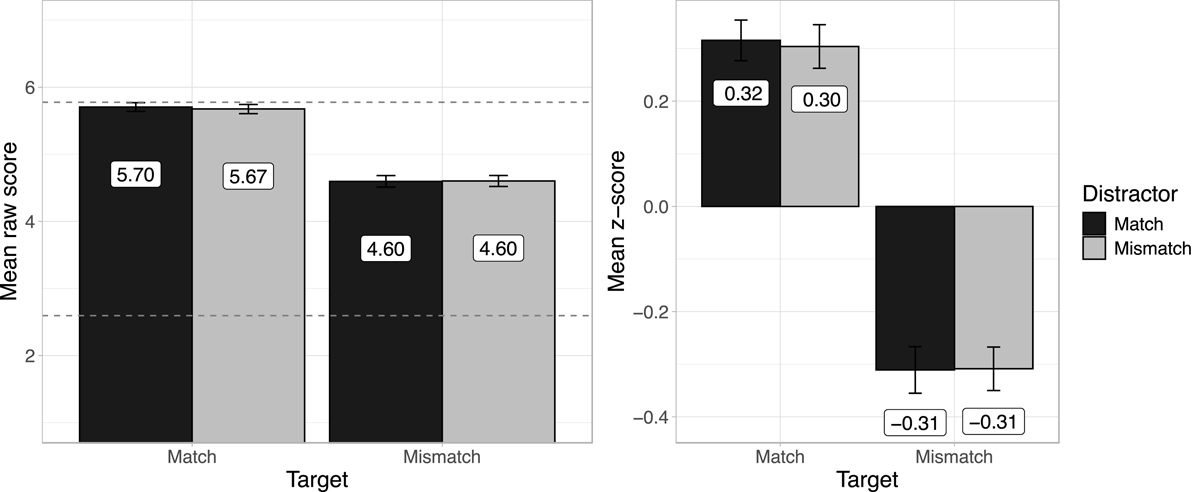
Figure 1: Mean acceptability of target sentences by condition in raw and z-transformed scores in SCO.
Statistical analysis on z-transformed scores, summarized in Table 1, confirms a main effect of Target (p < 0.001). There is no main effect of Distractor: gender congruency between pronouns and distractors does not modulate acceptability ratings. The Target × Distractor interaction is not significant, either. These results, consistent with the findings of Kush et al. (2017), suggest that native English speakers do not consider structurally inaccessible antecedents in their global, post-sentence interpretations.
Table 1: Summary of statistics for z-transformed ratings of target sentences in SCO (*: < 0.05).
| β | SE | t | p | |
| Target | 0.62 | 0.04 | 15.41 | < 0.001* |
| Distractor | 0.004 | 0.04 | 0.12 | 0.90 |
| Target × Distractor | 0.01 | 0.08 | 0.14 | 0.89 |
Model structure: lmer (Score ~ Target * Distractor + (1|Item) + (1|Participant), data)
5.5.2 Reading times
The mean RTs by region and condition are displayed in Figure 2. See Table 2 for statistics. Prior to the critical pronoun region, no effects are significant. At the critical region, we found a main effect of Target (p = 0.03): gender mismatch between the structurally accessible Target and the pronoun leads to reading slowdowns. As mentioned earlier, such gender mismatch effects act as a diagnostic suggesting that participants attempted to retrieve the matrix subject during processing. In contrast, gender mismatch between the structurally inaccessible distractor (e.g., which man) and the pronoun does not significantly impact reading times, as evidenced by the absence of a main effect of Distractor. The Target × Distractor interaction is not significant, either. Thus, at the critical region, we only see an early effect of Target gender mismatch, but no distractor-related gender intrusion effects.
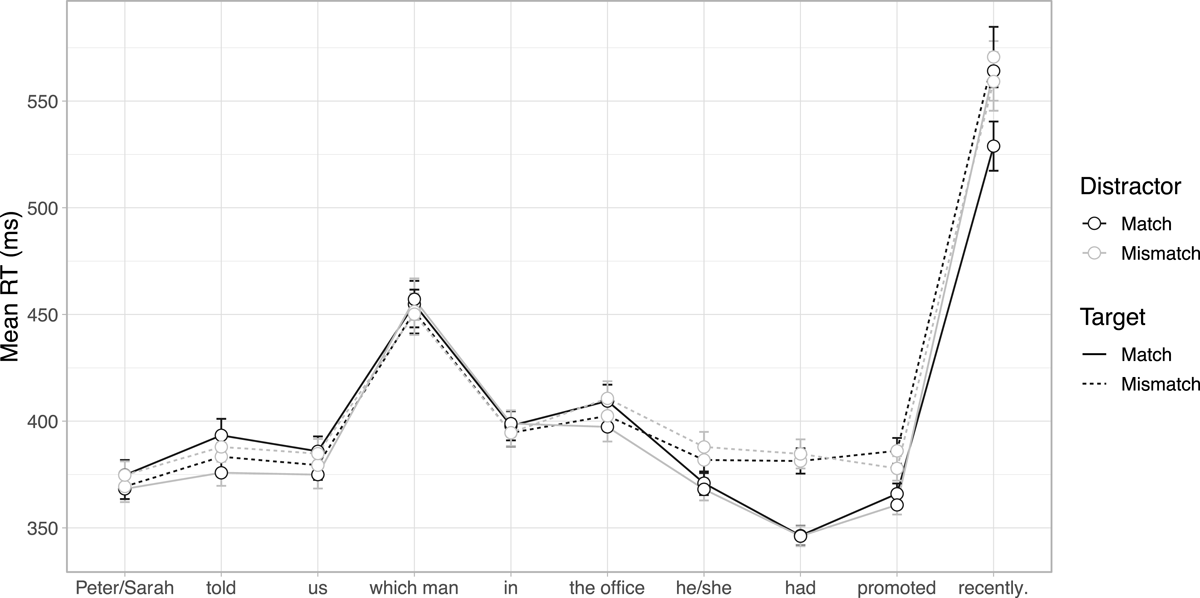
Figure 2: Mean RTs (ms) by region and condition in SCO.
Table 2: Summary of statistics for log-transformed RTs in SCO (*: < 0.05).
| Target | Distractor | Target × Distractor | ||||||||||
| Region | β | SE | t | p | β | SE | t | p | β | SE | t | p |
| Peter/Sarah | –0.01 | 0.01 | –0.85 | 0.39 | 0.003 | 0.01 | 0.26 | 0.79 | 0.02 | 0.02 | 0.63 | 0.53 |
| told | –0.008 | 0.01 | –0.66 | 0.51 | 0.01 | 0.02 | 0.65 | 0.52 | 0.02 | 0.03 | 0.75 | 0.45 |
| us | –0.002 | 0.01 | –0.20 | 0.84 | 0.004 | 0.01 | 0.31 | 0.76 | 0.03 | 0.02 | 1.12 | 0.26 |
| which man | 0.007 | 0.02 | 0.41 | 0.68 | –0.02 | 0.02 | –0.92 | 0.37 | –0.01 | 0.03 | –0.44 | 0.66 |
| in | 0.006 | 0.01 | 0.43 | 0.67 | –0.007 | 0.01 | –0.56 | 0.58 | –0.007 | 0.02 | –0.29 | 0.77 |
| the office | –0.001 | 0.01 | –0.06 | 0.95 | 0.006 | 0.01 | 0.46 | 0.65 | 0.03 | 0.03 | 0.98 | 0.33 |
| he/she | –0.03 | 0.01 | –2.23 | 0.03* | 0.002 | 0.01 | 0.13 | 0.89 | 0.01 | 0.02 | 0.51 | 0.61 |
| had | –0.07 | 0.01 | –6.69 | < 0.001* | 0.005 | 0.01 | 0.44 | 0.66 | –0.003 | 0.02 | –0.13 | 0.90 |
| promoted | –0.03 | 0.01 | –2.61 | 0.009* | 0.01 | 0.01 | 1.15 | 0.25 | –0.007 | 0.02 | –0.34 | 0.74 |
| recently | –0.03 | 0.03 | –1.02 | 0.32 | –0.01 | 0.02 | –0.60 | 0.55 | –0.06 | 0.03 | –1.77 | 0.08 |
Model structures for critical and post-critical regions:
Pronoun region: lmer (logRT ~ Distractor * Target + (1 | Item) + (1 + Target | Subject), data)
1st spillover region: lmer (logRT ~ Distractor * Target + (1 | Item) + (1 | Subject), data)
2nd spillover region: lmer (logRT ~ Distractor * Target + (1 | Item) + (1 + Distractor | Subject), data)
Final region: lmer (logRT ~ Distractor * Target + (1 + Target | Item) + (1 + Target | Subject),
For the spillover regions following the pronoun, we found main effects of Target at the 1st (e.g., had) and 2nd (e.g., promoted) spillover regions (ps < 0.01) but no main effects of Distractor. This strengthens the finding from the critical region: the parser only attends to structurally accessible antecedents at initial stages of processing SCO configurations. We find no main effect of Distractor and no significant Target × Distractor interaction at any region. These findings show that the structural constraints for SCO (crossover constraint + Condition C) strictly guide antecedent retrieval during all processing stages.
5.6 Discussion
Experiment 1 employs self-paced reading and acceptability judgments to probe whether structurally inaccessible distractors influence pronoun resolution in the SCO configuration, where both the crossover constraint and Condition C are violated. To this end, we manipulated gender congruency between the pronoun and the candidate antecedents (target and distractor), in order to observe whether the gender of the distractor impacts the acceptability ratings and reading times.
In the post-reading judgment task, we see no interference from the distractor (the wh-phrase). Only the gender of the structurally accessible target modulates acceptability ratings, as gender mismatch leads to significantly lower acceptance. This suggests that in an SCO configuration, native English speakers do not consider distractors in their offline judgments. This finding replicates the results of Kush et al. (2017), who similarly observed no gender intrusion from the distractor in SCO. We note that our conclusion is restricted to wh-phrases that are thematic arguments and is not intended to generalize to wh-phrases that appear inside arguments (e.g. Which picture of Maryi did she*?i/j like?), where coreference can be marginally acceptable to some speakers (e.g., Adger et al., 2017; Bruening & Al Khalaf, 2019; Salzmann et al., 2023).
In the self-paced reading task, where participants read sentences incrementally, we see similar results as in the acceptability judgment task. Specifically, as soon as the pronoun was encountered, the participants showed reading slowdowns in the Target-mismatch conditions relative to Target-match conditions, constituting evidence that targets were considered for retrieval. The absence of gender effects related to the distractor at any processing stage (early or late) in any form (facilitatory or inhibitory) matches the findings of the acceptability judgment task that the structural constraints involved in the SCO configuration strictly guide pronoun resolution. Thus, the reading time results do not align with the Uniform Multiple Constraints Hypothesis, but instead correspond to the predictions of the Early Filter Hypothesis.
Taken together, Experiment 1 replicates the grammatical intuitions and experimental findings from previous studies regarding the unavailability of bound pronoun readings in SCO configurations (e.g., Kush et al., 2017; Wasow, 1972). Furthermore, it presents reading time data that support the structurally constrained approach (e.g., Chow et al., 2014; Cunnings & Sturt, 2014; Cunnings et al., 2015; Dillon et al., 2013). We now move on to our other research questions: (i) How acceptable are bound pronoun readings in WCO sentences when the wh-operators are D-linked? (ii) Does the crossover constraint apply as an early filter in WCO configurations? To address these questions, we turn to Experiment 2.
6. Experiment 2: Weak crossover
6.1 Participants
Ninety-eight native English speakers over age 18 from the Stony Brook University community participated in exchange for course credit. None had participated in Experiment 1.
6.2 Materials
Experiment 2 adopts a similar design to Experiment 1, fully crossing the factors Target (target match/mismatch) and Distractor (distractor match/mismatch) in a 2 × 2 factorial design. The materials used for Experiment 2 were minimally adapted from those in Experiment 1, with a complex NP as the embedded subject (e.g., his supervisor) to create a week crossover configuration, and the matrix predicate (e.g., wondered) presented as one region without any object to keep the number of regions in Experiments 1 and 2 identical. Four distinct matrix predicates (wondered, was curious, asked, knew) were used and evenly distributed among the 24 target items. See (9) for an example set.
- (10)
- a.
- Target match/Distractor match
- Peter1 wondered2 which man3 in4 the office5 his6 supervisor7 had8 promoted9 recently.10
- b.
- Target match/Distractor mismatch
- Sarah1 wondered2 which man3 in4 the office5 her6 supervisor7 had8 promoted9 recently.10
- c.
- Target mismatch/Distractor match
- Sarah1 wondered2 which man3 in4 the office5 his6 supervisor7 had8 promoted9 recently.10
- d.
- Target mismatch/Distractor mismatch
- Peter1 wondered2 which man3 in4 the office5 her6 supervisor7 had8 promoted9 recently.10
As in Experiment 1, the gender of proper names and pronouns was fully balanced for each condition. The 24 sets of target sentences were mixed with the same 48 fillers from Experiment 1 and randomly distributed to the participants using a Latin Square design.
6.3 Procedure
The procedure for Experiment 2 was identical to Experiment 1.
6.4 Data analysis
The same screening procedure described in Section 5.4 was followed. Participants who did not pay close attention to the experiment task (assigning higher scores to ill-formed fillers than to well-formed fillers, giving identical scores to all sentences, or whose mean RTs were below 100 ms) were removed prior to analysis. This step removed 9 participants, leaving 89 participants for final analysis. In addition, for the analysis of reading times, data points outside the range of 100–4000 ms and 2.5 standard deviations above the mean by region and condition were also removed, which affected 3.44% of the original data. Mixed-effects linear regressions were used for data analyses.
6.5 Results
6.5.1 Acceptability judgments
Figure 3 shows the 89 participants’ mean acceptability of target sentences by condition in raw and z-scores. The acceptability ratings for well-formed and ill-formed fillers (represented by the two dashed lines in the left panel) are 5.87 and 2.86, respectively. See Table 3 for statistics.
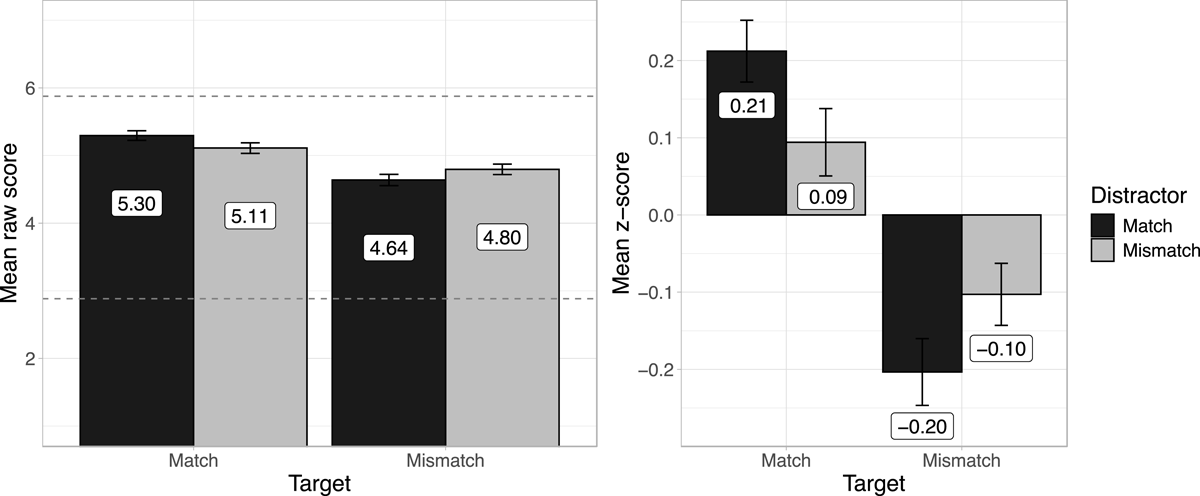
Figure 3: Mean acceptability of target sentences by condition in raw and z-transformed scores in WCO.
Table 3: Summary of statistics on z-transformed ratings of target items in WCO (*: < 0.05).
| β | SE | t | p | |
| Target | 0.31 | 0.04 | 7.58 | < 0.001* |
| Distractor | 0.01 | 0.04 | 0.24 | 0.81 |
| Target × Distractor | 0.22 | 0.08 | 2.73 | 0.006* |
Model structure: lmer (Score ~ Target * Distractor + (1|Item) + (1|Participant), data)
The mixed-effect linear model over z-transformed scores reveals a main effect of Target (p < 0.001), as Target-mismatch conditions were less acceptable than Target-match conditions, which suggests that the participants often treated the target and the pronoun as coreferential. There is no main effect of Distractor, which means that the structurally inaccessible distractor was not consistently considered in post-reading judgments.
However, the Target × Distractor interaction is significant (p = 0.006), demonstrating the influence of the distractor. Despite the modest size of the gender intrusion effects, planned comparisons indicate that, unexpectedly, distractor gender mismatch made the sentence significantly less acceptable within the Target-match conditions (β = 0.12, SE = 0.06, t = 2.11, p = 0.04), whereas distractor gender match marginally lowered the acceptability of the sentence within the Target-mismatch conditions (β = –0.17, SE = 0.09, t = –1.85, p = 0.07) (see similar processing patterns in, e.g., Cunnings & Felser, 2013; Cunnings & Sturt, 2014; Cunnings et al., 2015; Sturt, 2003; and see Engelmann et al., 2019, for discussion of such reversed intrusion effects).
Focusing on the two conditions that speak to our theoretical interest – conditions with gender-matching antecedents in structurally accessible and inaccessible positions (Target-match/Distractor-mismatch in (9b) and Target-mismatch/Distractor-match in (9c)) – we see that violating the crossover constraint incurs a cost (β = –0.68, SE = 0.01, t = –5.82, p < 0.001), even though the wh-phrase is D-linked. This is not predicted by grammar-based D-linking accounts, which rule in bound pronoun readings in WCO (e.g., Falco, 2010; Ishii, 2006).
Thus, unlike the results for the SCO configuration, distractors in the WCO configuration impact the final stages of pronoun resolution. However, we note that the distractors only play a minor role relative to the targets. The primary significance of the main effect of Target, especially given the contrast between (9b) and (9c), crucially suggests that the WCO effect cannot be reduced entirely to processing factors.
6.5.2 Reading times
Figure 4 displays the participants’ mean RTs by region and condition. See Table 4 for statistics. No effect reaches significance prior to the critical pronoun region. At the pronoun (e.g. his/her), a main effect of Target emerges (p = 0.009), as gender mismatch between the target and the pronoun leads to reading slowdowns. By contrast, the gender of the distractor does not significantly modulate RTs. The interaction is not significant, either. This means that upon encountering the pronoun, the parser only retrieves the structurally accessible antecedent. No gender intrusion effects appear at this early stage, which is more in line with the predictions of the Early Filter Hypothesis.
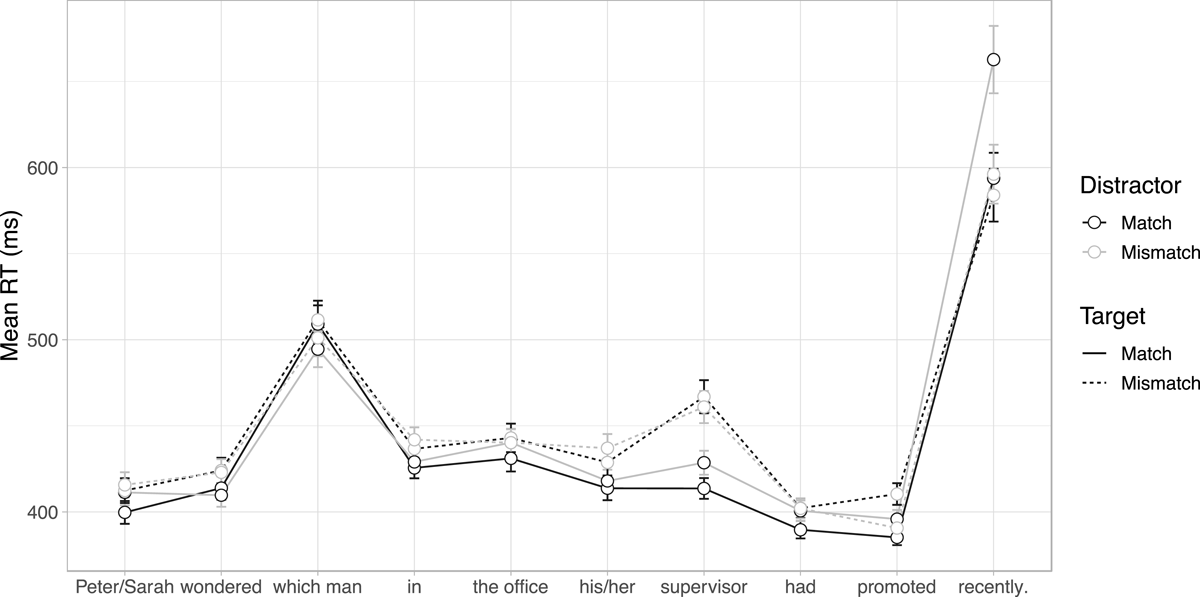
Figure 4: Mean RTs (ms) by region and condition in WCO.
Table 4: Summary of statistics for log-transformed RTs in WCO (*: < 0.05).
| Target | Distractor | Target × Distractor | ||||||||||
| Region | β | SE | t | p | β | SE | t | p | β | SE | t | p |
| Peter/Sarah | –0.02 | 0.01 | –1.32 | 0.19 | –0.01 | 0.01 | –1.24 | 0.21 | –0.01 | 0.02 | –0.43 | 0.67 |
| wondered | –0.01 | 0.01 | –1.22 | 0.22 | 0.01 | 0.01 | 0.89 | 0.37 | 0.004 | 0.02 | 0.17 | 0.87 |
| which man | –0.006 | 0.02 | –0.39 | 0.70 | 0.02 | 0.02 | 1.49 | 0.14 | 0.02 | 0.03 | 0.55 | 0.58 |
| in | –0.01 | 0.01 | –1.21 | 0.23 | –0.006 | 0.01 | –0.55 | 0.58 | –0.0003 | 0.02 | –0.01 | 0.99 |
| the office | –0.009 | 0.01 | –0.74 | 0.46 | –0.006 | 0.01 | –0.48 | 0.63 | –0.01 | 0.03 | –0.43 | 0.67 |
| his/her | –0.03 | 0.01 | –2.61 | 0.009* | –0.01 | 0.01 | –1.26 | 0.21 | –0.003 | 0.02 | –0.12 | 0.91 |
| supervisor | –0.07 | 0.01 | –4.46 | < 0.001* | –0.009 | 0.01 | –0.70 | 0.49 | –0.03 | 0.02 | –1.26 | 0.21 |
| had | –0.02 | 0.01 | –1.69 | 0.09 | -0.006 | 0.01 | –0.59 | 0.56 | –0.02 | 0.02 | –0.89 | 0.38 |
| promoted | –0.02 | 0.01 | –1.54 | 0.13 | 0.01 | 0.01 | 1.10 | 0.27 | –0.05 | 0.02 | –2.37 | 0.02* |
| recently | 0.06 | 0.02 | 3.20 | 0.001* | –0.03 | 0.02 | –1.28 | 0.21 | –0.05 | 0.03 | –1.33 | 0.18 |
Model structures for critical and post-critical regions:
Pronoun region: lmer (logRT ~ Distractor * Target + (1|Item) + (1|Subject), data)
1st spillover region: lmer (logRT ~ Distractor * Target + (1|Item) + (1 + Target|Subject), data)
2nd spillover region: lmer (logRT ~ Distractor * Target + (1|Item) + (1|Subject), data)
3rd spillover region: lmer (logRT ~ Distractor * Target + (1|Item) + (1 + Target|Subject), data)
Final region: lmer (logRT ~ Distractor * Target + (1 + Distractor|Item) + (1 + Distractor|Subject), data)
At the 1st spillover region (e.g., supervisor), we found similar results: only the main effect of Target is significant (p < .001). There is no main effect of Distractor and no significant Target × Distractor interaction. However, visual inspection suggests that within the Target-match conditions, gender-congruent distractors are associated with faster reading times than incongruent ones, at least numerically. However, this numerical trend is not significant. Thus, the gender of the distractor may be accessible to the parser to a slight degree, but only at a later processing stage.
The 2nd spillover region (e.g., had) does not show any significant effect. The 3rd spillover region (e.g., promoted) does not show any main effect, but shows a significant Target × Distractor interaction (p = 0.02). Planned comparisons revealed a gender intrusion effect within the Target-mismatch conditions: distractor gender match leads to longer RTs (β = 0.04, SE = 0.02, t = 2.38, p = .02), indicating processing difficulty. This inhibitory interference effect within the Target-mismatch conditions – contrary to the facilitatory interference effect predicted by the Uniform Multiple Constraints Hypothesis – has been identified in some prior studies (e.g., Chow et al., 2014; Cunnings et al., 2015; Jäger et al., 2015; Sturt, 2003) and has been taken to suggest that “readers sometimes attempted to coerce an interpretation in which the pronoun was linked to a syntactically illicit but gender matching antecedent” (Cunnings et al. 2015, p. 15).
At the final region, there is only a main effect of Target (p = 0.001).6 This main effect is due to overall reading slowdowns in the Target-match conditions, which seems different from the main effects of Target in preceding regions. However, visual inspection suggests that this unexpected reversed main effect of the target is due to a distractor-related gender intrusion effect within the Target-match conditions. Planned comparisons support this observation, indicating that gender-congruent distractors lead to faster RTs than gender-incongruent distractors within the Target-match conditions (β = –0.05, SE = 0.02, t = –2.20, p = .03), but not within the Target-mismatch conditions. This facilitatory interference effect within the Target-match conditions is consistent with the similar pattern discovered at the 1st spillover region.
6.6 Discussion
Experiment 2 on WCO aims to examine whether the gender of a structurally inaccessible but D-linked wh-phrase modulates real-time pronoun resolution. Recall that previous accounts make divergent predictions regarding these two questions. On the grammatical side, prior crossover theories present divergent predictions, including full ungrammaticality (e.g., Koopman & Sportiche, 1983; Reinhart, 1983), partial ungrammaticality (e.g., Wasow & Clausen, 2011), and full acceptability (e.g., Ishii, 2006). On the processing side, the Uniform Multiple Constraints Hypothesis predicts early gender intrusion effects, while the Early Filter Hypothesis predicts no gender intrusion from the structurally inaccessible distractor.
First, consider the results of the post-reading acceptability judgment task, which speak to the theoretical question regarding specificity/D-linking and the crossover constraint. A key finding of our study is that native English speakers are sensitive to the crossover constraint, regardless of the specificity of the wh-phrase. WCO configurations are rated less acceptable when the gender of the target mismatches the gender of the pronoun, which indicates that native speakers attempted to link the pronoun to the target, adhering to the crossover constraint. Comparing sentences like (9b) and (9c) with semantically plausible antecedents in structurally accessible and inaccessible positions, we see that Target-match sentences were judged to be significantly more acceptable than Distractor-match sentences, even though the wh-phrase (distractor) is linearly closer to the pronoun (and therefore less subject to memory decay). We interpret this as evidence that structural accessibility outweighs both specificity and linear distance in offline judgments. While these results do not adjudicate between syntactic and non-syntactic explanations of the crossover constraint and our work does not aim to do so, they pose a challenge for specificity-based accounts that predict full acceptability under D-linking (e.g., Falco, 2010; Ishii, 2006).
That said, unlike our Experiment 1 on SCO, our findings regarding WCO point to the possibility that the distractor is considered at later stages of comprehension, as evidenced by the lower ratings of distractor mismatch within the Target-match conditions.7 On one account, this may stem from some participants considering the distractor to be the binder of the pronoun due to the specific syntactic representations they have constructed (e.g., the wh-phrase first moves to an A-position, in line with Ishii, 2006). On another account, this may be due to processing reasons (e.g., Culicover, 2013; Wasow & Clausen, 2011) as the wh-phrase is linearly closer to the pronoun. We refrain from choosing between these two possibilities and simply note that accounts excluding the role of the crossover constraint cannot adequately explain the main effect of Target. It is plausible that a more explanatorily satisfactory theory would incorporate both syntactic and processing factors, as suggested by Wasow and Clausen (2011).
Next, we turn to the reading times in the self-paced reading task, which pertain to psycholinguistic models. As explained in Section 2, the Uniform Multiple Constraints Hypothesis predicts gender intrusion effects related to the distractor: a facilitatory interference effect in the Target-mismatch conditions and an inhibitory interference effect in the Target-match conditions. While we did observe gender intrusion effects in RTs in Experiment 2, the results are inconsistent with the predictions of the Uniform Multiple Constraints Hypothesis for two reasons. First, gender intrusion only reliably occurs at the final wrap-up region and numerically at the 1st spillover region. Second, the direction of the gender intrusion effects is opposite to the predictions. We observed facilitatory interference in the Target-match conditions and inhibitory interference in the Target-mismatch conditions (see, e.g., Chow et al., 2014; Cunnings et al., 2015; Cunnings & Felser, 2013; Sturt, 2003, for similar findings). Furthermore, the RTs reported in Experiment 2 differ from Kush et al.’s (2017) findings and thus do not align with a weaker version of the Early Filter Hypothesis mentioned previously in Section 2, which posits that the crossover constraint is less weighted during initial processing compared to other structural constraints (e.g., Condition C). This variant version is not supported by our study due to the late emergence of gender intrusion effects. Instead, our findings are more consistent with the standard Early Filter Hypothesis, which views configurational constraints as early filters to pronoun resolution, regardless of the ultimate theoretical source of the constraint. Therefore, regardless of the type of constraint involved, WCO or SCO, our experimental findings suggest that native English speakers only consider structurally accessible referents during initial stages of processing.
7. General discussion
7.1 Summary of results
The two experiments reported in this article aim to achieve two goals. Our primary goal is to examine two competing views of pronoun resolution: while the Uniform Multiple Constraints Hypothesis predicts early gender intrusion effects during pronoun resolution, the Early Filter Hypothesis predicts that structurally inaccessible antecedents should not be considered at early stages of processing. To adjudicate between these views, we examined how gender congruency between pronouns and potential antecedents affects offline acceptability judgments and online processing in SCO and WCO configurations. A secondary goal is to assess the acceptability of bound pronoun readings in WCO configurations, thus contributing to theoretical discussions concerning D-linking and the crossover effect.
In Experiment 1 on SCO configurations, we discovered clear evidence that structurally inaccessible distractors (i.e., wh-phrases) are not considered as antecedents in either incremental processing or in global interpretation. In post-reading acceptability judgments, our participants only showed sensitivity to the gender of the structurally accessible target, since gender mismatch between the pronoun and the target led to lower acceptability ratings. No interference from the distractor was observed. Reading times from self-paced reading yielded similar results: a gender mismatch effect, serving as a diagnostic for detecting binding attempts in processing, emerged immediately at the pronoun when the target mismatched in gender, but no such effect was observed for the distractor at any region. Together, these results replicate previous findings obtained with different experimental designs/paradigms (Felser & Drummer, 2017; Kush et al., 2017) and indicate that pronoun resolution in SCO configurations is strictly constrained by structural principles (Condition C plus the crossover constraint). Experiment 1 therefore establishes a clear baseline against which the processing of WCO configurations in Experiment 2 can be evaluated.
In Experiment 2 on WCO configurations, we found a more nuanced pattern compared to Experiment 1 on SCO. In the acceptability judgment task, participants primarily linked the pronoun to the structurally accessible target, as indicated by higher ratings for Target-match than Target-mismatch conditions. However, unlike in SCO, the distractor also had an (albeit limited) influence: within Target-match conditions, gender mismatch with the distractor led to lower acceptability. This pattern suggests that the crossover constraint is weaker in WCO than in SCO, where it is reinforced by Condition C. Nevertheless, the crossover effect was observed in WCO, even with D-linked wh-phrases, which does not align with accounts predicting full grammaticality for WCO configurations under D-linking (e.g., Falco, 2010; Ishii, 2006).
Pertaining to the evaluation of sentence processing models, the results of the current study are more in line with the Early Filter Hypothesis than the Uniform Multiple Constraints Hypothesis. As explained in previous sections, the latter predicts early gender intrusion, while the former predicts the absence of such intrusion. As we saw in Experiment 2, the gender intrusion effects during incremental processing are absent at the critical pronoun region, which lends support to the Early Filter Hypothesis. Gender intrusion only emerges at later spillover regions, and the direction of the gender intrusion may present further challenge to the Uniform Multiple Constraints Hypothesis, since our finding (i.e., facilitatory interference in the Target-match conditions and inhibitory interference in the Target-mismatch conditions) is the opposite to its predictions. By contrast, delayed gender intrusion effects do not pose a challenge to the structurally-constrained approach because structural constraints can be ‘defeasible’ at later stages (e.g., Sturt, 2003).
To summarize, the findings from the current study suggest that the crossover constraint is arguably not reducible to processing factors alone and that it strictly guides antecedent retrieval at the early processing stages in WCO configurations. Moving forward, we discuss some broader implications of our study for understanding the similarities and differences between the SCO and WCO configurations. Given our priority, we first focus on models of sentence processing and potential alternative explanations for our results, before turning to linguistic discussions.
7.2 The structural primacy effect and the processing of crossover configurations
One major finding of our study is that the crossover constraint applies early in incremental pronoun resolution, albeit being defeasible during later processing stages. In this section, we focus on two patterns that have implications for understanding pronoun resolution: (i) the absence of gender intrusion at the pronoun region and (ii) the contrastive processing profiles of SCO and WCO configurations.
We begin with the absence of gender intrusion at the pronoun region in real-time processing. The overall reading-time patterns observed in our experiments closely mirror those reported in a large body of prior work investigating the accessibility of structurally accessible versus inaccessible antecedents (e.g., Chow et al., 2014; Cunnings & Sturt, 2014; Cunnings et al., 2015; Dillon et al., 2013; Felser et al., 2009; Kush et al., 2015; Sturt, 2003). These studies converge on the conclusion that, at early stages of processing, structural cues are prioritized, or at least heavily weighted, relative to non-structural cues (e.g., Van Dyke & McElree, 2011). This pattern is commonly taken to support a strong interpretation of the Early Filter Hypothesis. Our findings are consistent with this view, suggesting that the crossover constraint, like other configurational constraints, is operative early on and can effectively filter out structurally inaccessible antecedents during the initial stages of pronoun resolution.
At the same time, our results differ from those of Kush et al. (2017), who reported early gender intrusion in WCO configurations. As discussed earlier, one plausible source of this discrepancy lies in differences in structural complexity between the sentence structures tested. In our stimuli, the wh-phrase and the pronoun occur within the same clause, whereas in Kush and colleagues’ study, the pronoun is more embedded in a subordinate clause. It is well established that increased linear and structural distance between dependent elements increases processing demands. Under such conditions, comprehenders may be more likely to misrepresent the syntactic position of the wh-phrase (e.g., as in an A-position) or to establish ungrammatical anaphoric dependencies as a way of alleviating processing load (see, e.g., Chacón, 2019). From this perspective, early gender intrusion effects in more complex structures may reflect processing pressure rather than the early accessibility of non-structural constraints.
Despite the robust structural primacy effect observed in our study, we caution against overgeneralizing our findings to suggest that all structural constraints are invariably prioritized, regardless of the specific competing constraints and the language under consideration. In fact, crosslinguistic evidence suggests that discourse-level factors, such as discourse topicality and logophoric prominence, can influence pronoun resolution during early stages of processing, especially in languages (e.g., Chinese, Korean) and structures (e.g., logophoric contexts) where discourse prominence plays a crucial role (e.g., Han et al., 2015; Jäger et al., 2015; Kaiser et al., 2009; Lyu & Kaiser, 2021, 2024; Sloggett, 2017). Therefore, our conclusions regarding the structural primacy effect during incremental processing are restricted to the specific constraint of crossover in English. We also note that the structural primacy effect should be understood as a relative, rather than an absolute, notion; our results only suggest that the target is retrieved earlier relative to the distractor at the point when the pronoun is encountered. As self-paced reading methods do not provide distinct measures of early-stage versus late-stage processing, further research using eye-tracking methods is needed before stronger conclusions can be drawn.
Next, we turn our attention to the comparison between the processing patterns of SCO and WCO, which speaks to how we understand different approaches to pronoun resolution. Recall that some previous studies found no gender intrusion effects from structurally inaccessible distractors in SCO, but clear evidence of gender intrusion in WCO (Felser & Drummer, 2017; Kush et al., 2017). These results align more closely with a weaker interpretation of the Early Filter Hypothesis which suggests that only certain structural constraints are applied early on and are given precedence over non-structural constraints. As mentioned above, we are open to this nuanced position, particularly when discourse-based constraints are at play, but our findings seem to indicate that the crossover constraint does not fall into the category of “weak” structural constraints. Instead, given similar processing patterns for SCO and WCO at the pronoun region in our study, it appears that the crossover constraint acts as a robust early filter in pronoun resolution.
How, then, do we make sense of the different processing patterns of SCO and WCO at the later stages, and how can our results be reconciled with previous studies that present different findings? We hypothesize that although individual structural constraints may be overridden at later stages, the cumulative effect of multiple constraints can mitigate against distractor interference at later stages. Indeed, other structural constraints examined in isolation indicate similar delayed gender intrusion effects in relation to Condition A (e.g., Cunnings & Sturt, 2014; Sturt, 2003), Condition B (e.g., Cunnings & Sturt, 2018), and even Condition C (e.g., Kazanina et al., 2007), which contrast with our findings for SCO configurations. Viewed from this perspective, the different processing patterns of SCO and WCO are not necessarily related to the differences between the crossover constraint and Condition C, as suggested by Kush et al. (2017), but rather to the number of structural constraints at work. Additionally, pragmatic factors such as discourse plausibility (see more in Section 7.4) may also play a disproportional role in WCO configurations relative to SCO configurations during the later/global stages of processing (e.g., Gor, 2020; Gor & Syrett, 2019).
7.3 Potential alternative explanations for the structural primacy effect
We now consider four alternative explanations for the structural primacy effect observed during the early-stage processing of crossover configurations. While some of these accounts can capture certain aspects of our results, they do not cover the full range of facts; other alternative accounts remain viable in principle, but would require additional empirical support to offer a strong alternative to a structurally constrained account.
The first alternative account relates to the potential preference for coreferential readings. As the target referent in crossover configurations is a referential DP, whereas the distractor is a wh-operator, one potential alternative explanation is that the target advantage reflects a general bias for coreferential over bound variable readings. It is possible that bound variable readings may incur greater processing costs and that this processing burden, instead of the crossover constraint, leads to the absence of gender intrusion by the distractor.
However, this explanation is hard to reconcile with existing psycholinguistic evidence for two reasons. First, when both bound variable and coreferential options are available, native speakers often prefer bound variable readings (e.g., Cunnings et al., 2014; Frazier & Clifton, 2000; Koornneef, 2008; Koornneef et al., 2006, 2011; Puebla & Felser, 2024). This pattern challenges the view that bound variable readings are generally disfavored due to higher processing costs. Second, pronoun resolution is strongly influenced by linear proximity (e.g., Cunnings et al., 2014; Omaki et al., 2019). In our materials, the distractor (wh-phrase) is linearly closer to the pronoun. If structural constraints were not operative at early stages, the bound variable reading should enjoy a clear processing advantage. However, contrary to this prediction, we observed no gender intrusion from the distractor during the initial stages of processing, suggesting that the structural primacy effect is plausibly related to the crossover constraint.
The second alternative invokes the parallel function constraint (e.g., Chambers & Smyth, 1998; Sheldon, 1974; Smyth, 1994): could the preference we observed for the (subject) target stem from a bias toward antecedents that share the same grammatical function as the (subject) pronoun, rather than the operation of the crossover constraint per se? This account seems untenable when applied to WCO sentences. While the parallel function constraint is plausibly relevant for SCO sentences (e.g., Peter wondered which man in the office he…), it is less straightforwardly applicable in WCO sentences, where the pronoun appears as a genitive modifying a subject (e.g., Peter wondered which man in the office his supervisor…). Given the lack of grammatical role parallelism in WCO, it seems that the parallel function constraint alone cannot account for the structural primacy effects observed in the WCO experiment.
A third alternative concerns the potential role of Condition B. A reviewer suggests that comprehenders may underspecify wh-movement during incremental processing and thus may only consider coreferential readings at the point when the pronoun is initially encountered. On this view, Condition B would rule out the most local referent in favor of a non-local one, i.e., the target, thereby producing the observed preference for the target referent without appeal to the crossover constraint. However, this proposal seems inadequate in light of existing psycholinguistic evidence and in terms of its empirical coverage. First, previous work indicates that native speakers do compute wh-movement during online processing, as revealed by evidence for immediate gap positions (e.g., Felser & Roberts, 2007; Gibson & Warren, 2004; Keine, 2020). In light of this, it is reasonable to assume that participants in our study had already constructed a representation of wh-movement when the pronoun was encountered. Second, this account does not extend to our WCO sentences: since Condition B does not rule out coreference between the wh-phrase and the possessive pronoun (as they are not co-arguments), we should observe coreferential effects, contrary to our findings. Given these reasons, we think that Condition B cannot fully account for our findings.
The last alternative account we consider is topicality. The idea is that the target referent, a proper name no less, may be construed as a topic. Since topicality boosts referential accessibility (e.g., Ariel, 1990; Arnold, 2010; Kaiser, 2011), the preference for the target may stem at least partly from a preference for a topical referent. Relatedly, an anonymous reviewer points out that the structural primacy effect observed in SCO may plausibly reduce to Condition C effects, whereas the corresponding effect in WCO could instead arise from discourse-pragmatic factors (e.g., topicality), without requiring an independent crossover constraint. Under such an interpretation, the dispreference for the distractor antecedent in WCO may reflect differences in discourse rather than structural accessibility.
We acknowledge that this alternative interpretation has important implications for how the WCO findings should be understood, and we therefore adopt a more cautious interpretation of the results. At the same time, we note that although the matrix subject can be theoretically analyzed as a discourse topic even in a stand-alone sentence, topicality was not independently established or manipulated in our experimental design. Therefore, whether and to what extent participants actually treated the matrix subject as a discourse topic is unclear (also see Kaiser, 2011, on the dissociation between subjecthood and topicality in English). Thus, while discourse accessibility could potentially account for the crossover effect, we remain cautious about to what extent this account affects our core conclusions regarding the crossover constraint as an early filter.
In sum, although these alternatives may account for parts of our findings, none provide a fully satisfactory account of the early-stage structural primacy effects. We thus conclude that the Early Filter Hypothesis offers a more plausible account of our results, but acknowledge that potential effects of discourse-level factors merit further investigation.
7.4 Implications for theoretical accounts of crossover
For the remainder of our discussion, we focus on the theoretical implications of our findings. In particular, the current study speaks to ongoing debates about the nature of crossover configurations and the role of D-linking in licensing bound variable interpretations.
First, our results provide empirical evidence that challenges claims that D-linking bleeds the crossover constraint (e.g., Falco, 2010; Ishii, 2006). Recall that Ishii (2006) proposes that a D-linked wh-phrase initially moves to an A-position, rendering the crossover constraint vacuous (e.g., Mahajan, 1990; Reinhart, 1983). Under this analysis, a bound variable interpretation of the pronoun in a WCO configuration should be available from the earliest stages of the syntactic derivation. Similarly, Falco’s (2010) feature-matching account, which derives binding via agreement feature correspondence between the wh-operator and the pronominal variable, predicts full availability of bound variable readings in such configurations.
The results of our acceptability judgment study concerning WCO sentences with D-linked wh-phrases indicate that native English speakers prefer coreference with gender-congruent targets over gender-congruent distractors. Crucially, the online reading-time data further indicate that native speakers initially retrieve the target referent and only consider the distractor at later stages, and, even then, to a limited extent. If D-linking were to bleed the crossover constraint from the outset, one would expect the wh-phrase to be immediately accessible during real-time parsing. This prediction is not borne out by our results. Instead, our findings align better with alternative linguistic accounts that (i) predict crossover effects regardless of the referential complexity of wh-operators (e.g., Agüero-Bautista, 2012; Koopman & Sportiche, 1982; Reinhart, 1983; Shan & Barker, 2006) and (ii) attribute the D-linking effect, characterized by the increased acceptability of D-linked wh-phrases relative to bare ones (e.g., Wasow & Clausen, 2011), to non-syntactic factors (e.g., informativity, plausibility, processing).
Our results are more compatible with a “non-reductionist” view that assigns an independent role to the crossover constraint. At the same time, it is worth considering Culicover’s (2013) processing-based account as a potential complementary perspective. Culicover proposes that crossover effects arise from the low accessibility of wh-phrases at the point when the pronoun is encountered, due to their underspecified grammatical function and thematic role. However, this factor does not fully account for the present findings. In particular, the wh-phrases in our materials are highly referential – being D-linked and further modified by a prepositional phrase – which should mitigate accessibility-based limitations. Indeed, WCO configurations with heavily modified wh-phrases have been taken to be fully grammatical (see Culicover, 2013, p. 130). Thus, for Culicover’s account to be reconciled with the early structural primacy effects, a more explicitly articulated model that quantifies the interaction of various processing factors is needed.
We acknowledge a limitation in our study regarding specificity, as noted by an anonymous reviewer. D-linking was not explicitly manipulated in our design, and a bare wh-phrase baseline is unavailable, since bare wh-phrases do not inflect for gender agreement in English. For this reason, our results only constitute indirect evidence against analyses that predict early availability of bound variable readings with D-linked wh-phrases. That said, we note that the predictions of D-linking accounts should remain applicable to the structures tested in our study even in the absence of a non-D-linked comparison condition; such a baseline would only serve to quantify the magnitude of any D-linking effect. Additionally, we also acknowledge that Falco’s account could potentially accommodate the present findings, if the proposed feature-matching mechanism were assumed to operate at a later stage of processing, even though this extension lies beyond the original proposal. Nevertheless, we believe that our findings contribute meaningfully to theoretical discussions by providing experimental evidence on the interaction between D-linking and crossover in both offline judgments and online processing.
Second, this study highlights the similarities, in addition to the differences, between WCO and SCO. While it has been noted since Wasow (1972) that bound variable readings are considerably less acceptable in SCO than in WCO, it remains unclear how we should interpret this difference in acceptability. A common view held by many researchers is that the crossover constraint is violable, and that the stronger crossover effect observed in SCO is due to the (additional) violation of Condition C, which effectively rules out bound pronoun readings (e.g., Bruening & Al Khalaf, 2019; Lasnik & Stowell, 1991). However, our experimental results refine this picture by showing how the crossover constraint operates over time. We find that the crossover constraint influences interpretation in both SCO and WCO configurations, and that the two constructions show similar processing profiles at early stages. In both Experiments 1 and 2, early reading-time measures reveal no gender intrusion effects and only a main effect of the structurally accessible target, suggesting that SCO and WCO are processed similarly during initial pronoun resolution.
Our findings demonstrate that the differences between SCO and WCO only emerge during later stages of processing. In this respect, our study provides preliminary insight into when, rather than merely whether, the two configurations diverge. As for the source of these later-stage differences, prior experimental work suggests that pragmatic factors, such as plausibility, can modulate the strength of Condition C effects (e.g., Gor, 2020; Harris & Bates, 2002; Salzmann et al., 2023). Indeed, plausibility conceivably may have played a more prominent role in SCO. For example, while it is plausible for someone to be affected by the actions of others (e.g., being promoted by one’s supervisor), as in WCO sentences like (9), it is less plausible for someone to perform an action on themselves (e.g., promoting themselves), as in SCO sentences like (8). To closely examine the independent role of Condition C as a structural effect and the extent to which it constrains the bound pronoun readings in SCO, future studies should carefully tease apart the factors of plausibility and Condition C. We regard this as a valuable direction for future research.
8. Conclusion
This study examines whether, how, and when bound pronoun readings are available in crossover configurations. Using acceptability judgment and self-paced reading tasks, we find that pronominal variable readings are excluded from consideration by native English speakers in both strong and weak crossover sentences during early processing stages. This suggests that the structural crossover constraint applies immediately to preclude structurally inaccessible wh-phrases. Only during the later resolution stages is the wh-phrase considered, exclusively in weak crossover constructions. In strong crossover constructions, the structurally inaccessible wh-phrase is disregarded throughout, which we attribute to the presence of an additional structural constraint, namely, Condition C.
Taken together, these findings suggest that the crossover effect cannot be fully reduced to processing limitations. Rather, they support the view that real-time antecedent retrieval in English is tightly constrained by structural information from the earliest stages of comprehension. We note, however, that our conclusions are based on self-paced reading data, which provide relatively coarse-grained temporal resolution. Future research using methodologies with distinct measures for early- versus late-stage processing, such as eye-tracking during reading, will be crucial for shedding more light on our understanding of how structural constraints impact pronoun resolution in real time.
Notes
- A reviewer notes that the SCO effect is often taken to be reduced to a Condition C violation (e.g., Citko, 2001; Lebeaux, 1991) and that the WCO effect may instead reflect discourse-related constraints rather than structural constraints. In this article, we follow Kush et al. (2017) in assuming that both the crossover constraint and Condition C are violated, as they are conceptually distinct, albeit often co-occurring, constraints. Nevertheless, we return to this alternative theoretical perspective in Section 7.3 and discuss how it may bear on the interpretation of the WCO results. [^]
- We note that the WCO effect can be suspended by focus in sentences like Who does his own niece detest? (e.g., Agüero-Bautista, 2012; Postal, 1993). The present study does not involve WCO constructions with focused pronouns. [^]
- What matters for our prediction is the relative timing of structural vs. non-structural constraints. Following prior formulations of the multiple constraints approach, non-structural constraints are expected to cause some degree of early interference effects. However, we acknowledge a reviewer’s insight that alternative implementations of multiple constraints approaches may assign differential weights to structural and non-structural constraints, such that structural information could be prioritized over gender agreement. While such variants are certainly plausible, and have indeed been proposed in prior work (e.g., Kaiser et al., 2009; Parker & Phillips, 2017; Van Dyke & McElree, 2011), we start with the assumption that different cues are weighted similarly for this approach. We view this as a valuable starting point that can be refined in future work. [^]
- Here, we illustrate pronoun resolution under a cue-based retrieval framework to make more precise predictions about reading times, in line with more recent work (e.g., Cunnings et al., 2015; Jäger et al., 2017). As an anonymous reviewer correctly points out, different implementations of the Multiple Constraints Hypothesis (e.g., MacDonald, 1993; MacDonald et al., 1994) might not necessarily align in predictions regarding the direction of the distractor interference effects. Although we agree that the direction of the effects is theoretically important for evaluating particular implementations of the model, our focus is narrower: despite potential differences, the various implementations converge in predicting that distractors should exert some influence during early processing, facilitatory or inhibitory. Therefore, our predictions focus on the presence versus absence of early distractor interference effects, rather than on the direction of the effects. [^]
- This article deals only with crossover configurations involving displaced arguments (e.g., which man) that obligatorily undergo reconstruction (e.g., Huang, 1993), unlike adjuncts (e.g., which picture near John did he like?) (e.g., Lebeaux, 1991). [^]
- We agree with an anonymous reviewer that wrap-up effects should be interpreted with caution due to additional cognitive processes involved. Nonetheless, we have opted to include the final region for statistical analysis, as prior studies have shown that it often reflects meaningful integrative processes such as ambiguity resolution (e.g., Hirotani et al., 2006; Meister et al., 2022; Rayner et al., 2000; Stowe et al., 2018). [^]
- A reviewer also noted an inhibitory effect within the Target-mismatch conditions, where gender-congruent distractors led to slightly lower acceptability. Although this trend was not statistically significant, it may reflect participants initially considering the distractor as a potential antecedent, before retracting the anaphoric dependency (e.g., Kazanina et al., 2007). Alternatively, participants may have attempted to coerce an anaphoric interpretation, resulting in increased processing difficulty. [^]
Data accessibility statement
The data and analyses are available at https://osf.io/k4cvj.
Ethics and consent
Data collection was remote and was in accordance with the 1964 Helsinki Declaration and its later amendments. The study was approved by the Institutional Review Board (IRB) of the authors’ institutions.
Acknowledgements
We thank the anonymous reviewers and the editor for their insightful comments and suggestions, which greatly improved this article. We also thank the audience at the 37th Annual Conference on Human Sentence Processing (HSP) for valuable feedback and suggestions.
Competing interests
The authors have no competing interests to declare.
Authors’ contributions
Jun Lyu: Conceptualization, Data curation, Formal analysis, Investigation: Lead, Methodology, Visualization, Writing – original draft: Lead, Writing – review and editing: Equal.
Jiwon Yun: Investigation: Supporting, Resources, Writing – original draft: Supporting, Writing – review and editing: Equal.
Elsi Kaiser: Investigation: Supporting, Writing – original draft: Supporting, Writing – review and editing: Supporting.
ORCiD IDs
Jun Lyu: 0000-0001-5974-3376
Jiwon Yun: 0000-0002-6516-1898
Elsi Kaiser: 0000-0003-3594-4127
References
Adger, D., Drummond, A., Hall, D., & van Urk, C. (2017). Is there Condition C reconstruction? In A. Lamont & K. Tetzloff (Eds.), Proceedings of the 47th annual meeting of the North East Linguistic Society (vol. 1, 21–30). GLSA.
Agüero-Bautista, C. (2012). Team weak crossover. Linguistic Inquiry, 43(1), 1–41. http://doi.org/10.1162/LING_a_00072
Agüero-Bautista, C. (2014). Weak crossover is not a semantic phenomenon. In L. Crnič & U. Sauerland (Eds.), The art and craft of semantics: A festschrift for Irene Heim, vol. 1 (pp. 31–60). https://semanticsarchive.net/Archive/jZiNmM4N/
Alphonce, C. (1998). A processing account of weak crossover. In L. Chang, E. Currie, & K. Shahin (Eds.), Proceedings of the North West Linguistics Conference 13 (pp. 255–274). University of British Columbia.
Ariel, M. (1990). Accessing noun-phrase antecedents. Routledge.
Arnold, J. E. (2010). How speakers refer: The role of accessibility. Language and Linguistics Compass, 4(4), 187–203. http://doi.org/10.1111/j.1749-818X.2010.00193.x
Badecker, W., & Straub, K. (2002). The processing role of structural constraints on the interpretation of pronouns and anaphors. Journal of Experimental Psychology: Learning, Memory and Cognition, 28(4), 748–769. http://doi.org/10.1037/0278-7393.28.4.748
Barker, C. (2012). Quantificational binding does not require c-command. Linguistic Inquiry, 43(4), 614–633. http://doi.org/10.1162/ling_a_00108
Bates, D., Mächler, M., Bolker, B. M., & Walker, S. C. (2015). Fitting linear mixed-effects models using lme4. Journal of Statistical Software, 67(1), 1–48. http://doi.org/10.18637/jss.v067.i01
Bianchi, V. (2001). Antisymmetry and the leftness condition: Leftness as anti-c-command. Studia Linguistica, 55(1), 1–38. http://doi.org/10.1111.1467-9582.00073
Bresnan, J. (1994). Linear order vs. syntactic rank: Evidence from weak crossover. in K. Beals, J. Denton, B. Knippen, L. Melnar, H. Suzuki, & E. Zeinfeld. (Eds.), Papers from the 13th Regional Meeting of the Chicago Linguistic Society (pp. 57–89). Chicago Linguistic Society.
Bresnan, J. (1998). Morphology competes with syntax: Explaining typological variation in weak crossover effects. In P. Barbosa, D. Fox, P. Hagstrom, M. McGinnis, & D. Pesetsky (Eds.), Is the Best Good Enough? Optimality and Competition in Syntax (pp. 59–92). MIT Press.
Bruening, B., & Al Khalaf, E. (2019). No argument–adjunct asymmetry in reconstruction for Binding Condition C. Journal of Linguistics, 55(2), 247–276. http://doi.org/10.1017/S0022226718000324
Büring, D. (2004). Crossover situations. Natural Language Semantics, 12, 23–62. http://doi.org/10.1023/B:NALS.0000011144.81075.a8
Chacón, D. A. (2019). Minding the gap? Mechanisms underlying resumption in English. Glossa: a journal of general linguistics, 4(1), 68. http://doi.org/10.5334/gjgl.839
Chambers, C. G., & Smyth, R. (1998). Structural parallelism and discourse coherence: A test of Centering Theory. Journal of Memory and Language, 39, 593–608. http://doi.org/10.1006/jmla.1998.2575
Chang, W., Duan, Y., Qian, J., Wu, F., Jiang, X., & Zhou, X. (2020). Gender interference in the processing of Chinese compound reflexive: Evidence from reading eye-tracking. Language, Cognition and Neuroscience, 35(10), 1355–1370. http://doi.org/10.1080/23273798.2020.1781213
Chen, Z., Jäger, L., & Vasishth, S. (2012). How structure-sensitive is the parser? Evidence from Mandarin Chinese. In B. Stolterfoht & S. Featherston (Eds.), Empirical approaches to linguistic theory: Studies in meaning and structure (Studies in Generative Grammar) (pp. 43–62). Mouton de Gruyter.
Chomsky, N. (1976). Conditions on rules of grammar. Linguistic Analysis, 2(4), 303–351.
Chomsky, N. (1981). Lectures on government and binding. Foris.
Chow, W.-Y., Lewis, S., & Phillips, C. (2014). Immediate sensitivity to structural constraints in pronoun resolution. Frontiers in Psychology, 5, 630. http://doi.org/10.3389/fpsyg.2014.00630
Citko, B. (2001). Deletion under identity in relative clauses. Proceedings of North East Linguistic Society, 31(1), Article 10.
Culicover, P. W. (2013). The role of linear order in the computation of referential orders. Lingua, 136, 125–144. http://doi.org/10.1016/j.lingua.2013.07.013
Cunnings, I., & Felser, C. (2013). The role of working memory in the processing of reflexives. Language and Cognitive Processes, 28(1–2), 188–219. http://doi.org/10.1080/01690965.2010.548391
Cunnings, I., Patterson, C., & Felser, C. (2014). Variable binding and coreference in sentence comprehension: Evidence from eye movements. Journal of Memory and Language, 71(1), 39–56. http://doi.org/10.1016/j.jml.2013.10.001
Cunnings, I., Patterson, C., & Felser, C. (2015). Structural constraints on pronoun binding and coreference: Evidence from eye movements during reading. Frontiers in Psychology, 6, 840. http://doi.org/10.3389/fpsyg.2015.00840
Cunnings, I., & Sturt, P. (2014). Coargumenthood and the processing of reflexives. Journal of Memory and Language, 75, 117–139. http://doi.org/10.1016/j.jml.2014.05.006
Cunnings, I., & Sturt, P. (2018). Coargumenthood and the processing of pronouns. Language, Cognition and Neuroscience, 33(10), 1235–1251. http://doi.org/10.1080/23273798.2018.1465188
Dillon, B., Mishler, A., Sloggett, S., & Phillips, C. (2013). Contrasting intrusion profiles for agreement and anaphora: Experimental and modeling evidence. Journal of Memory and Language, 69, 85–103. http://doi.org/10.1016/j.jml.2013.04.003
Drummer, J.-D., & Felser, C. (2018). Cataphoric pronoun resolution in native and non-native sentence comprehension. Journal of Memory and Language, 101, 97–113. http://doi.org/10.1016/j.jml.2018.04.001
Engelmann, F., Jäger, L. A., & Vasishth, S. (2019). The effect of prominence and cue association on retrieval processes: A computational account. Cognitive Science, 43, e12800. http://doi.org/10.1111/cogs.12800
Falco, M. (2010). The licensing of pronominal features in WCO and OPC configurations. University of Pennsylvania Working Papers in Linguistics, 16(1), Article 9.
Felser, C., & Cunnings, I. (2012). Processing reflexives in a second language: The timing of structural and discourse-level constraints. Applied Psycholinguistics, 33(3), 571–603. http://doi.org/10.1017/S0142716411000488
Felser, C., & Drummer, J.-D. (2017). Sensitivity to crossover constraints during native and non-native pronoun resolution. Journal of Psycholinguistic Research, 46(3), 771–789. https://dooi.org/10.1007/s10936-016-9465-8
Felser, C., & Roberts, L. (2007). Processing wh-dependencies in a second language: a cross-modal priming study. Second Language Research, 23(1), 9–36. http://doi.org/10.1177/0267658307071600
Felser, C., Sato, M., & Bertenshaw, N. (2009). The on-line application of binding Principle A in English as a second language. Bilingualism: Language and Cognition, 12(4), 485–502. http://doi.org/10.1017/S1366728909990228
Ferreira, F., & Henderson, J. M. (1990). Use of verb information in syntactic parsing: Evidence from eye movements and word-by-word self-paced reading. Journal of Experimental Psychology: Learning, Memory, and Cognition, 30, 555–568. http://doi.org/10.1037//0278-7393.16.4.555
Ferreira, F., Bailey, K. G. D., & Ferraro, V. (2002). Good-enough representations in language comprehension. Current Directions in Psychological Science, 11(1), 11–15.
Frazier, L., & Clifton, C. (2000). On bound variable interpretations: The LF-only hypothesis. Journal of Psycholinguistic Research, 29(2), 125–139. http://doi.org/10.1023/A:1005136826534
Fujita, H., & Yoshida, M. (2024). Online reflexive resolution and interference. Language, Cognition and Neuroscience, 39(4), 513–526. http://doi.org/10.1080/23273798.2024.2329269
Gibson, T., & Warren, T. (2004). Reading-time evidence for intermediate linguistic structure in long-distance dependencies. Syntax, 7, 55–78. http://doi.org/10.1111/j.1368-0005.2004.00065.x
Gor, V. (2020). Experimental investigations of Principle C at the syntax-pragmatics interface [Unpublished doctoral dissertation]. Rutgers University.
Gor, V., & Syrett, K. (2019). Beyond Principle C: (Not)-at-issueness and plausibility influence acceptability of coconstrual. In E. Ronai, L. Stigliano, & Y. Sun (Eds.), Proceedings of the 54th Annual Meeting of the Chicago Linguistic Society (pp. 109–124). Chicago Linguistic Society.
Grewendorf, G. (1988). Aspekte der deutschen Syntax. Narr.
Haider, H. (1993). Deutsche Syntax-Generativ. Narr.
Han, C., Storoshenko, D. R., Leung, H. M., & Kim, K. (2015). The time course of long-distance anaphor processing in Korean. Korean Linguistics, 17(1), 1–32. http://doi.org/10.1075/kl.17.1.01han
Harris, C. L., & Bates, E. A. (2002). Clausal backgrounding and pronominal reference: A functional approach to c-command. Language and Cognitive Processes, 17(3), 237–269. http://doi.org/10.1080/01690960143000227
Hirotani, M., Frazier, L., & Rayner, K. (2006). Punctuation and intonation effects on clause and sentence wrap-up: Evidence from eye movements. Journal of Memory and Language, 54(3), 425–443. http://doi.org/10.1016/j.jml.2005.12.001
Huang, C.-T. J. (1993). Reconstruction and the structure of VP: Some theoretical consequences. Linguistic Inquiry, 24(1), 103–138.
Ishii, T. (2006). A nonuniform analysis of overt wh-movement. Linguistic Inquiry, 37(1), 155–167. http://doi.org/10.1162/ling.2006.37.1.155
Jäger, L. A., Engelmann, F., & Vasishth, S. (2015). Retrieval interference in reflexive processing: Experimental evidence from Mandarin, and computational modeling. Frontiers in Psychology, 6, 617. http://doi.org/10.3389/fpsyg.2015.00617
Jäger, L. A., Engelmann, F., & Vasishth, S. (2017). Similarity-based interference in sentence comprehension: Literature review and Bayesian meta-analysis. Journal of Memory and Language, 94, 316–339. http://doi.org/10.1016/j.jml.2017.01.004
Kaiser, E. (2011). Focusing on pronouns: Consequences of subjecthood, pronominalisation, and contrastive focus. Language and Cognitive Processes, 26, 1625–1666. http://doi.org/10.1080/01690965.2010.523082
Kaiser, E., Runner, J. T., Sussman, R. S., & Tanenhaus, M. K. (2009). Structural and semantic constraints on the resolution of pronouns and reflexives. Cognition, 112(1), 55–80. http://doi.org/10.1016/j.cognition.2009.03.010
Kazanina, N., Lau, E. F., Lieberman, M., Yoshida, M., & Phillips, C. (2007). The effect of syntactic constraints on the processing of backwards anaphora. Journal of Memory and Language, 56, 384–409. http://doi.org/10.1016/j.jml.2006.09.003
Keine, S. (2020). Locality domains in syntax: Evidence from sentence processing. Syntax, 23(2), 105–151. http://doi.org/10.1111/synt.12195
Koopman, H., & Sportiche, D. (1982). Variables and the bijection principle. The Linguistic Review, 2, 139–160. http://doi.org/10.1515/tlir.1982.2.2.139
Koornneef, A. (2008). Eye-catching anaphora. LOT International Dissertation Series.
Koornneef, A., Avrutin, S., Wijnen, F., & Reuland, E. (2011). Tracking the preference for bound variable dependencies in ambiguous ellipses and only-structures in experiments at the interfaces. In J. Runner (Ed.), Syntax and Semantics, 37 (pp. 67–100). Emerald. http://doi.org/10.1163/9781780523750_004
Koornneef, A., Wijnen, F., & Reuland, E. (2006). Towards a modular approach to anaphora processing. In R. Artstein, & M. Poesio (Eds.), Ambiguity in Anaphora Workshop proceedings (pp. 65–72). ESSLLI.
Kush, D., & Dillon, B. (2021). Principle B constrains the processing of cataphora: Evidence for syntactic and discourse predictions. Journal of Memory and Language, 120. 104254. http://doi.org/10.1016/j.jml.2021.104254
Kush, D., Lidz, J., & Phillips, C. (2015). Relation-sensitive retrieval: Evidence from bound variable pronouns. Journal of Memory and Language, 82, 18–40. http://doi.org/10.1016/j.jml.2015.02.003
Kush, D., Lidz, J., & Phillips, C. (2017). Looking forward and backwards: The real-time processing of strong and weak crossover. Glossa: a journal of general linguistics, 2, 70. http://doi.org/10.5334/gjgl.280
Lasnik, H., & Stowell, T. (1991). Weakest crossover. Linguistic Inquiry, 22(4), 687–720.
Lebeaux, D. (1991). Relative clauses, licensing, and the nature of the derivation. In S. Rothstein (Ed.), Syntax and semantics, vol. 25: Perspectives on phrase structure: Heads and licensing (pp. 209–239). Academic Press.
Lewis, R. L., & Vasishth, S. (2005). An activation-based model on sentence processing as skilled memory retrieval. Cognitive Science, 29, 375–419. http://doi.org/10.1207/s15516709cog0000_25
Lewis, R. L., Vasishth, S., & Van Dyke, J. A. (2006). Computational principles of working memory in sentence comprehension. Trends in Cognitive Science, 10, 447–454. http://doi.org/10.1016/j.tics.2006.08.007
Lyu, J., & Kaiser, E. (2021). Unpacking the blocking effect: syntactic prominence and perspective-taking in antecedent retrieval in Mandarin Chinese. Glossa: a journal of general linguistics, 6(1), 136. http://doi.org/10.16995/glossa.5781
Lyu, J., & Kaiser, E. (2024). Logophoricity and the processing of Chinese reflexives. Journal of East Asian Linguistics, 33, 559–597. http://doi.org/10.1007/s10831-024-09287-9
MacDonald, M. C. (1993). The interaction of lexical and syntactic ambiguity. Journal of Memory and Language, 32, 692–715. http://doi.org/10.1006/jmla.1993.1035
MacDonald, M. C., Pearlmutter, N. C., & Seidenberg, M. S. (1994). Lexical nature of syntactic ambiguity resolution. Psychological Review, 101(4), 676–703. http://doi.org/10.1037/0033-295x.101.4.676
Mahajan, A. (1990). The A/A-bar distinction and movement theory [Unpublished doctoral dissertation]. MIT.
Marsden, H., Thompson, S., & Plonsky, L. (2018). A methodological synthesis of self-paced reading in second language research. Applied Psycholinguistics, 39, 861–904. http://doi.org/10.1017/S0142716418000036
Matuschek, H., Kliegl, R., Vasishth, S., Baayen, H., & Bates, D. (2017). Balancing Type I error and power in linear mixed models. Journal of Memory and Language, 94, 305–315. http://doi.org/10.1016/j.jml.2017.01.001
Meister, C., Pimentel, T., Clark, T. H., Cotterell, R., & Levy, R. (2022). Analyzing wrap-up effects through an information-theoretic lens. Proceedings of the 60th Annual Meeting of the Association for Computational Linguistics (Volume 2: Short Papers).
Omaki, A., Ovans, Z., Yacovone, A., & Dillon, B. (2019). Rebels without a clause: Processing reflexives in fronted wh-predicates. Journal of Memory and Language, 107, 80–94. http://doi.org/10.1016/j.jml.2019.04.003
Parker, D., & Phillips, C. (2017). Reflexive attraction in comprehension is selective. Journal of Memory and Language, 94, 272–290. http://doi.org/10.1016/j.jml.2017.01.002.
Patil, U., Vasishth, S., & Lewis, R. L. (2016). Retrieval interference in syntactic processing: The case of reflexive binding in English. Frontiers in Psychology, 7, 329. http://doi.org/10.3389/fpsyg.2016.00329
Pesetsky, D. (1987). Wh-in-situ: Movement and unselective binding. In E. J. Reuland, & A. G. B. ter Meulen (Eds.), The representation of (in)definiteness (pp. 98–129). MIT Press.
Phillips, C., Wagers, M. W., & Lau, E. F. (2011). Grammatical illusions and selective fallibility in real-time language comprehension. In Runner, J., (Ed.), Experiments at the interfaces. Syntax & Semantics, vol. 37 (pp. 147–180). Emerald Group Publishing Limited.
Postal, P. M. (1971). Cross-over phenomena. Holt, Rinehart and Winston.
Postal, P. M. (1993). Remarks on weak crossover effects. Linguistic Inquiry, 24(3), 539–555.
Puebla, C., & Felser, C. (2024). Discourse-based pronoun resolution in non-native sentence processing. Bilingualism: Language and Cognition, 27, 557–571. http://doi.org/10.1017/S1366728923000676
R Core Team. (2025). R: A language and environment for statistical computing. http://www.R-project.org/
Rayner, K., Kambe, G., & Duffy, S. A. (2000). The effect of clause wrap-up on eye movements during reading. The Quarterly Journal of Experimental Psychology A: Human Experimental Psychology, 53A(4), 1061–1080. http://doi.org/10.1080/02724980050156290
Reinhart, T. (1983). Anaphora and semantic interpretation. Croom Helm.
Runner, J. T., Sussman, R. S., & Tanenhaus, M. K. (2006). Processing reflexives and pronouns in picture noun phrases. Cognitive Science, 30(2), 193–241. http://doi.org/10.1207/s15516709cog0000_58
Ruys, E. G. (2000). Weak crossover as a scope phenomenon. Linguistic Inquiry, 31, 513–539. http://doi.org/10.1162/002438900554424
Safir, K. (1984). Multiple variable binding. Linguistic Inquiry, 15, 603–638.
Safir, K. (2017). Weak crossover. In M. Everaert, & H. van Riemsdijk (Eds.), The Wiley Blackwell Companion to Syntax, vol. 8 (pp. 4939–4978). John Wiley and Sons. http://doi.org/10.1002/9781118358733.wbsyncom090
Salzmann, M., Wierzba, M., & Georgi, D. (2023). Condition C in German A’-movement: Tackling challenges in experimental research on reconstruction. Journal of Linguistics, 59, 577–622. http://doi.org/10.1017/S0022226722000214
Sanford, A., & Sturt, P. (2002). Depth of processing in language comprehension: Not noticing the evidence. Trends in Cognitive Sciences, 6(9), 382–386. http://doi.org/10.1016/S1364-6613(02)01958-7
Shan, C.-C., & Barker, C. (2006). Explaining crossover and superiority as left-to-right evaluation. Linguistics and Philosophy, 29, 91–134. http://doi.org/10.1007/s10988-005-6580-7
Sheldon, A. (1974). The role of parallel function in the acquisition of relative clauses in English. Journal of Verb Learning and Verbal Behavior, 13, 272–281. http://doi.org/10.1016/S0022-5371(74)80064-2
Sloggett, S. (2017). When errors aren’t: How comprehenders selectively violate binding theory [Unpublished doctoral dissertation]. University of Massachusetts, Amherst.
Smyth, R. (1994). Grammatical determinants of ambiguous pronoun resolution. Journal of Psycholinguistic Research, 23(3), 197–229. http://doi.org/10.1016/s0022-5371(74)80064-2
Stowe, L. A., Kaan, E., Sabourin, L., & Taylor, R. C. (2018). The sentence wrap-up dogma. Cognition, 176, 232–247. http://doi.org/10.1016/j.cognition.2018.03.011
Sturt, P. (2003). The time-course of the application of binding constraints in reference resolution. Journal of Memory and Language, 48(3), 542–562. http://doi.org/10.1016/S0749-596X(02)00536-3
Tanenhaus, M. K., Spivey-Knowlton, M. V., Eberhard, K. M., & Sedivy, J. C. (1995). Integration of visual and linguistic information in spoken language comprehension. Science, 268(5217), 1632–1634. http://doi.org/10.1126/science.7777863
Trueswell, J. C., Tanenhaus, M. K., & Kello, C. (1993). Verb-specific constraints in sentence processing: Separating effects of lexical preference from garden-paths. Journal of Experimental Psychology: Learning, Memory, and Cognition, 19, 528–553. http://doi.org/10.1037/0278-7393.19.3.528
Trueswell, J. C., Tanenhaus, M. K., & Garnsey, S. M. (1994). Semantic influences on parsing: Use of thematic role information in syntactic disambiguation. Journal of Memory and Language, 33, 285–318. http://doi.org/10.1006/jmla.1994.1014
Van Dyke, J. A., & McElree, B. (2011). Cue-dependent interference in comprehension. Journal of Memory and Language, 65, 247–263. http://doi.org/10.1016/j.jml.2011.05.002
Wasow, T. (1972). Anaphoric relations in English [Unpublished doctoral dissertation]. MIT.
Wasow, T., & Clausen, D. (2011). Weak cross-over and informativity [Conference presentation]. The 18th International Conference on Head-Driven Phrase Structure Grammar, Aug. 22–25, Seattle, WA.
Wierzba, M., Salzmann, M., & Georgi, D. (2021). An experimental investigation of reconstruction for Condition C in German A’-movement. In A. Aitha, S. Castro, & B. Wilson. (Eds.), Proceedings of the 56th Annual Meeting of the Chicago Linguistic Society (pp. 479–491). Chicago Linguistic Society.
Zehr, J., & Schwarz, F. (2018). PennController for internet based experiments (IBEX). http://doi.org/10.17605/OSF.IO/MD832