


1 Introduction
Events and objects as grammatical elements hold a very particular mapping between syntax and semantics which has emerged as an important area of research in psycholinguistics. Their interaction with the distribution of copulas in languages that present more than one variant has been largely studied within theoretical linguistics.
Spanish grammar alternates between two copulas, ser and estar, both of which translate to ‘to be’ in English. Each of these verbs has a different behaviour and selects different types of grammatical categories in order to form attributive and locative sentences.
In attributive contexts such as (1), ser denotes a permanent or inherent characteristic, suggesting that in (1a) being intelligent is a defining trait or property of Juan. In contrast, estar combines with spatially and temporally bounded attributes and conveys a more temporary or transient state: in (1b) Juan is currently experiencing the condition of being tired.
- (1)
- a.
- Lola es inteligente.
- Lola isSER intelligent
- ‘Lola is intelligent.’
- b.
- Lola está cansada.
- Lola isESTAR tired
- ‘Lola is tired.’
The mapping of permanent versus temporary internal limits of adjective denotation has been associated with the classic distinction between individual-level (i-level) and stage-level (s-level) predicates first established by Carlson (1977). Hence, the choice of copula in Spanish determines a difference in meaning, emphasizing either a lasting characteristic (ser) or a temporary state (estar) (see Kratzer, 1995).
1.1 The copula alternation in locative contexts
In contrast with attributive sentences, locative constructions have not received so much attention in the previous literature (see, nonetheless, Brucart, 2012; Leonetti, 1994; Roldán, 1974). In locative contexts, estar is generally used to locate non-eventive nouns or entities (e.g., the boy, 2a), while ser is used to locate events (e.g., the concert, 2b).
- (2)
- a.
- El niño está en el patio
- The boy isESTAR in the courtyard
- ‘The boy is in the courtyard.’
- b.
- El concierto es en el patio.
- The concert isSER in the courtyard.
- ‘The concert is in the courtyard.’
When the same subject is paired with different copulas, the alternation of copulas implies a change in the meaning. For instance, the example (3a) refers to the event of exiting the building whereas (3b) refers to an object: the exit door or gate itself.
- (3)
- a.
- La salida es por atrás.
- ‘The exit isSER in the back.’
- b.
- La salida está por atrás
- ‘The exit isESTAR in the back.’
- (adapted from Roldán, 1974, p. 73)
In a few restricted cases with movable events (e.g., a demonstration), the alternation of copula implies a change of focus: while ser localizes the event in all its extension (4a), estar focuses on a temporary internal phase of the event (4b):
- (4)
- a.
- La manifestación es en las Ramblas
- The demonstration isSER in the Ramblas
- ‘The demonstration is in the Ramblas’
- b.
- La manifestación está en las Ramblas
- The demonstration isESTAR in the Ramblas
- ‘The demonstration goes down the Ramblas’
- (Brucart, 2012, p. 31)
Previous theoretical studies have posed the question of whether all these combinations and restrictions are encoded in the lexicon (Chierchia, 1995; Kratzer, 1995). Is there a default copula? (or, in other words, is there a copula that is less restrictive?). The behaviour of other types of predicates may shed some light on the lexical status of the copulas. For instance, nouns that express qualities select estar (5) and relational adjectives select ser (6):
- (5)
- ¿Dónde está/*es tu determinación?1
- ‘Where isESTAR/*isSER your determination?’
- (6)
- Esta nueva ley es/*está educativa.
- ‘This new law isSER/*isESTAR educational.’
In a locative context estar seems to be the default copula while in an attributive context, ser is the less restrictive (or more flexible) structure.2 The pattern shown in the previous examples suggests that speakers tend to rely on these copulas for most predicates within their respective domains, which in turn implies that estar and ser function as the default forms in these contexts (locative and attributive, respectively). This implies that the prototypical combinations with these copulas should be lexically encoded in some way. In this paper we assume that certain features in the copula’s lexical entry preselect for certain types of predicates, that is, the copula ser should have a feature indicating that they are normally paired with events and the copula estar a feature that selects object nouns. In contrast, other uses (estar + event nouns or ser + s-level adjectives) suggest that these predicates are more flexible, as they can be combined with the non-prototypical copula3 (see for instance, example 7d below). Nevertheless, as will be discussed below, this process of accommodation may entail an additional cognitive cost (i.e., coercion).
The matter becomes more complex when considering that all the combinations described above can be altered,4 as shown in (7). In the case of ser, it can be used to talk about a temporary situation (e.g., being a waitress) and an object noun (e.g., an exam) can be accommodated to refer to an event (i.e., the situation of taking an exam) (7a). In the case of estar, it can encode a lasting state (e.g., being dead), and an event (e.g., a concert) can be accommodated to refer to an object (i.e., a video tape with the registration of the concert) (7b). Moreover, there are adjectives (7c) and nouns (7d) that are compatible with both copulas:
- (7)
- a.
- Juan es camarero /El examen es en esa clase.
- ‘John isSER a waiter.’ / ‘The exam isSER in that classroom.’
- b.
- Juan está muerto / El concierto está en la cinta
- ‘John isESTAR dead’. / ‘The concert isESTAR in the tape.’
- c.
- Juan es/está tonto.
- ‘John isSER/isESTAR silly.’
- d.
- El café es/está en el hall.
- ‘The coffee isSER/isESTAR in the hall.’
These (and many other) irregularities made some scholars claim that the binary distribution of copulas and types of predicates is insufficient to fully explain the behaviour of the two copulas (see, for instance, Silvagni, 2018). Maienborn (2004) proposed a pragmatic discourse-based account that incorporates discourse-level factors. According to her proposal, estar refers to a particular situation and is used to situate entities in a specific spatial or temporal context introducing information that is more situational or context-dependent within the discourse, while ser can refer to general situations and tends to introduce information that is relevant to the larger, more stable discourse background. Along similar lines, Escandell-Vidal (2018) accounts for the distinction between types of adjectives by appealing to a spatiotemporal anchoring mediated by evidentiality, i.e., by an extralinguistic factor.5 More recently, Fábregas et al. (2023) claimed that the distinction between ser and estar may depend on a differential aspectual configuration (specifically, estar has a dynamic feature encoded in its lexical entry that ser lacks).
Although there are some questions far from resolved (such as why some predicates accept the non-prototypical combinations but others do not, e.g., Juan es/está tonto ‘Juan isSER/isESTAR stupid’ vs. Juan es/*está fiel6 ‘Juan isSER/*isESTAR faithful’), the examples in (7) can be explained applying the concept of coercion (first used by Moens & Steedman 1988). Coercion is a corrective mechanism that is applied when a structure violates any lexical-semantic restriction (i.e., it is used to resolve mismatches at interface level): for instance, in (7c) tonto is a i-level adjective (hence, usually combined with ser); however, when combined with estar it is reinterpreted (or coerced) as a s-level predicate.7 Thus, coercion allows combinations that, initially, should not be possible (according to the restrictions encoded in the lexical entry) and makes their interpretation plausible. This mechanism has implications, firstly, in terms of interpretation (the sentences of 7c do not mean the same for a native Spanish speaker) and, secondly, in terms of processing (a cognitive load is expected when processing a sentence that undergoes coercion). All of the above shows that it is difficult to fully grasp the distinction between ser and estar and to account for all its possible combinations and restrictions. From a theoretical perspective, copulas provide an ideal ground to explore interface phenomena, as their interpretation involves not only syntax but also lexical-semantic processes. From an experimental point of view, it is interesting to consider how comprehenders actually deal with all these elements in online processing. In what follows, we review previous experimental research on locative copulas, which constitutes the primary focus of this paper.
1.2 Previous research
Earlier experimental research in Spanish on the distribution of copulas explored the division of labor of both copulas in children and second language learners of Spanish using a variety of techniques: cloze task (Sera, 1992), acceptability judgement task (Pérez-Leroux et al., 2010), picture matching task and elicited production task (Perpiñán et al., 2020; Perpiñán and Marín, 2021). These studies show that intermediate and advanced learners of Spanish correctly use estar for object locations, but the distinctive use of the two copulas to locate events proved more difficult, even for advanced learners who performed at native level.
The general observation is that there is an overproduction of estar for both children and second language learners, while ser seems to be more restrictive in its combinatorial possibilities, exclusively accepting events across the board. These results are relevant as they reveal how the differences between both copulas emerge early in the developmental stages of first language (L1) acquisition in children and in the patterns of second language (L2) learning.
This asymmetry observed between ser and estar extends to adult native speakers of Spanish. Sera (1992) reported that estar is consistently used to describe the location of objects 100% of the time, while ser is used to locate events with slightly less consistency, at 81% of the time. More recently, Álvarez-García and López-Cortés (In press) tested in a series of experiments the combination of the two copulas with i-level and s-level adjectives on one side, and with event nouns and object nouns on the other side. These authors found that certain combinations deemed incompatible or ungrammatical a priori (i.e., s-level adjectives + ser or events + estar) had a high level of acceptability, while other combinations (i.e., i-level adjectives + estar or objects + ser) were less accepted, which was interpreted as an indicator of difficulty to reinterpret (or in other words, coerce). The authors argued that some combinations could be easily reinterpreted because their representation in the lexicon (i.e., their semantic features) may be different, that is, in the case of i-level adjectives and objects some combinatorial restrictions originate from the lexicon.
There are just two online studies in this literature, and both employed event-related brain potentials (ERPs) to study this phenomenon with native speakers (Leone-Fernández et al., 2012) and second language learners (Dussias et al., 2014). Leone-Fernández et al. (2012) combined grammaticality judgments and ERPs to examine responses when native speakers of Spanish read compatible and incompatible combinations of object and event subjects followed by one of the Spanish copulas and a locative predicate such as in example (5)8:
- (8)
- a.
- La silla está/*es en la cocina.
- The chair is ESTAR/SER in the kitchen.
- b.
- La fiesta *está/es en la cocina.9
- The party is ESTAR/SER in the kitchen.
In line with the previous literature, grammaticality judgments showed that participants rated as completely acceptable sentences with objects followed by estar and events followed by ser, and as not acceptable sentences with objects followed by ser, but the combination of events with estar was considered only marginally ungrammatical. Crucially, this contrast was mirrored by the different ERPs signatures yielded on the different subject-copula combinations. The combination of objects with ser yielded a larger P600 when compared to events, which was interpreted as evidence of repair processes that arise when there is an irreconcilable mismatch between syntactic and semantic information. The combination of events with estar in comparison to objects yielded more positive amplitudes centrally distributed between 280 and 380 ms at the beginning of the locative (i.e., following the presentation of the en preposition), which was interpreted as a P3-related component (a component that quickly detects when a word or phrase deviates from expectations). At the postcritical region (i.e., the determiner which followed the preposition en) another positive-going wave was registered between 400 and 700 ms at frontal sites, which may reflect repair or reanalysis operations.
The two different ERP signatures have been interpreted to signal different processes involved in the parsing of the different combinations. In the case of objects with ser, the P600 may indicate the impossibility of repair, so the object cannot be accommodated to fit the restrictions imposed by ser. The picture in the case of events with estar is different. There is an initial detection of an anomaly marked by the P3-component followed by a repair process (here is where coercion may take place). The authors concluded that different types of information (syntactic, semantic, and pragmatic) are relevant to parse these combinations, although syntax has a prominent role.
Dussias et al. (2014) partially replicated these results with native speakers and second language learners of Spanish. For both native speakers and advanced learners, the mismatching combination of objects with ser showed a larger P600 (compared to the condition with events and ser) in central and posterior regions after the presentation of the preposition ‘en’, replicating the findings reported in Leone-Fernández et al. (2012). However, for the mismatching combination of events with estar, the authors observed a centrally distributed negative-going wave between 500 and 700 ms (compared to the condition with objects and estar) after the presentation of the preposition ‘en’, although the effect was only marginal in both the native and the advanced groups. It is important to highlight that Dussias et al. (2014) and Leone-Fernández et al. (2012), like most studies on locative copulas, examined canonical sentence structures in which the subject introduces an eventive or non eventive noun before the copula, followed by a prepositional phrase as illustrated in example (8). In both ERP studies, the preposition “en”, which marks the onset of the prepositional phrase, was designated as the critical region. However, this design may present challenges, as en can also introduce structures beyond locative constructions. Taking as an example the sentence in sentence (3a), en might introduce an adjectival phrase describing the subject’s state, e.g., La silla está en muy mal estado (The chair is in poor condition). This point is important because the experimental design employed in our study was specifically intended to avoid this potential confound.
The sum of these studies seems to indicate that the different properties of subject-copula combinations constrain the selection of the copula asymmetrically, and this asymmetry is captured by behavioral and EEG studies. An important unresolved question is at what point during sentence processing the verb-based restriction on the eventiveness of the noun comes into play.
1.3 Aims and Predictions of the present study
The primary goal of this study is to explore the timing in which native speakers of Spanish extract and deploy the grammatical restrictions imposed by locative structures with ser and estar. With that aim, we constructed locative sentences with event nouns (i.e., nouns that have an internal duration and are anchored in time and place, e.g., la conferencia/ the conference) and non-event-nouns or object nouns (i.e., objects or individuals that do not have inherent aspectual properties, e.g., la caja/ the box) in sentences with an embedded locative wh-question clause (e.g., Eva sabe dónde es la conferencia/ Eva knows where the conference is). Previous studies employed canonical sentences where the event or object noun was followed by the copula (e.g., El libro está en la estantería/ The book is in the shelf). The main advantage and novelty of the type of sentences we test here is that the where-question clause introduces the locative construction in a way that the eventiveness of the upcoming noun follows the parsing of the copula. This way, our design allows to measure the costs of integration of the non-expected event or object noun that follow the copula.
In the case of event nouns, if the parsing of ser in a locative sentence selectively triggers the activation of an event, the integration of an event noun would be significantly faster in sentences with ser in comparison to sentences with estar. In the case of object nouns, if the parsing of estar in a locative sentence selectively triggers the activation of an object noun, we expect faster times when non-eventive nouns are preceded by estar in comparison to ser.
We present the results of a self-paced reading study and an eye-tracking while reading experiment. The two different methodologies measure complementary aspects of sentence processing. While the self-paced reading task captures reading times at a coarse level, focusing on sequential processing, the eye-tracking technique provides fine-grained temporal data, including measures of early and late processing stages and regressions to earlier parts of the sentence, and focuses on more natural reading processes. With this comparison across methodologies, we aim to replicate the observed effects and strengthen the robustness and generalizability of our findings.
2 Experiment 1
2.1 Method
2.1.1 Participants
Fifty-one undergraduate students (M age = 20.3, SD = 2.0, 39 females) participated in the study for course credit. All participants were Peninsular Spanish native speakers with normal or corrected-to-normal vision. All participants gave informed consent before taking part in the study. The study was approved by the Ethics Committee of the Universitat Rovira i Virgili (CEIPSA-2021-PR-0024).
2.1.2 Materials
Forty experimental items were built in four conditions following a 2*2 design crossing type of noun (object vs. event) and copula (ser vs. estar) in a latin square design resulting in four presentation lists. Each list contained 160 sentences: 40 experimental and 120 filler sentences. Table 1 presents an example of an experimental item across the four conditions. Condition ‘a’ and condition ‘d’ are not semantically felicitous. As mentioned before, in some cases, especially in condition d, the reader may accommodate the semantics of events to fit the requirements of the copular form. We tried to avoid a possible coercive interpretation in the final list of materials by selecting the sentences accordingly.10
Table 1: The four conditions of the experiment with examples.
| Condition | Copula | Noun | Example |
| a | ser | object | * Ana averiguó dónde es el estadio de fútbol. Ana found out where isSER the soccer stadium Ana found out where the soccer stadium is. |
| b | estar | object | Ana averiguó dónde está el estadio de fútbol. Ana found out where isESTAR the soccer stadium Ana found out where the soccer stadium isESTAR. |
| c | ser | event | Ana averiguó dónde es el partido de fútbol. Ana found out where isSER the soccer game Ana found out where the soccer game isSER. |
| d | estar | event | * Ana averiguó dónde está el partido de fútbol. Ana found out where isESTAR the soccer game Ana found out where the soccer game isESTAR. |
2.1.3 Procedure
The self-paced reading task was implemented using the DMDX software package (Forster & Forster, 2003) on desktop PCs. The experiment started with a short practice of 6 sentences for participants to become familiar with the task, followed by the experimental session. Sentences were presented individually, centered on the screen in a single line in a word-by-word, noncumulative, self-paced moving window (Just et al., 1982). Each word in the sentence was initially covered up with dashes, with each letter replaced by a single dash. Participants pressed the spacebar to reveal one word at a time, which simultaneously re-covered up the previous word with dashes. Target and filler items were interspersed, and their presentation was fully randomized. Eighty filler items were followed by a comprehension question. Participants answered the questions using the keyboard: pressing the left shift key for “no” and the right shift key for “yes.” The correct answer for half of the items was “yes”, and for the other half was “no”. Participants were instructed to respond as quickly and accurately as possible, and no feedback was provided. When the question disappeared, the next sentence was presented. Reading times and accuracy rates were recorded. Reading times were recorded in milliseconds for each word, measured from the moment it appeared on the screen until the spacebar was pressed. Participants were randomly assigned in equal numbers to one of the four presentation lists. The experiment lasted around 30 minutes.
2.1.4 Data analysis
Accuracy rates were analysed to ensure participants’ attention to the task. All participants achieved scores above 80% on the comprehension questions, and thus, no participants were excluded. The overall mean accuracy was 92.57%.
Analyses were conducted separately in the critical and the postcritical regions using mixed-effects models with crossed random effects for subjects and items (Baayen et al., 2008). The critical region comprised an event or an object noun. The post-critical region +1 and the post-critical region +2 contained the two words following the critical region, typically consisting in a preposition and a noun. The procedure was the same for all the analyses. Reading times were log-transformed to minimise skewness (Vasishth & Nicenboim, 2016). Models included sum coded (–0.5, 0.5) fixed main effects of Copula (estar vs ser), Type of noun (event vs object), and their interaction. Random intercepts for participant and item were included, with random slopes specified for Copula and Type of noun. Linear mixed-effects models were fitted using buildmer (Voeten, 2023) in the statistical software R (v. 4.3.0). Buildmer uses lmer from the lme4 package (Bates et al., 2015) and allows for a systematic and replicable way of simplifying random effects structures and testing fixed effects. Buildmer starts by attempting to fit the maximal model; if it fails to converge, buildmer simplifies the random effects structure via backwards stepwise elimination. Once the maximally converging model has been identified, buildmer calculates the p-values for all fixed effects based on Satterthwaite denominator degrees of freedom using the lmerTest package (Kuznetsova et al., 2020). We followed current best practices for automatic and reproducible statistical outlier detection (Thériault et al., 2024). After identifying the maximally converging model, outliers were identified using the check outliers’ function from the performance package (Lüdecke et al., 2023). This function uses a composite outlier score that applies multiple multivariate distance metrics. No outlier was detected following this procedure.
Planned pairwise post-hoc comparisons (with Bonferroni correction) were performed using the emmeans package (Lenth, 2022).
2.2 Results
Table 2 provides the full output of the statistical models, and a visual plot of how readers progressed through the sentences is presented in Figure 1. The mean reading times for the different sentence regions can be found in this OSF project.
Table 2: Experiment 1. Summary of linear mixed effects models (LMEM) fitted on log-transformed reading times at the critical word and the two words following it.
| Estimate | SE | t-value | Slope | p-value | |
| Regions | |||||
| Critical | |||||
| Type | 0.011 | 0.012 | 0.925 | .355 | |
| Copula | –0.003 | 0.012 | –0.227 | .820 | |
| Type * Copula | 0.119 | 0.025 | 4.622 | <.001 | |
| Critical+1 | |||||
| Type | –0.005 | 0.018 | –0.274 | (i) | .785 |
| Copula | 0.000 | 0.012 | 0.032 | .974 | |
| Type * Copula | 0.096 | 0.024 | 3.906 | <.001 | |
| Critical+2 | |||||
| Type | 0.006 | 0.035 | 0.191 | (i) | .850 |
| Copula | 0.000 | 0.016 | 0.054 | .954 | |
| Type * Copula | 0.134 | 0.033 | 4.019 | <.001 |
-
Notes: Estimates, standard errors, t-values and p-values are reported for the main effects of Type and Copula, as well as for the interaction of these two factors in each region. For the factor Type, a positive coefficient reflects a slowdown in sentences with object nouns. For the factor Copula, a positive coefficient reflects a slowdown for sentences with ser. The “Slope” column indicates whether the model included the corresponding predictor as a random slope for participants (p), items (i) or both (p, i). Effects are bolded if they were significant at an alpha level adjusted for multiple comparisons (.007).
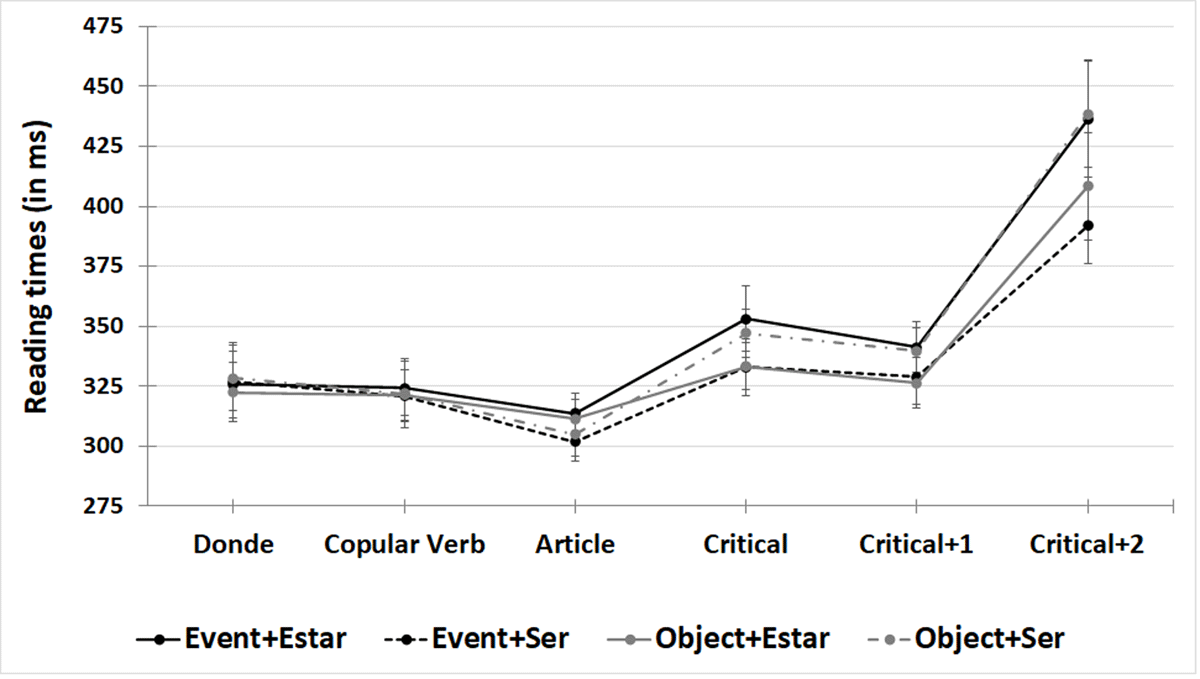
Figure 1: Empirical reading times of the three regions before and two regions after the critical region. The points show condition means and error bars show 95% confidence intervals calculated for each condition across participants and items. The x-axis shows the different sentence regions, starting from the third sentence region. Sample sentence: María olvidó dónde es la competición de atletismo/ Maria forgot where the athletics competition is).
Critical word: The analyses revealed that the main effects of Type of noun and Copula were not significant. The analyses revealed a statistically significant interaction between Type of noun and Copula. Planned comparisons in the condition with event nouns showed shorter reading times when preceded by ser (332 ms) in comparison to estar (353 ms) (β = 0.06, SE = 0.02, t = –3.42, p < .001). In the condition with object nouns, shorter reading times were observed when preceded by estar (333 ms) in comparison to ser (347 ms) (β = 0.06, SE = 0.02, t = 3.11, p = .002).
Critical +1: The analysis revealed that the main effects of Type of noun and Copula were not significant. The results showed again a significant interaction between type of noun and copula. Planned comparisons revealed a significant difference between the conditions with ser and estar in the subset with event nouns (β = –0.048, SE = 0.02, t = –2.742, p = .006) and in the subset with object nouns (β = 0.049, SE = 0.02, t = 2.783, p = .005). Mean reading times on events were shorter when preceded by ser (328 ms) in comparison to estar (341 ms). Contrarily, mean reading times on objects were shorter when preceded by estar (326 ms) in comparison to ser (339 ms).
Critical +2: The analysis revealed that the main effects of Type of noun and Copula were not significant. Again, the results show a significant interaction between type of noun and copula. Planned comparisons revealed a significant difference between the conditions with ser and estar in the subset with event nouns (β = –0.066, SE = 0.02, t = –2.803, p = .005) and in the subset with object nouns (β = 0.067, SE = 0.02, t = 2.879, p = .004). The pattern of reading times mirrors the pattern observed in the two previous regions, that is, reading times on events were shorter when preceded by ser (392 ms) in comparison to estar (436 ms), while reading times on objects were shorter when preceded by estar (408 ms) in comparison to ser (438 ms).
Across regions, the combination of ser + object led to increased reading times in comparison to estar + object, and the opposite was true to event nouns, that is, the combination of estar + event led to increased reading times in comparison to ser + event.
To ensure that reading times for the critical word were not influenced by spillover effects from prior regions, analyses of the three preceding regions were included in the Supplemental Materials. No significant effects were observed in the ‘dónde’ or ‘copular verb’ regions. However, a main effect of copula (i.e., longer reading times for sentences with estar as compared to sentences with ser) was found in the ‘article’ region, which we attribute to a length effect spilling over from the preceding copular region, as the form of estar used throughout the materials was longer than the ser form (i.e., está vs. es). Please refer to the complete statistical analyses in this OSF project.
2.3 Discussion
The results of the self-paced reading study show that the selective restrictions of Spanish copulas have an immediate impact on the integration of the postverbal noun. As expected, events were read faster after ser in comparison to estar, and the contrary applies to objects, that is, faster reading times were observed after estar in comparison to ser. The same pattern was observed in the critical and two postcritical regions. Both copulas seem to restrict the eventive properties of the type of noun they take as arguments. A possible explanation is that eventive lexical features of the incoming noun are activated, during or immediately following the processing of the copula.
The following study presents an eye-tracking experiment aimed at identifying the earliest point at which the restriction on eventiveness has an effect.
3 Experiment 2
3.1 Method
3.1.1 Participants
Forty-six undergraduate students (M age = 19.4, SD = 1.8, 40 females) participated in the study for course credit. None of them participated previously in the self-paced reading experiment described above. All participants were Peninsular Spanish native speakers, had normal or corrected-to-normal vision and gave informed consent before taking part in the study. The study was approved by the Ethics Committee of the Universitat Rovira i Virgili (CEIPSA-2021-PR-0024).
3.1.2 Materials
The materials of this study were the same as in Experiment 1, including both filler and target items.
3.1.3 Procedure
Participants were tested individually in a sound-attenuated room. An EyeLink 1000 eye tracker (SR Research) was used to record eye movements while participants read sentences. Sentences were presented in one line on a 24-inch computer screen in a monospaced font (Inconsolata) of size 24. The monitor resolution was 1920×1080. Participants were seated 98 cm away from the monitor such that 3.8 characters were within one degree of visual angle. Viewing was binocular but only the right eye was recorded. Before the experiment began, participants first read and signed an informed consent form, then read the instructions and completed a short practice of 6 sentences to become familiar with the procedure. Calibration was performed before and halfway through the experiment after a short break. The experiment lasted around 30 minutes.
3.1.4 Data analysis
Accuracy rates on filler items were analysed to ensure participants’ attention to the task. All participants achieved scores above 80% on the comprehension questions, and thus, no participants were excluded. The overall mean accuracy was 91% (sd = 0.04). Trials with track loss or data collection error were not included in the analyses. Before the analyses, and as it is common practise in eye-tracking while reading studies (e.g., Featherstone & Sturt, 2010; Kwon & Sturt, 2016), fixations of less than 80 ms were incorporated into larger fixations within one character, and then any remaining fixations of less than 80 ms were deleted. Fixations longer than 1200 ms were also removed prior to analysis.
Three eye-tracking measures were computed in the precritical, critical and postcritical regions. The precritical region encompasses the data from the two words preceding the critical word (dónde +copula).11 The critical word contains the event or object noun. The postcritical region encompasses the data from the words following the critical word to the end of the sentence, consisting in two or three words.
Gaze duration is the sum of fixation duration before the eyes leave that area, either to the left or to the right. Go-past time is the sum of all fixations in a region from the initial fixation entering the region until moving to the right of the region (including any fixation to the left of the region as a result of regressive eye movements). Total reading time is the sum of all fixations, first, second and further passes included.
Data were analysed following the same procedure as in Experiment 1. No outlier was detected following this procedure.
3.2 Results
Precritical region: The inferential analyses revealed a main effect of Copula in gaze duration and go-past time, whereby reading times in the copula ser are shorter in comparison to estar in both cases. The main effect of Type of noun was not significant. The full output of the statistical models is presented in Table 3.
Table 3: Experiment 2. Summary of linear mixed effects models (LMEM) fitted on log-transformed reading times at the dónde+copula region.
| Estimate | SE | t-value | Slope | p-value | |
| Gaze Duration | |||||
| Type | 0.015 | 0.020 | 0.738 | .461 | |
| Copula | –0.258 | 0.020 | –12.465 | <.001 | |
| Type * Copula | 0.022 | 0.041 | 0.540 | .589 | |
| Go-past time | |||||
| Type | 0.029 | 0.023 | 1.229 | .219 | |
| Copula | –0.262 | 0.023 | –11.000 | <.001 | |
| Type * Copula | 0.007 | 0.047 | 0.167 | .868 | |
| Total Time | |||||
| Type | –0.002 | 0.021 | –0.100 | .920 | |
| Copula | –0.030 | 0.027 | –1.101 | (p) | .277 |
| Type * Copula | 0.286 | 0.043 | 6.567 | <.001 |
-
Notes: Estimates, standard errors, t-values and p-values are reported for the main effects of Type and Copula, as well as for the interaction of these two factors in each region. For the factor Type, a positive coefficient reflects a slowdown in sentences with object nouns. For the factor Copula, a positive coefficient reflects a slowdown for sentences with “ser”. The “Slope” column indicates whether the model included the corresponding predictor as a random slope for participants (p), items (i) or both (p, i). Effects are bolded if they were significant at an alpha level adjusted for multiple comparisons (.005).
There is also an interaction between Type and Copula in total time, explained by shorter reading times when an event is preceded by ser (540 ms) in comparison to estar (655 ms) (β = –0.174, SE = 0.035, t = –4.953, p <.0001), and shorter reading times when an object is preceded by estar (532 ms) in comparison to ser (640 ms) (β = 0.113, SE = 0.035, t = 3.232, p = 0.002).
Critical region: The analyses revealed that the main effects of Type of noun and Copula were not significant in any of the three eye-tracking measures. The analyses revealed a statistically significant interaction between Type of noun and Copula starting in gaze duration, followed by go-past time, and total time. The full output of the statistical models is presented in Table 4.
Table 4: Experiment 2. Summary of linear mixed effects models (LMEM) fitted on log-transformed reading times at the critical region.
| Estimate | SE | t-value | Slope | p-value | |
| Gaze Duration | |||||
| Type | –0.017 | 0.042 | –0.415 | (i) | .680 |
| Copula | –0.002 | 0.018 | –0.156 | .876 | |
| Type * Copula | 0.150 | 0.037 | 4.003 | <.001 | |
| Go-past time | |||||
| Type | –0.090 | 0.054 | –1.671 | (i) | .103 |
| Copula | 0.040 | 0.025 | 1.568 | .117 | |
| Type * Copula | 0.300 | 0.051 | 5.872 | <.001 | |
| Total Time | |||||
| Type | –0.068 | 0.054 | –1.261 | (i) | .215 |
| Copula | 0.022 | 0.024 | 0.912 | .362 | |
| Type * Copula | 0.221 | 0.048 | 4.548 | <.001 |
-
Notes: Estimates, standard errors, t-values and p-values are reported for the main effects of Type and Copula, as well as for the interaction of these two factors in each region. For the factor Type, a positive coefficient reflects a slowdown in sentences with object nouns. For the factor Copula, a positive coefficient reflects a slowdown for sentences with ser. The “Slope” column indicates whether the model included the corresponding predictor as a random slope for participants (p), items (i) or both (p, i). Effects are bolded if they were significant at an alpha level adjusted for multiple comparisons (.005).
Gaze duration: Planned comparisons showed shorter fixations when an event noun was preceded by ser (290 ms) in comparison to estar (323 ms) (β = –0.08, SE = 0.03, t = –2.96, p = .003), while for objects, gaze duration was shorter when the object noun was preceded by estar (282 ms) in comparison to ser (315 ms) (β = 0.07, SE = 0.03, t =2.77, p = .006).
Figure 2 provides a visual plot of the precritical, critical and postcritical regions.
Go-past time: Planned comparisons showed shorter reading times when the event noun was preceded by ser (402 ms) in comparison to estar (488 ms) (β = –0.11, SE = 0.03, t = –3.06, p = .002) and when an object noun was preceded by estar (362 ms) in comparison to ser (490 ms) (β = 0.19, SE = 0.03, t = 5.24, p < .001).
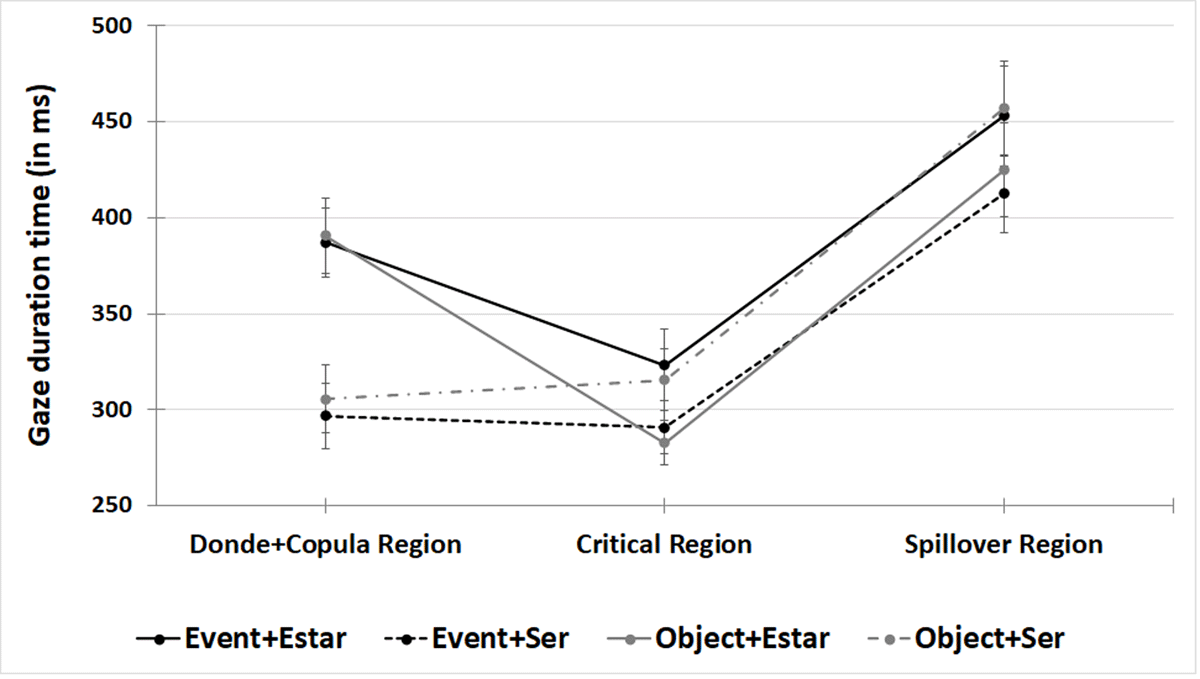
Figure 2: Experiment 2: Gaze duration empirical reading times for the three regions, ranging from the dónde+copula region to the spillover region. Points show condition means and error bars show the 95% confidence intervals calculated for each condition across participants and items. The x-axis shows the different sentence regions.
Figure 3 provides a visual plot of the precritical, critical and postcritical regions.
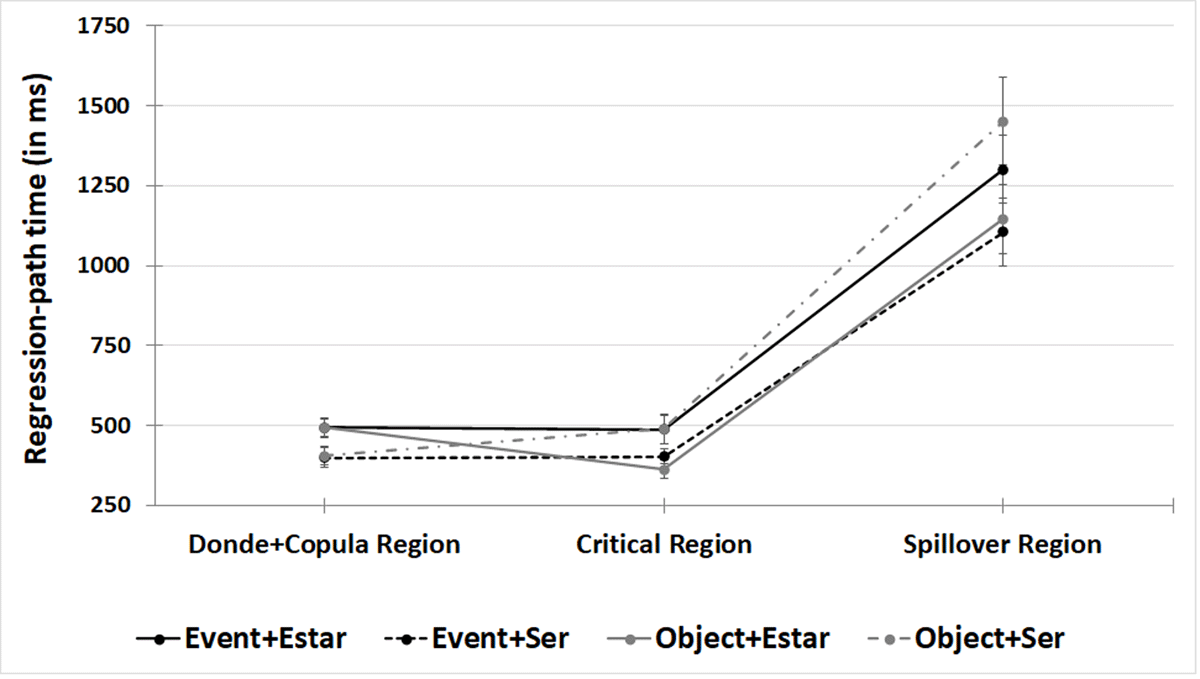
Figure 3: Experiment 2: Go-past duration empirical reading times for the three regions, ranging from the dónde+copula region to the spillover region. Points show condition means and error bars show the 95% confidence intervals calculated for each condition across participants and items. The x-axis shows the different sentence regions.
Total reading time: The same pattern of results is observed here for total time. Shorter reading times were recorded when the event noun was preceded by ser (479 ms) in comparison to estar (521 ms) (β = –0.09, SE = 0.03, t = –2.57, p = .010) and when an object noun was preceded by estar (426 ms) in comparison to ser (506 ms) (β = 0.13, SE = 0.03, t = 3.86, p = .001).
Figure 4 provides a visual plot of the precritical, critical and postcritical regions.
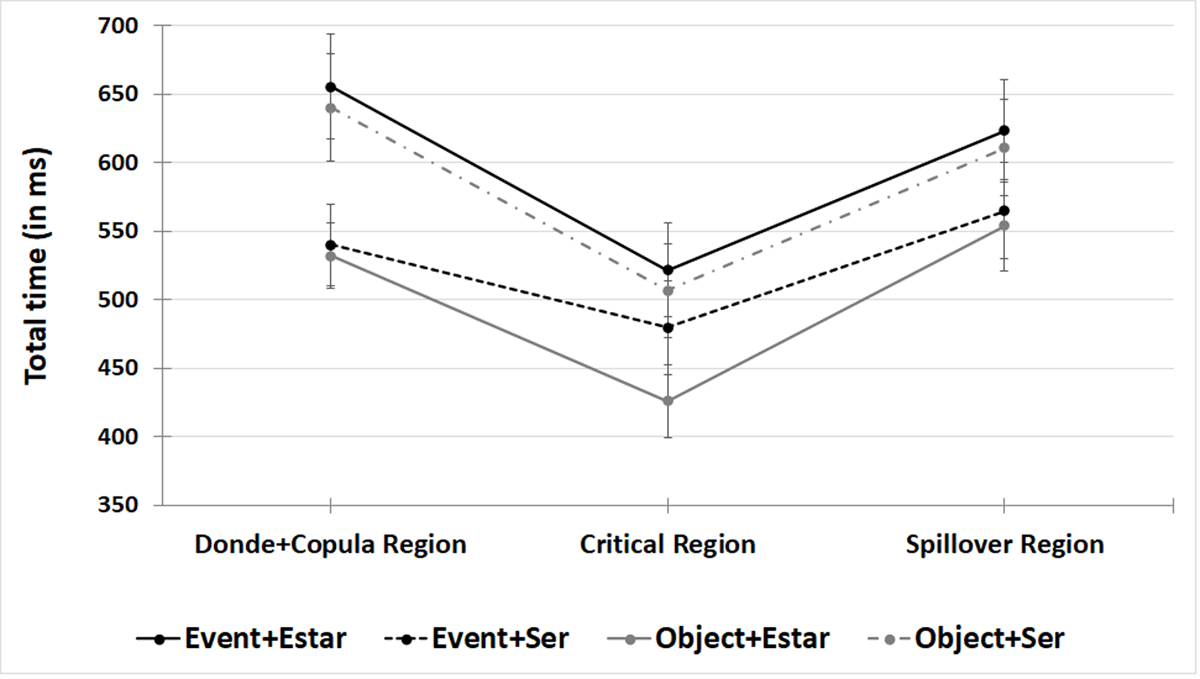
Figure 4: Experiment 2: Total reading times for the three regions, ranging from the dónde+copula region to the spillover region. Points show condition means and error bars show the 95% confidence intervals calculated for each condition across participants and items. The x-axis shows the different sentence regions.
Postcritical region: The analyses revealed that the main effects of Type of noun and Copula were not significant in any of the three eye-tracking measures. The analyses revealed a statistically significant interaction between type of noun and copula starting in gaze duration, followed by go-past time, and total reading time. The full output of the statistical models is presented in Table 5.
Table 5: Experiment 2. Summary of linear mixed effects models (LMEM) fitted on log-transformed reading times at the spillover region.
| Estimate | SE | t-value | Slope | p-value | |
| Gaze Duration | |||||
| Type | 0.011 | 0.032 | 0.365 | (i) | .717 |
| Copula | 0.002 | 0.022 | 0.112 | .911 | |
| Type * Copula | 0.181 | 0.044 | 4.030 | <.001 | |
| Go-past time | |||||
| Type | 0.030 | 0.035 | 0.879 | .379 | |
| Copula | 0.005 | 0.035 | 0.153 | .879 | |
| Type * Copula | 0.378 | 0.070 | 5.394 | <.001 | |
| Total Time | |||||
| Type | –0.008 | 0.037 | –0.234 | (i) | .816 |
| Copula | –0.000 | 0.023 | –0.041 | .968 | |
| Type * Copula | 0.212 | 0.047 | 4.437 | <.001 |
-
Notes: Estimates, standard errors, t-values and p-values are reported for the main effects of Type and Copula, as well as for the interaction of these two factors in each region. For the factor Type, a positive coefficient reflects a slowdown in sentences with object nouns. For the factor Copula, a positive coefficient reflects a slowdown for sentences with “ser”. The “Slope” column indicates whether the model included the corresponding predictor as a random slope for participants (p), items (i) or both (p, i). Effects are bolded if they were significant at an alpha level adjusted for multiple comparisons (.005).
Gaze Duration Planned comparisons showed shorter fixation times when the event noun was preceded by ser (412 ms) in comparison to estar (453 ms) (β = –0.09, SE = 0.03, t = –2.77, p = .006) and when an object noun was preceded by estar (424 ms) in comparison to ser (456 ms) (β = 0.09, SE = 0.03, t = 2.93, p = .003).
Go-past time were significantly shorter in the subset with events when preceded by ser (1105 ms) in comparison to estar (1300 ms) (β = –0.18, SE = 0.05, t = –3.70, p <.001) and in the subset of objects preceded by estar (1146 ms) in comparison to ser (1452 ms) (β = 0.19, SE = 0.05, t = 3.93, p < .001).
Total Time The same pattern is observed in total reading times. Event nouns were read faster after ser (565 ms) than estar (623 ms) (β = –0.11, SE = 0.03, t = –3.17, p = .001), while object nouns were read faster after estar (554 ms) than ser (611 ms) (β = 0.10, SE = 0.03, t = 3.11, p = .002).
3.3 Discussion
Despite the methodological differences between eye tracking and self-paced reading (i.e., parafoveal preview, backtracking, and fine-grained measures in eye tracking) the results of this experiment replicate the results reported for the self-paced reading task.
The results show that the restrictions imposed by copular form have an impact on early stages of processing. We found that events are integrated quicker when preceded by ser, and objects when preceded by estar. This is significant in all measures from gaze duration to total times immediately at the noun region (the critical region), and the same pattern is observed in the post-critical region.12
As regards the results in the precritical region, the main effect of copula is likely explained by a length effect. The conjugation of estar (i.e., está) used in our sentences was systematically longer than the conjugation of ser (i.e., es).13 Furthermore, the interaction in total reading time indicates that readers revisited the precritical region upon encountering the mismatch between copula and type of noun (i.e., ser + object, and estar + event). This suggests that readers backtrack to confirm the copular form after detecting a mismatch.
We interpret these results as evidence that the parser proactively uses this type of semantic restriction during the parsing of the copula to constraint expectations for the upcoming noun. We further develop this hypothesis in the general discussion.
4 General Discussion
The results of the two experiments presented in this paper, a self-paced reading experiment and an eye-tracking while reading experiment, converge in showing a quick access of the parser to eventive restrictions subcategorized by the two copulas in Spanish in locative sentences. This is the first study aimed at exploring the timing of online processing of locative copulas with the eye-tracking methodology. Moreover, the materials employed in this study were thought to avoid a possible confounding detected in the previous literature (i.e., the use of the preposition en as a critical region, which can introduce other structures beyond locatives). In the sentences employed in our study, the interrogative adverb dónde (where) introduces unambiguously a locative structure, followed by a copula (ser vs. estar) and an eventive vs. non-eventive DP.
The self-paced reading experiment revealed an immediate effect of copula’s selectional restrictions on the critical region, i.e., the postverbal noun: events were read faster after ser compared to estar, while objects showed faster reading times after estar compared to ser, and the same pattern was observed in the subsequent regions. This finding was replicated in the eye-tracking experiment using more fine-grained measures. The copula’s restrictions are computed and deployed as early as the critical region during the initial stages of processing, showing significant effects across all measures, from gaze duration to total reading times. Taken together, the present findings show a clear picture.
We interpret the results as suggesting that a specific feature of eventiveness encoded within the lexical entry of the nouns may be preactivated during or immediately after the parsing of the copular form, facilitating the integration of matching combinations (i.e., ser + events, estar + objects). In matched conditions, the satisfaction of the eventiveness constraint facilitates lexical access, reflected in faster reading times. In mismatched conditions, the violation of these constraints incurs a processing cost, potentially due to disrupted integration or violation of the expected eventive features of the noun. The preactivation mechanism for the eventiveness feature may parallel that of semantic priming by triggering anticipatory activation in the mental lexicon, where exposure to the copula’s selectional restrictions spreads facilitation to compatible lexical entries, thereby accelerating retrieval and integration of matching nouns during sentence processing. Alternatively, selectional restrictions may not preactivate eventiveness features but instead project an eventive semantic axis, facilitating faster integration of eventive nouns due to the inherent match between their lexical eventiveness specification and the projected dimension upon access.
There is consistent evidence in the literature that shows that comprehenders use predictive mechanisms to anticipate how sentences will unfold. Beyond specific words or syntactic structure, comprehenders are able to use the copula’s selectional restrictions to predict an upcoming direct object (Altmann & Kamide, 1999; Arai & Keller, 2013; Kaiser & Trueswell, 2008; Knoeferle & Kreysa, 2012). The current findings suggest that the parser can exploit the copula’s selectional restrictions on eventiveness to anticipate upcoming elements in the sentence.
The results broadly align with the previous ERP literature (Dussias et al., 2014; Leone-Fernandez et al., 2012) which reported the brain’s sensitivity to incompatible combinations in sentences like e.g., La silla es en la cocina/ The chair is in the kitchen, where the object chair prefers estar rather than ser, or sentences like e.g., El concierto está en la iglesia/ The concert is in the church, where the event concert prefers ser rather than estar, although the main focus of these studies was to examine the potential differences in processing the two types of copulas. The results indeed suggested that different processing strategies underlie both restrictions. Conversely, our study focuses on timing, revealing that the processing patterns for events and objects are consistent. In both cases, we find that copulas restrict the type of nouns they take as arguments and that the restriction is computed quickly, within the first stages of processing.
More broadly, the results are on a par with a wide range of other sources of information and biases derived from the verb, that have been shown to rapidly affect comprehension (Altmann & Kamide, 1999; Arai & Keller, 2013; Kaiser & Trueswell, 2008; Knoeferle & Kreysa, 2012). For instance, the verb’s semantic constraints on the lexical-semantic features of animacy of the agent (Trueswell et al., 1994), or the verb-based implicit causality biases (Koornneef & van Berkum, 2006) had an early effect on first pass reading measures. In the visual world paradigm literature, the semantics of verbs was quickly used to anticipate plausible specific object arguments, e.g., verbs like ‘to eat’ anticipate edible objects (Altmann & Kamide, 1999). Other studies have shown that whether the verb selects or not for events affects how the verb arguments are mapped onto syntactic structure. This is evident in the case of perceptual verbs in the pseudo-relative versus relative clause ambiguity (Grillo & Costa, 2014; Pozniak et al., 2019). The parsing of a perceptual verb (which selects for events) can impact how the eventual structure is integrated, either as a pseudo-relative, which introduces events, or as a relative clause, which attributes properties to an object or entity (although the effect only affected later measures of processing in Aguilar et al., 2021). We contributed to this body of literature by exploring how the parser exploits the copula’s selectional restrictions on eventiveness to activate and integrate upcoming elements in the sentence.
Although our experimental design was not specifically crafted to test the copula’s behavioral asymmetry, our results suggest that the selectional restrictions encoded in locative copulas emerge early and consistently for both: object nouns are rapidly preferred following estar, and event nouns similarly align with ser. This suggests that selectional restrictions are inherently encoded in both copulas, rather than being exclusive to ser. Although additional research, in both locative and attributive contexts, is warranted, these findings may be informative for theories concerning the default copula.
5 Conclusion
In this paper we proposed that certain semantic/lexical features of nouns related to their eventiveness are anticipated or made available to the parser at very early stages of processing. This is supported by the observation that the effect emerges within the first fixations on the word before progressing further in the sentence. While this is an interesting finding, further research is needed to provide stronger evidence for anticipation or prediction, as the reading experiment presented here does not allow for the examination of anticipatory eye movements, unlike the visual world paradigm. Further research may also help elucidate whether (how and when) the eventiveness feature can be activated (+ eventiveness) or also deactivated (– eventiveness), facilitating the recognition and integration of events after ser and objects after estar correspondingly.
Data accessibility statement
Data, code, and materials can be accessed at the following OSF repository: https://osf.io/pheqn/overview.
Ethics and consent
Ethical approval for the experiments reported in this article was granted by the Ethics Committee of the Universitat Rovira i Virgili (reference: CEIPSA-2021-PR-0024).
Acknowledgements
We are grateful to the editor Matt Husband and two reviewers for their insightful and valuable feedback, which significantly enhanced the contribution of this article.
This work was supported by the Agencia Estatal de Investigación, Programa Juan de la Cierva-Formación, Ministerio de Ciencia e Innovación del gobierno de España [FJC2021-047114-I, 2023] awarded to the first author.
Competing interests
The authors have no competing interests to declare.
Author contributions
MA was in charge of writing the original draft, writing and editing the review, and validation. NLC was in charge of writing the original draft and the review. JD was in charge of conceptualization, data and stimuli curation, statistical analyses, data visualization, and editing the review. The contributor roles are based on the CRediT system taxonomy.
ORCiD IDs
Míriam Aguilar: https://orcid.org/0000-0002-7787-5732
Natalia López-Cortés: https://orcid.org/0000-0001-9131-8660
Josep Demestre: https://orcid.org/0000-0001-9221-066X
Notes
- Example taken from Brucart (2012). [^]
- The term default copula is used in this literature (Brucat, 2012; Fábregas, 2023; Van Patten, 2010; among many others) to refer to the preferred copula form in a specific context. [^]
- Another option is to consider, as suggested by a reviewer, that ser is always the copula by default and that, in locative context (such as the structure dónde + ser, used in our experiment), it needs more lexical specifications than estar (see Gallego and Uriagereka, 2016, in this line). [^]
- It is important to note that these combinations may also serve as evidence that a broader range of predicates are compatible with both copulas than traditionally assumed. This perspective aligns with Maienborn (2004) and Sánchez-Alonso (2018), who contend that discourse-pragmatic factors frequently enable copula accommodation. [^]
- From this perspective, the way in which the speaker acquires or accesses the relevant information may play a crucial role in the coercion (or reinterpretation) process, suggesting that the resolution of mismatches is influenced by contextual and epistemic considerations. For an introduction on evidentiality in Spanish, see González-Ruiz et al. (2016). [^]
- An anonymous reviewer suggested that the acceptability of this sentence depends on the context. For instance, Juan está fiel desde el casamiento would be acceptable for some speakers. [^]
- There is ongoing debate regarding the extent to which these examples involve a genuine coercion: formalist approaches tend to assume that coercion involves an internal semantic adjustment—an implicit operation that restores compatibility by introducing a covert operator which converts the mismatched constituent into one of the required type (type-shifting, Partee and Rooth, 1983). Escandell-Vidal (2018) argues that in cases such as those illustrated in (7), the phenomenon at hand does not constitute coercion in the strict sense (i.e., type-shifting), but rather involves pragmatic inferencing—specifically, a process more closely related to presupposition accommodation (Stalnaker, 1974) and thus dependent on contextual information. [^]
- Example taken from Leone-Fernández et al. (2012, p. 3). [^]
- As pointed out by an anonymous reviewer, the acceptability of this sentence may vary across Spanish varieties. More on variability in Spanish dialects in Sánchez-Alonso, Piñago and Deo (2019). [^]
- For this matter, the inclusion of movable events (e.g., a protest, a demonstration) and the inclusion of ambiguous nouns that could be interpreted as an event (e.g., La merienda está en la mesa/ The snack is on the table vs. La merienda es a las 17h/ The snack is at 17h) were avoided. The complete list of materials used in the study is available in this OSF repository. [^]
- An article appears between the copula and noun, but we have not included this region due to high skipping rates. [^]
- As highlighted by a reviewer, the results of the postcritical region may encode wrap-up effects together with spillover effects. Indeed, we cannot disentangle both as the region is end-of-sentence. However, the pattern in the postcritical region mirrors that of the critical region, and this consistency persists across both experiments, suggesting a robust effect. [^]
- An anonymous reviewer suggested that dónde may evoke an eventive, location-related meaning. According to this hypothesis, ser + event should be parsed faster. While this is an interesting possibility to be explored by future research, our current design does not allow us to determine whether the reviewer’s hypothesis or the length effect is the correct explanation. We chose to interpret the results in terms of the length effect, as it is an effect well established in the literature. [^]
References
Aguilar, M., Ferré, P., Gavilán, J. M., Hinojosa, J. A., & Demestre, J. (2021). The actress was on the balcony, after all: Eye-tracking locality and PR-availability effects in Spanish. Cognition, 211, 104624. http://doi.org/10.1016/j.cognition.2021.104624
Altmann, G. T. M., & Kamide, Y. (1999). Incremental interpretation at verbs: Restricting the domain of subsequent reference. Cognition, 73(3), 247–264. http://doi.org/10.1016/S0010-0277(99)00059-1
Álvarez García, E., & López-Cortés, N. (In press). Las oposiciones individuo/estadio y evento/objeto en combinación con ser y estar. Un estudio con cuestionarios. RESLA: Revista Española de Lingüística Aplicada.
Arai, M., & Keller, F. (2013). The use of verb-specific information for prediction in sentence processing. Language and Cognitive Processes, 28(4), 525–560. http://doi.org/10.1080/01690965.2012.658072
Baayen, R. H., Davidson, D. J., & Bates, D. M. (2008). Mixed-effects modeling with crossed random effects for subjects and items. Journal of Memory and Language, 59(4), 390–412. http://doi.org/10.1016/j.jml.2007.12.005
Bates, D., Mächler, M., Bolker, B., & Walker, S. (2015). Fitting linear mixed-effects models using lme4. Journal of Statistical Software, 67(1). http://doi.org/10.18637/jss.v067.i01
Brucart, J. M. (2012). Copular alternation in Spanish and Catalan attributive sentences. Revista de Estudos Linguísticos da Universidade do Porto, 7, 9–43.
Carlson, G. N. (1977). Reference to kinds in English. University of Massachusetts.
Chierchia, G. (1995). Individual-Level predicates as inherent generics. In G. Carlson & F. J. Pelletier (Eds.), The generic book (pp. 176–224). University of Chicago Press.
Dussias, P. E., Contemori, C., & Román, P. (2014). Processing ser and estar to locate objects and events: An ERP study with L2 speakers of Spanish. Revista Española de Lingüística Aplicada/Spanish Journal of Applied Linguistics, 27(1), 54–86. http://doi.org/10.1075/resla.27.1.03dus
Escandell-Vidal, M. V. (2018). Evidential commitment and feature mismatch in Spanish estar constructions. Journal of Pragmatics, 128, 102–115.
Fábregas, A., Marín, R., & Perpiñán, S. (2023). Events always take (place with) ser. Linguistics, 61(3), 679–723. http://doi.org/10.1515/ling-2021-0142
Featherstone, C. R., & Sturt, P. (2010). Because there was a cause for concern: An investigation into a word-specific prediction account of the implicit-causality effect. Quarterly Journal of Experimental Psychology, 63(1), 3–15. http://doi.org/10.1080/17470210903134344
Gallego, Á. J., & Uriagereka, J. (2016). Estar=Ser+ X. Borealis: An International Journal of Hispanic Linguistics, 5(1), 123–156. http://doi.org/10.7557/1.5.1.3634
González Ruiz, R., Izquierdo Alegría, D., & Loureda Lamas, Ó. (Eds.) (2016). La evidencialidad en español: teoría y descripción, Iberoamericana/Vervuert.
Grillo, N., & Costa, J. (2014). A novel argument for the Universality of Parsing principles. Cognition, 133(1), 156–187. http://doi.org/10.1016/j.cognition.2014.05.019
Just, M. A., Carpenter, P. A., & Woolley, J. D. (1982). Paradigms and processes in reading comprehension. Journal of Experimental Psychology: General, 111(2), 228–238. http://doi.org/10.1037/0096-3445.111.2.228
Kaiser, E., & Trueswell, J. C. (2008). Interpreting pronouns and demonstratives in Finnish: Evidence for a form-specific approach to reference resolution. Language and Cognitive Processes, 23(5), 709–748. http://doi.org/10.1080/01690960701771220
Knoeferle, P., & Kreysa, H. (2012). Can speaker gaze modulate syntactic structuring and thematic role assignment during spoken sentence comprehension? Frontiers in Psychology, 3. http://doi.org/10.3389/fpsyg.2012.00538
Koornneef, A., & Vanberkum, J. (2006). On the use of verb-based implicit causality in sentence comprehension: Evidence from self-paced reading and eye tracking. Journal of Memory and Language, 54(4), 445–465. http://doi.org/10.1016/j.jml.2005.12.003
Kratzer, A. (1995). Stage-level and individual-level predicates. In G. N. Carlson & F. J. Pelletier (Eds.), The generic book (pp. 125–175). Chicago University Press.
Kuznetsova, A., Brockhoff, P. B., Christensen, R. H. B., & Jensen, S. P. (2020). lmerTest: tests in linear mixed effects models. Available at: https://cran.r-project.org/web/packages/lmerTest.
Kwon, N., & Sturt, P. (2016). Processing control information in a nominal control construction: An eye-tracking study. Journal of Psycholinguistic Research, 45(4), 779–793. http://doi.org/10.1007/s10936-015-9374-2
Leone-Fernandez, B., Molinaro, N., Carreiras, M., & Barber, H. A. (2012). Objects, events and “to be” verbs in Spanish – An ERP study of the syntax–semantics interface. Brain and Language, 120(2), 127–134. http://doi.org/10.1016/j.bandl.2010.12.006
Leonetti, M. (1994). Ser y estar: estado de la cuestión. Barataria, 1, 182–205.
Maienborn, C. (2004). A pragmatic explanation of the stage level/individual level contrast in combination with locatives. In B. Agbayani, V. Samiian & B. V. Tucker (Eds.), Proceedings of the Western Conference of Linguistics 15 (pp. 158–170). CSU Fresno.
Partee, B., & Rooth, M. (1983). Generalized conjunction and type ambiguity. Formal semantics: The essential readings, 334–356.
Pérez-Leroux, A. T., Álvarez, Y., & Battersby, T. (2010). Cuando era feliz, e indocumentado: An aspectual approach to copula choice in L2 Spanish. In Selected proceedings of the 12th Hispanic linguistics symposium (pp. 209–220). Somerville, MA: Cascadilla Proceedings Project.
Pozniak, C., Hemforth, B., Haendler, Y., Santi, A., & Grillo, N. (2019). Seeing events vs. entities: The processing advantage of Pseudo Relatives over Relative Clauses. Journal of Memory and Language, 107, 128–151. http://doi.org/10.1016/j.jml.2019.04.001
Roldán, M. M. (1974). On the so-called auxiliaries ‘ser‘ and ‘estar‘. Hispania, 57(2), 292–295.
Sánchez-Alonso S. (2018). The cognitive sources of language change and variation: Connecting synchronic variation and diachrony in Spanish copula use [PhD thesis, Yale University].
Sánchez-Alonso, S., Piñango, M., & Deo, A. (2019). Variability in ser/estar use across five Spanish dialects: An experimental investigation. Ms. Huskins Laboratories, Yale University.
Sera, M. D. (1992). To be or to be: Use and acquisition of the Spanish copulas. Journal of Memory and Language, 31(3), 408–427. http://doi.org/10.1016/0749-596X(92)90021-O
Silvagni, F. (2018). Sobre la distinción individuo/estadio y su relación son ser y estar. Revista Española de Lingüística, 48, 15–53. http://doi.org/10.31810/RSEL.48.2
Stalnaker, R. (1974). Pragmatic Presuppositions. In M. Munitz & P. Unger (Eds.), Semantics and Philosophy. New York University Press (pp. 197–213).
Thériault, R., Ben-Shachar, M. S., Patil, I., Lüdecke, D., Wiernik, B. M., & Makowski, D. (2024). Check your outliers! An introduction to identifying statistical outliers in R with easystats. Behavior Research Methods, 56(4), 4162–4172. http://doi.org/10.3758/s13428-024-02356-w
Trueswell, J. C., Tanenhaus, M. K., & Garnsey, S. M. (1994). Semantic influences on parsing: Use of thematic role information in syntactic ambiguity resolution. Journal of Memory and Language, 33(3), 285–318. http://doi.org/10.1006/jmla.1994.1014
Vasishth, S., & Nicenboim, B. (2016). Statistical methods for linguistic research: Foundational Ideas – Part I. Language and Linguistics Compass, 10(8), 349–369. http://doi.org/10.1111/lnc3.12201
Voeten, C. C. (2023). Buildmer: Stepwise elimination and term reordering for mixed-effects regression. Available at: https://CRAN.R-project.org/package=buildmer.